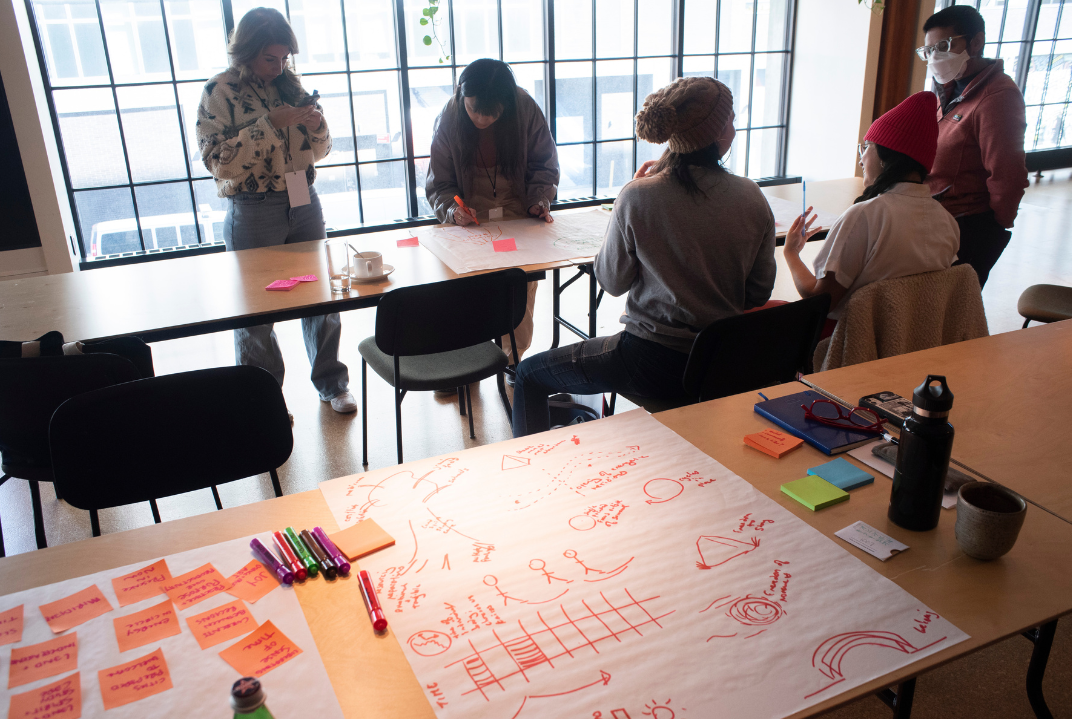
We should all have a say in the decisions that affect us.  Our voices must be heard in voting booths, at public forums and across the media.  Expanding opportunity requires that we listen to the ideas, hopes, and dreams of everyone who lives here.

Type Title
Research Report: The State of Opportunity Report (2009)

This is the 2009 State of Opportunity report.  Here you may download the final report, the final report with accompanying charts, a synopsis, and each of the indicators individually.

Read more about the report here.

Law and Policy Brief of The Opportunity Agenda as Amicus Curiae in Loeffler v. Staten Island Univ. Hosp. (2008)

In this "friend-of-the-court" brief before the U.S. Second Circuit Court of Appeals, The Opportunity Agenda urges the court to read the New York City Human Rights Law as its authors intended it to operate: as a broad protection for New Yorkers against all discrimination, even when caused by problematic systems rather than prejudiced individuals.  

Communications Talking Points: The State of Opportunity Report (2009)

This memo offers guidance for using the 2009 State of Opportunity in America report, which examines various dimensions of opportunity, including health care, wealth and income, education, and incarceration. While expanding opportunity in America remains a goal of policymakers and advocates alike, this report finds that access to full and equal opportunity is still very much a mixed reality. Our recommendations to address this reality offer concrete ideas for moving us forward together.

Communications Talking Points: Health Care Equity Talking Points (2007)

Telling the story of health care equity is a critical contribution to the country’s ongoing dialogue about how to improve our health care system.

Communications Media Tool: Five Ways to Promote Community Values in Your State (2008)

During an election year, how can you promote your issue with limited resources?  This sheet offers simple ways to promote the concept of community values, but you can use it to think about how to promote a variety of causes and issues. 

Communications Toolkit: Community Values (2008)

This publication contains a balance of historical context, framing advice, resources, practical tools and strategies for moving toward a new political conversation.  

Communications Sample Op-ed: Community Values - Des Moines Register (2007)

This Op-ed is an example of harnessing a media opportunity, in this case the Iowa caucuses, to frame a message.

Communications Media Coverage: Heartland Presidential Forum - Campaign for Community Values (2007)

Held December 2, 2007 in Des Moines, IA, the Heartland Presidential Forum kicked off the Campaign for Community Values.  The resulting press coverage included a values dimension otherwise missing in much of the caucus coverage.

Research Report: The State of Opportunity Update (2007)

This is the 2007 update to the State of Opportunity report.  There are two files, the full chart of indicators and a summary.

Research Report: State of Opportunity (2006)

If the promise of opportunity is a core national commitment, it is essential to measure our success in fulfilling that commitment.  This report assesses the nation’s progress toward protecting and expanding opportunity for all Americans and encourages our policymakers, through bold leadership and innovative policies, to ensure the promise of o

Research Fact Sheet: Voting and Political Expression in the Gulf (2006)

This fact sheet summarizes research on the political participation of vulnerable Gulf Coast communities after Katrina, as well as national trends in electoral participation.

Research Media Analysis: Immigration in Spanish Speaking and Hispanic Media (2007)

This report analyzes Spanish speaking and Hispanic media coverage of immigration issues.

Research Brochure: About The Opportunity Agenda (2008)

Read about The Opportunity Agenda in our new brochure.

Page Mapping Social Justice

More information on our mapping projects, Health Care That Works, and Map4Change.

Page Promoting Health Opportunity in New York

In New York, we worked to show how health care resource decisions were impacting low-income and communities of color.  A central tool was the healthcarethatworks.org website, which shows where hospitals have closed over time in New York City.

Page 1000 Voices

The Opportunity Agenda's partner, Creative Counsel, and The Fledgling Fund are co-presenting the 1000 Voices Archive—a curated, national collection of video stories created by filmmakers and communities across the country.

Page The Opportunity Agenda YouTube Channel

Check out our channel on YouTube.  See video clips that show the state of opportunity—or lack thereof—in America. We feature man on the street interviews, produced video spots, mini documentaries, and other videos that we encourage people to share with their friends, and hope that social justice advocates will use in their work.

Blog Post Possible Internet Regulations Threaten Opportunity

As reported Oct. 22 on NPR, current efforts by telecom providers threaten access to information and applications on the Internet. Possible changes by the Federal Communications Commission highlight these efforts, which pertain to what power internet service providers have in restricting access that conflicts with their own interest.

Blog Post Blog Action Day: Climate Change

Today is blog Action Day. In the organizers' own words:

Blog Action Day is an annual event that unites the world's bloggers in posting about the same issue on the same day on their own blogs with the aim of sparking discussion around an issue of global importance. Blog Action Day 2009 will be the largest-ever social change event on the web. One day. One issue. Thousands of voices.

Blog Post A Voice in Society

A truly functional democracy depends on the ability of everyone to have a voice—a chance to contribute their views and perspectives, and to have them heard and respected.

That everyone be able to participate in public debate, in decisions that affect us, and to be part of the social and cultural life of that nation is essential to our ability to achieve our full potential, as individuals and together.

Blog Post A Community-Minded Generation

Much has been made of the vitality that President Obama brings to the White House.  To be sure, this is in part the story of his relative youth—only Clinton, Grant, Kennedy, and Theodore Roosevelt were younger when assuming the office—but it’s also a function of his ability to convince the millennial generation (or vocalize the millennial generation’s belief) that their voices matter.  Given the size and scope of the challenges facing our nation, we need young people to see the stake that they have in their communities.    

Blog Post The State of Opportunity in America (2009) Released

The Opportunity Agenda is pleased to announce the release of our 2009 State of Opportunity in America report. The report documents America’s progress in protecting opportunity for everyone who lives here, and finds that access to full and equal opportunity is still very much a mixed reality.

Blog Post Still Changing After All of These Years

Celebrating forty years of outreach to America's marginalized, the Center for Community Change has helped carry on the dreams of America's most inspirational dreamers. Launched in 1968, following the assassinations of Robert F. Kennedy and Dr. Martin Luther King Jr., the center was a direct response to the war on poverty that was embarked upon during the 1960s.

The Movement Vision Lab has posted a well produced video that looks at the movement that launched the center, and the work CCC has done over the years to lift up American communities.

We're excited about the work that we've been able to do with the Center for Community Change, working to foster values that bring our communities together and open the doorway for opportunity to all Americans. Forty years after RFK was gunned down in front of the nation's eye, I find a great sense of satisfaction and hope in the cry for change that many have been calling for in recent times.

The spirit of Kennedy seems alive and well in the hearts of the many attendees I encountered last Friday at the Better Deal Conference in Washington. The conference set out the many issues that young Americans face; issues such as the fact that many find themselves achieving a lesser standard of living than that of their parents. Key issues such as housing raise some serious questions as to the obstacles that our Future Majority will face.

However, in spite of the mountain that has risen in front of young Americans since their parents traveled down these same roads, a great energy was felt throughout the crowd. Rev. Lennox Yearwood, from the Hip Hop Caucus said that the children born after 1968 are part of the "Dream Generation," those who have lived in the world that Dr. King had dreamed of when he imagined freedom ringing from the highest mountain.

with the National Mall only a few blocks from the Beter Deal conference, where Dr. King had cried out his dream, change seemed well masted in the horizon.

The seeds that the Center for Community Change has planted over the past forty years continue to grow, and bear the fruit of our future leaders. Their voice is strong, and when reflecting on the work CCC has done over the past forty years, I'm excited to think what the next forty will hold.

Blog Post The US Promises to Rehabilitate Prisoners, but Continues to Confine Them at Higher Rates
  • The Real Cost of Prisons Weblog has posted a New York Times article stating that nearly "one in every 31 adults in the United States was in prison, in jail or
    on supervised release at the end of last year."  The article continues with the findings of a new Department of Justice report:

An estimated 2.38 million people were incarcerated in state and federal
facilities, an increase of 2.8 percent over 2005, while a record 5
million people were on parole or probation, an increase of 1.8 percent.
Immigration detention facilities had the greatest growth rate last
year. The number of people held in Immigration and Customs Enforcement
detention facilities grew 43 percent, to 14,482 from 10,104.

The data reflect deep racial disparities in the nation’s correctional
institutions, with a record 905,600 African-American inmates in prisons
and state and local jails. In several states, incarceration rates for
blacks were more than 10 times the rate of whites. In Iowa, for
example, blacks were imprisoned at 13.6 times the rate of whites,
according to an analysis of the data by the Sentencing Project, a
research and advocacy group.

These statistics of mass incarceration and racial disparities highlight the fact that our government policies are failing to offer a second chance to citizens and immigrants alike.  Instead of spending millions of dollars to confine millions of people, we should invest in their personal development. In human
rights law, the International Covenant on Civil and Political
Rights
provides that “the penitentiary system shall comprise
treatment of prisoners the essential aim of which shall be their
reformation and social rehabilitation” -- and the United States has pledged to uphold the values in this United Nations treaty.

  • Over at The Huffington Post, Mike Garibaldi Frick has posted an interview with street artist and free speech activist Robert Lederman.  Lederman "was arrested over 40 times by the Rudy Giuliani administration for
    exercising his free speech and sued the city of New York to strike down
    permit requirements for artists in public spaces." The post discusses the way government restrictions on public spaces interfere with our constitutional rights -- and human rights -- to self-expression, a cornerstone of our democracy.

Though American democracy promotes "freedom of expression," regular
citizens are effectively blocked from creative and free speech public
space uses unless they have considerable financial or political
influence.

Opposition groups, nascent movements, students, artists and all
citizens need safe, free public space in which to communicate and
develop. Planned events, spontaneous gatherings and ongoing meeting
places that are autonomous from entrenched government and corporate
interests are vital to a free public speech. The health and well-being
of a true democracy requires free access to open public forums.

The post also includes a YouTube video of the interview with Lederman:

The Democratic Party finally released what appears to be their official strategy/talking points intended to counter the Republican immigration wedge.

The strategy in essence revolves around a few key concepts:

  • The Republicans are using the immigration issue for political gain
  • The Republicans had plenty of time to fix immigration and didn't
  • The Republicans have been unable to secure the border
  • The Republicans are using fear and bigotry to scapegoat immigrants
  • The scapegoating isn't working

Of course there's one glaring omission in this strategy …. there isn't any sort of a alternative plan proposed.

Nowhere
is there a word about what in fact the Democrats are going to do about
immigration. Not even the usual vague call for "comprehensive reform
that secures our border while providing a path to citizenship to
undocumented immigrants." And you can just forget about specifics.

In the absence of this vision, Migra Matters proposes its own strategies:

There have to be other, more complex, and comprehensive ways of controlling immigration:

  • Things like adjusting free trade agreements so they don't foster poverty in sender nations.

  • Things
    like working with foreign governments in sender nations to ensure that
    they not only respect human rights, but worker rights and economic
    justice.

  • Things like examining and reforming our
    immigration codes to make them more practical, fair, and reflective of
    economic realities.

  • Things like fixing our immigration
    bureaucracy so it can efficiently and humanely process the flow of
    immigrants in a timely and effective manner.

And these are but just a few of the things that should be talked about. There are many, many more.


Blog Post Heartland Forum Highlights Support for Community Values
  • As mentioned previously, this Saturday saw the Heartland Presidential Forum in Des Moines, Iowa, an opportunity to talk with candidates about 'real issues facing real people in our communities' with attention to our values and policies of interconnection. You can watch a webcast of the forum on the Center for Community Change's Movement Vision Lab blog. Additionally, The Huffington Post linked to a Des Moines Register article on the event, and Adam Bink over at Open Left liveblogged summaries of statements made by each of the participating candidates: Clinton, Obama, Edwards, Dodd, and Kucinich.
  • The Real Cost of Prisons Weblog has reposted a Texas Observer article about the challenges faced in the expansion of drug courts in Texas.  While courts geared towards rehabilitation and redemption (rather than simply inflicting prison time) are much more effective than traditional courts in helping people overcome addiction, court practices vary widely according to the judge on the stand.

"Bennett and Leon Grizzard are the two judges who oversee Travis County's drug diversion court. They steer addicts into a court-supervised treatment program instead of prison. In the past decade, drug courts like the one in Travis County have successfully handled nonviolent defendants with drug and alcohol addictions—if success is defined as increasing public safety at the least cost to the taxpayer. People who complete drug-court programs rarely tumble back into substance abuse. According to four drug-court judges surveyed, about 10 percent of program graduates commit new crimes—a recidivism rate roughly one-fifth that of traditional probation routines. That means drug courts can ease the strain on overcrowded prisons and save taxpayer money. A study of the Dallas drug court by Southern Methodist University showed that every government dollar spent on diversion courts saved taxpayers more than $9.

Though criminal justice reform groups have advocated drug courts for years, Texas until recently lagged behind the rest of the country.

...

But as drug courts become more widespread, it appears that—like the narcotics they were created to fight—the courts can be abused. State and federal governments have instituted few regulations and set up no oversight. Judges have wide latitude to decide people's fates. In the hands of the right judges, the drug court model performs marvelously. Other judges appear to have trouble reconciling their punitive role with this new therapeutic one. The U.S. Department of Justice designed a set of guidelines and best practices—but they're the criminal justice equivalent of blueprints without building codes. The guidelines suggest that judges receive ongoing training and partner with treatment programs and community groups.

Because drug courts grow mostly from the local level, there is little standardization. Texas law broadly defines a drug court, but places hardly any restrictions on what judges can do. There is no oversight specifically for the drug courts. A recent case in Houston demonstrates the potential risks behind the courts' expansion. Judge K. Michael Mayes of Montgomery County is facing a federal lawsuit by a defendant who claims his treatment in Mayes' drug court was arbitrary and violated his rights to due process."

  • Firedoglake has written a post on a bill under consideration in the Senate known as the Violent Radicalization and Homegrown Terrorism Prevention Act.  This Democratically-authored legislation, which has already passed the House by a large margin, has many progressives questioning its vague definition of 'ideologically-based violence,' arguing that this law would be a step towards a fascist state in which citizens can by prosecuted for 'thought crimes.' We must remember that democracy in America is dependent upon our ability to raise our voices, on our rights to free speech and fair elections.  Any law that seeks to contradict our capacity to participate fully in our communities is a violation of our human rights.
  • In a related story, the Latina Lista blog has been the subject of a recent spam attack, bad enough that the site's commenting feature has temporarily been disabled.  Offering "Anything and Everything from a Latina Perspective," the blog often discusses issues of immigration, American history and culture.
Blog Post As Elections Near, We Need to Hear Candidates Debate Community Values
  • The Huffington Post offers an introduction to last night's CNN/YouTube debate for Republican presidential candidates, noting that "people from across the country submitted more than 3,500 videos posing
    questions" to the candidates, of which 40 were selected to be broadcast during the debates.  The Opportunity Agenda was among those submitting questions, with four videos created for the purposes of promoting community values in our nation's political debate.  Mike Connery has written two posts about the debate over at Future Majority, the first offering a comprehensive summary of the event and the second publicizing the fact that CNN did not coordinate with YouTube at all in order to select the forty questions that were aired.  By single-handedly shaping the content of the debate, CNN was able to bypass the debate's original intention, that of providing a voice to a diverse group of Americans.
  • In other event news, the Heartland Presidential Form will be held this Saturday December 1 in Des Moines, Iowa, only weeks before the Iowa caucus.  Five of the Democratic presidential candidates will be in attendance at the forum, the focus of which will not be on specific issues but on progressive vision and values.  According to the website:

The Iowa Heartland Presidential Forum is part of a new nationwide Campaign for Community Values
Iowa Citizens for Community Improvement, the Center for Community
Change is - and hundreds of grassroots partner groups - are
coordinating this groundbreaking effort to challenge the "go it alone"
mentality that has dominated politics and build a new politics for the
common good.

'Tis the season for presidential politics, and with it, the debate over what values propel voters to the ballot box.

A
recent debate in Florida claimed to represent and display the interests
of so-called "values voters." The dissection of the nation's "moral
values" took up a good bit of ink following the 2004 elections. And
we're all familiar with the "family values" that guided policy
throughout the '80s and '90s. But in all this talk of values, why are
so many core American values consistently missing?

Instead of concentrating on people's individual moral decisions, or
their family life, we should focus on our collective values, the ways
we can move forward together and the policies that work toward the
common good. We need to reintroduce to the debate the ideals of
equality, opportunity and fairness. And we need to acknowledge that our
individual stories and circumstances add up to a national community
best positioned to solve our problems together. In short, we should be
talking about our community values.

Blog Post US Military Asking Wounded Soldiers to Return Signing Bonuses
  • Mirror on America reports that the US military has been asking soldiers wounded in combat to return the signing bonuses they received upon joining the armed forces. As the military is exhausting those Americans who are willing to sign up for duty, it has begun offering up to $30,000 in signing bonuses which it has then asked to be refunded when soldiers who have lost limbs, hearing or eyesight are no longer able to serve out their commitments.  In the case where America's foreign policies are proving responsible for the destruction of its own citizens, our country should honor and respect these sacrifices with additional support from the community, not less.
  • Ezekiel Edwards at the DMI Blog has written about a client and personal friend who was able to triumph over a drug and alcohol addiction that had brought her into contact with the criminal justice system.  Edwards uses her example to illustrate the difficulties people face when they are trying to make a new start:

It took her a number of months to find any sort of work. The road to
employment is difficult enough as a poor African-American woman with
little formal education, currently taking GED classes, but with a
criminal record, it becomes outright impassable. She finally found a
part-time job working four hours a day, five days a week, at $9 an
hour. She arrived 20 minutes early every day. After six weeks, she was
fired without explanation. Now she is looking for work again.

She cannot afford her rent, and is looking for public housing, but,
again, her criminal record (all for nonviolent offenses) limits her
options. She is trying to do the right thing, trying to become
gainfully employed, trying to further her education, trying to find
affordable housing, trying to spend time with her daughter, and, most
of all, trying not to drown herself in the bottle by remaining in her
program, but society is not making it easy, or even somewhere in
between easy and frighteningly difficult, to move forward. Even after
all she has gone through, there is no relief in sight.

  • The Pro Inmigrant blog has posted about a new coalition between the American Jewish Committee and a group of Mexican-American advocates to fight discrimination and demand comprehensive immigration reform in the US. Working with the idea that Jewish Americans who have successfully assimilated can and should help today's immigrant populations, the AJC just co-sponsored a three-day workshop with Mexico's Institute for Mexicans Abroad. According to Mexican Ambassador Arturo Sarukhán, whose grandfather came to Mexico from Armenia,

"Now, more than ever, we must underscore a self-evident truth:
Migrants are not a threat to the security of the US...They are important actors in
the fabric of what makes America great."

  • Along this same theme, the ImmigrationProf Blog has linked to a new report by UC Davis economist Giovanni Peri which found that "high immigration
    cities experienced higher wage and housing price growth. Immigration
    had a positive productivity effect on natives overall, but important
    distributional effects. Highly educated natives enjoyed the largest benefits while the less educated did not gain (but did not lose much either)."
  • The 'Just News' blog quotes an AP article discussing the fact that a serious backlog in the processing of citizenship applications may prevent thousands of residents from voting in the 2008 presidential elections. Hopefully this media attention will encourage immigration authorities to expedite the process so that all Americans will have a voice in electing our national leaders.
Blog Post Congress Approves of Giving a Second Chance, While New York Reviews Disenfranchisement Policies
  • The Real Cost of Prisons Weblog has posted about last week's House vote on the Second Chance Act, legislation that aims to address the needs of individuals reintegrating into the community after time spent in prison. The bill passed the House with overwhelming bipartisan support in a vote of 347-62, and it is expected that the Senate will consider the same legislation before the end of the year.  Based in the spirit of redemption, the idea that we all deserve the support we need to make a new start,

"H.R. 1593 would provide grants to States and local areas to create or
strengthen the systems that help adults and youth transition into the
community when they are released from incarceration by providing drug
addiction and mental health treatment services, job training and
education opportunities, housing and other necessary services."

  • The same blog also covered a recent report by the Brennan Center on felony disenfranchisment in New York state which found that "87% of those currently disenfranchised in New York are Latino and African American."  The state's sentencing structure is currently under review for its early Nineteenth Century laws that still effectively deny the right to vote to people of color.
  • Also, a successful doctor and his entrepreneur wife are facing sudden deportation proceedings in Pennsylvania after a small error was found in the documents they used to apply for American citizenship. Although Pedro and Salvacion Servano have been in the US legally for twenty-five years, and have come to embody the American Dream in their family life and contributions to their community, they are currently fighting to appeal the mandate that they report to ICE the day after Thanksgiving in order to initiate deportation proceedings to the Philippines.
  • Finally, the Immigrants in USA Blog featured two articles on the value of a multilingual society. Statesman.com wrote about the tensions involved when a California school district announced its intentions to provide bilingual education to all students, and mercurynews.com published an opinion piece on the value of learning English but not losing the language of one's cultural heritage. Given that "many folks pay thousands of dollars to acquire a second language," linguistic diversity is an undeniable advantage to our community and our economy in an increasingly interconnected world.
Blog Post All Things Being Equal: Instigating Opportunity in an Inequitable Time

"One year from now, our country will choose a new president. And
while the candidates have debated extensively on individual issues like
health care, the war, the economy, and the environment, they have
offered far less in terms of a positive, overarching vision for our
country that both addresses and transcends individual issues.

While candidates' positions on the issues of the day are crucially
important, it's equally important to take their measure on what George
H. W. Bush called "the vision thing":
the clarity of ideals, values, and principles that inspire and shape a
president's approach to a broad range of issues, including ones that no
one could have anticipated on the day he or she was elected.

A new book by The Opportunity Agenda
offers such a vision on the domestic front; one to which we hope the
presidential contenders of both parties will respond. Not surprisingly,
that vision centers on opportunity, the idea that everyone deserves a
fair chance to achieve his or her full potential. In the book "All Things Being Equal: Instigating Opportunity in an Inequitable Time,"
a dozen leading thinkers paint a picture of what opportunity means in
our society, where we are falling short, and what must be done to
instigate opportunity for all. Their vision bridges myriad
issues—education, employment, housing, criminal justice, immigration,
health care, human rights—and disciplines—public health, economics,
criminology, law, sociology, psychology, education, social work. The
authors provide a clear and hopeful path to the future, a wake-up call
to our nation's current and future leaders, and concrete solutions that
promise to carry us forward.

As I've written before in this column, opportunity is not just a set of national conditions, but a body of national values:
economic security, mobility, a voice in decisions that affect us, a
chance to start over after missteps or misfortune, and a shared sense
of responsibility for each other-as members of a common society.
Analyzing their own and others' research through the lens of those
values, the authors of All Things Being Equal warn that opportunity is
increasingly at risk for all Americans and, therefore, for our country
as a whole. They find that many communities are facing multiple
barriers to opportunity that cannot be overcome through personal effort
alone. But, most importantly, they find that we have it in our power as
a country to turn those trends around."

  • The Immigration Equality blog has posted about yesterday's confirmation of Michael Mukasey as US Attorney General, after a long struggle in the Senate Judiciary Committee over his unwillingness to label waterboarding as illegal and torturous. The blog also notes that his position on the matter is being interpreted by some as a way of insulating the Department of Justice from future lawsuits or charges against government officials for human rights violations.
  • Racial_diversity_in_staffs_2

  • The Real Cost of Prisons Weblog reposted a recent New York Times article on the Surge Seen in Number of Homeless Veterans.  While many veterans have ended up the sort of post-traumatic stress disorder which often correlates with homelessness, it's unusual that veterans would show up in shelters as soon after deployment as have the most recent batch after duty in Iraq or Afghanistan.  Sexual abuse is another factor which correlates with homelessness -- the article states that "roughly 40 percent of the hundreds of homeless female veterans of
    recent wars have said they were sexually assaulted by American soldiers
    while in the military."
  • Finally, the Too Sense
    blog posted a graph of the racial diversity in campaign staff among the top 2008 presidential candidates.  While Clinton's staff is the most
    diverse, Giuliani's staff is 100% white.
Blog Post Checks and Balances Preserve Our Democracy
  • Both Prometheus 6 and the ACS Blog have highlighted a recent Washington Post article that speaks of the president's intention to use executive orders as much as possible to single-handedly make government policy because he feels that the Democrat-controlled Congress is not getting anything done.  Bush is disappointed by the delay in confirming Mukasey as head of the Department of Justice, a nomination stalled by differing ideas as to what qualifies as the human right to freedom from torture.
  • In Oklahoma, a federal judge has declined the request of a coalition of immigrants rights advocates to block the enforcement of a new state immigration law.  According to Immigration News Daily, the law "will bar illegal immigrants from obtaining jobs or state assistance and make it a felony to harbor or transport illegal aliens." Once convicted of a felony, Americans lose their right to vote, making this issue just as much about preserving the voice of democracy as about immigration per se.

"Children experienced the emotional trauma of their parents' sudden
absence, often personalizing the cause of the separation and feeling
abandoned or fearful that their parents could be abruptly taken away
from them.

Mental health experts noted that children's and parents' fears and
the events surrounding the raids led to depression, post-traumatic
stress disorder, separation anxiety, and suicidal thoughts in children."

In Grand Island, Nebraska, 17% of children affected experienced the loss of both parents in the raids.  Author Treviño says of ICE's lack of a standard to protect children from abandonment, "It's a fine line between being sensitive to children's well-being and
enforcing the law. But that is what marks the difference between great
nations and...countries that let fear and intimidation rule
instead of compassion and common sense."

  • The HealthLawProf Blog has cited a new report by the Economic Policy Institute which concluded that "the number of Americans lacking health insurance rose by nearly 8.6 million to 47 million from 2000 to 2006."  The study goes on to analyze the demographics and causes of the changes, finding widespread losses in coverage due to employers no longer offering insurance to their workers.  It's time we start taking these numbers seriously and work to fix our broken health care system with consideration for how best to benefit the community as a whole.
  • In today's hopeful news, Rachel's Tavern notes that Genarlow Wilson has told reporters after his release from prison that he wants to go to college to study sociology. Wilson had been given a 10-year sentence for committing a consensual sex act with a fellow teenager; his recent release was due to a redemptive Georgia Supreme Court ruling that decided his sentence was cruel and unusual punishment.  A free man, Wilson has received several offers to fund his college education, and he holds the conviction that "This situation, what I had to endure, has a lot to do with sociology.”
Blog Post Human Rights and New Media in America
  • The ImmigrationProf Blog has written a post featuring the new Guantánamo Testimonials Project,
    a project of
    the University of California, Davis Center for the Study of Human
    Rights in the Americas (CSHRA). The goal of the project is to collect and make available testimonies
    of detainees' experiences at Guantánamo and includes statements by "prisoners, FBI Agents, interrogators, prosecution
    and defense lawyers, military physicians, a chaplain, a marine, a CIA
    asset, and others. "
  • Yesterday saw an article in The Huffington Post entitled Dangerous Toys are a Human Rights Issue.  Author David Nassar discusses the connections between this controversial issue and a lack of protections for workers:

"These dangerous toys aren't putting just our children at risk:
they also endanger the lives of the factory workers who make them.

The
same forces that make manufacturers cut corners on paint and plastic
also make manufacturers cut corners on labor costs. Working long hours
in appalling conditions - often with toxic chemicals and no protection
- laborers in China bear the true cost of America's low price toys.
Stores like Wal-Mart demand bottom dollar costs, but the costs come
back not only to us and our children, but to entire communities
overseas. Today's news stories regarding children making clothing for
the Gap, Inc. in India's factories are another harsh reminder of that
truth.

Last week's Congressional hearing on toy safety and working
conditions in China's factories highlighted the fact that without
ensuring the safety of employees in supplier factories, it is
challenging at best to ensure the safety of the products that come out
of those factories and ultimately the safety of our children."

  • Regarding education policy, the last few days have seen discussion of high schools functioning as 'dropout factories' (with one in ten American high schools seeing less than 60% of their original class finishing school) and the importance of the federal Head Start preschool program in increasing graduation rates (while also cutting crime rates). Others have discussed new legislation to help control college costs for American youth, while high-achieving immigrants in favor of the DREAM Act have expressed worries such as "I always worried that immigration (officers) would come if I didn't excel." It is important to continue these dialogues concerning the human rights issues of where we as a nation can do better in ensuring that our young people have the opportunities they need to achieve their full potential.
  • Finally, the DMI Blog has posted on an innovative new media project of the Drum Major Institute for Public Policy, their just-launched website TheMiddleClass.org.
    The website is meant to function as "a dynamic site that will update
    throughout the year as members of
    Congress vote on legislation of significance to the current and
    aspiring middle class." Speaking of its democratizing role of holding politicians accountable to the voice of their constituents by reporting on legislation in an interactive fashion, the site
    says:

"For each bill, we begin with a brief description of the legislation,
information about its status in the legislative process, and an
analysis of its impact on the middle class. But themiddleclass.org also
provides more extensive context: you’ll find informative online video
about each piece of legislation, quotations from experts speaking out
on the issue, and hard-hitting numbers from DMI’s Injustice Index. We
look beyond the bill to what more could be done to address the issues
as stake. And we provide links to further resources.

We also provide information on how each member of the U.S. Senate
and House of Representatives voted on the legislation. You can look at
how every member voted on a particular bill, or how your own
representative voted. You can search for legislation by issue area or
keyword and look for legislators by name, state, or entering your zip
code. And you can check out the grades we assign each member of
Congress based on their votes."

Blog Post Columbus Day Protests Highlight Human Rights in America

"What if America launched a new New Deal and no one noticed? And what
if, instead of lifting the unemployed out of poverty, this
multibillion-dollar project steadily drove poor communities further and
further out of the American mainstream?

That's how America should think about its growing prison system,
some leading social scientists are saying, in research that suggests
prisons have a far deeper impact on the nation than simply punishing
criminals."

These posts are definitely worth a read with attention to the way that our prison system values retribution over redemption, the idea that those who falter in their efforts or break societal rules warrant the chance for reconciliation, rehabilitation, and a new start.

  • Tennessee Guerilla Women posted a story about 2600 members of the Minnesota National Guard who just returned from 22 months of duty in Iraq to find that they were deployed one day short of the 730 days required to receive the college education benefits outlined in the GI Bill.  To knowingly deny veterans the chance to go to college is a disrespectful statement that in spite of government promises and their personal sacrifices, the soldiers must 'go it alone' and support themselves through school.  This myth that we should all 'pull ourselves up by the bootstraps' is contrary to our nation's long-held belief that our success as a country depends on the success of all, that we should be striving for the common good.  The policies of our government should be based in community values rather than punitive individualism.
  • An interesting post on the Immigrants in USA Blog discusses the way lack of transportation negatively affects immigrant populations.  Based on an article published in Alabama's News Courier about a lecture by sociology professor Stephanie Bohon, the piece discusses how transportation barriers "prevent [immigrants] from learning the language, learning about job or housing opportunities and having access to services."  If undocumented individuals are unable to obtain drivers licenses and there is no public transport available in their area, they are left dependent on expensive taxi fares and may choose to forgo outings such as taking their child for necessary vaccinations.
  • After recent crackdowns on the mobility of immigrant workers, a shortage of farm workers has left farmers threatening to leave fruit and vegetable rotting in their fields.  As a result, the Bush administration is quietly working to rewrite federal regulations on foreign labor.  This is a perfect example of how reactionary, anti-immigrant policies have not only failed to fix the problem but are making things worse for the American economy.  Immigration replenishes our country's workers, communities, and traditions.  Immigrants are central to our productivity and success, and help ensure that the US continues to be a land of wealth and opportunity.
  • Finally, Future Majority alerts us to a new campaign to get young Latinos to vote called Vota Por Tu Futuro (Vote 4 UR Future). A media campaign based on PSAs and in-show
    ads, Vote 4 UR Future is a partnership between the youth-focused TV channel Telemundo, mun2 and a coalition of political organizations such as Rock the Vote, the US
    Hispanic Leadership Institute, and Democracia USA. Thie campaign is a great step towards ensuring that the growing Latino population has a voice in electing our public officials.
Blog Post Bush Vetoes, Spitzer Sues over Children's Health
  • This just in: President Bush has indeed vetoed the SCHIP legislation that recently passed through Congress seeking to expand funding for children's health care.  While the Senate had passed the bill with enough of a margin to override a veto, the House fell short. Representatives will be reconsidering their votes as our nation continutes to reflect on the values of individualism or community support. These values have tangible effects on the health of millions of children.
  • Yesterday, New York's Governor Eliot Sptizer announced that he is filing suit against the Bush administration over its new eligibility rules for children insured through the State Children's Health Insurance Program (SCHIP).  The new guidelines refuse federal funding for states to insure children whose parents earn more than 250% of the povery line, which will force some states to cancel the enrollment of children already in the program. A number of states are on board with Spitzer, including New Hampshire, and New Jersey has filed a similar suit. Spitzer has posted his argument on the Huffington Post, saying of Bush's casual commentary that everyone has access to health care in the emergency room that "this politics of 'not my problem'...has led to the health crisis we have today."
  • Also on the SCHIP debate, Families USA has just released a new ad campaign entitled "Bush vs. Kids," showing a series of children talking about how nice and sweet they think the president is, overlayed with text about how Bush is doing his best to cut health care for 10 million children.

  • Supreme Court justice Clarence Thomas has gotten a lot of media attention lately, between the launch of his new memoir and an interview on CBS '60 Minutes.'  The only African American member of the Supreme Court, Thomas has been controversial for his opposition to affirmative action policies and other progressive social reforms as well as his alleged sexual harassment of former employee Anita Hill.  Blogger Keith Boykin refers to Thomas as the "most dangerous black man in America," not dangerous to white America but to African Americans for his "record of disregard for the poor and minorities."
  • A federal judge in San Francisco again extended the ban against the mailing of the "no-match" letters by the Social Security administration.  President Bush and the Department of Homeland Security have mandated that employers receiving the 141,000 letters about discrencies in 8.7 million worker records sort out the mismatches within 90 days, fire their employees, or risk prosecution for knowingly hiring undocumented workers. The judge has indicated that he is disinclined to allow the letters to be sent, arguing that known inaccuracies in the federal database would cause irreparable harm to American businesses and to workers.
  • As the 2010 census approaches, people are beginning to discuss its effects on and the effects of undocumented immigrants.  On one hand, Immigration and Customs Enforcement (ICE) has stated that it has no intention of discontinuing raids during the census in the interest of obtaining more accurate records.  More recently, the there has been talk on the issue of whether or not to include undocumented workers in the count as it affects the reallotment of representation in the US House of Representatives.  Different states would gain or lose a voice in each case, although the means of defining how many are undocumented will likely be challenging given immigrants' general fear and distrust of government officials.
  • Lastly, Culture Kitchen has published a thought-provoking piece entitled Why I Hate Hispanic Heritage Month, which is celebrated from September 15th through October 15th. Latina blogger Liza outlines her dislike of the word 'hispanic' and the way it leads people to make unfounded assumptions about the history, culture and linguistic background of Latin Americans.

Blog Post 'Sanctuary' Challenged in Illinois, While Senate Considers FEC Nominee
  • In the ongoing dilemma surrounding 'sanctuary cities', the Department of Homeland Security is now suing the state of Illinois over a new state law that bans employers from using the Social Security administration's no-match database until the agency can certify that it is 99% accurate.  The Bush administration contends that the state law preempts the new federal law meant to increase pressure on undocumented workers.
  • Regarding the progress of SCHIP reauthorization, the bill has passed in the House, but without the margin necessary to override a veto by President Bush.  It will next move on to the Senate for consideration.  Blogger Lane Hudson on the Huffington Post has referred to SCHIP legislation as a "defining issue that neither side can afford to lose." If the program is not reauthorized, 6 million children already enrolled will lose health insurance coverage.
  • Facing South reports that the Supreme Court has announced that they will consider a case on the constitutionality of lethal injection in Tennessee.  The ruling could problematize the 'three-drug cocktail' that thirty-seven US states use to administer the death penalty, on grounds that improper administration of anaesthesia could result in an excruciatingly painful death. We hope that the Supreme Court considers the American value of redemption in their analysis of the process of lethal injection. If nothing else, it is helpful to reiterate judicial support for the constitutional ban against 'cruel and unusual punishment.'
  • An appeals court also ruled yesterday to overturn a lower ruling which prevented holding military trials for detainees held at Guantanamo Bay.  According to the New York Times, "the ruling allows military prosecutors to address a legal flaw that had ground the prosecutions to a halt."  There are some 340 detainees waiting an indefinite period to exercise their right to a fair trial.
  • Finally, big news today is the Senate committee hearing on the confirmation of Hans Von Spakovsky, who has been nominated as chair of the Federal Election Commission (FEC).  A coalition of civil rights groups such as Think Progress are vehemently opposed to the nominee, is said to have “used every opportunity he had over four years in the Justice Department to make it difficult for voters — poor, minority and Democratic — to go to the polls.” We trust that the committee will remember how important it is that all American voters have a voice in electing our governing officials.
Blog Post Jena Six Update and Other Ruminations on Justice
  • As an update on the Jena Six, Vox ex Machina reports that Mychal Bell remains in a Louisiana jail after having his conviction overturned because the judge and prosecutor did not show for his bail hearing yesterday.  Given that the black blogosphere has driven the case to be high-profile enough that the New York Times has finally reported on it, it's suprising that the legal officials in question would risk demonstrating their public disregard for Bell's fate.  Also noteworthy are various protests happening tomorrow around the country in support of the six students.
  • Curiously, Sentencing Law and Policy wrote today on an article in Mississippi's Clarion-Ledger about the need for prison reform in the state, as prisons are both more crowded and more costly than ever.  What's interesting is that the people currently pushing for reform are not prisoners' rights advocates but those working to keep prisons cost-effective and efficient.
  • Statesmen.com notes that legislation has just been introduced in Congress that would not only punish 'sanctuary cities' by denying Homeland Security funding but would make being in the country without proper documentation a felony.  'Cause we could really use 12 million more prisoners.  Really makes one wonder what the prison corporation lobby looks like. Imprisonment of immigrants is a violation of the human right of mobility. To attempt to do this on such a grand scale would be unthinkable.
  • Another piece of legislation that just failed to make its way through Congress involved voting representation for the District of Columbia. I'm always a bit shocked to see the 'Taxation Without Representation' DC license plates; shouldn't we have figured this out by now, given the revolutionary zeal to rectify this back in 1776? Chris Bowers elaborates on the racial injustice implicit in the decision:

"If Republicans are ever mesmerized as to why they do so poorly with the African-American vote, here is a prime example. An all-Republican minority of 42 just filibustered to prevent a overwhelmingly poor, African-American city from having representation in the United States Congress. Apart from FEMA's response to Katrina, could they make it any clearer that they do not stand up for African-Americans? Denying D.C. voting rights is a blatant, racist, right-wing attempt to cling to power. It is undemocratic and un-American for Republicans to block this bill."

Continuing to deny Washington's political voice based on discrimination or self-interest can only prove devastating to the capitol city and to our nation as a whole. It will not help instill confidence in our leadership.

  • Let's wrap things up with some better news, however, in the health realm: Walmart has been listening to criticism of its health insurance plan, and is making some changes.  The Huffington Post highlighted a New York Times article which says that America's largest employer is lowering premiums and prescription drug copays to make its health insurance more accessible to workers. Improved health coverage for millions of Americans is undeniably a step in the right direction.
Blog Post Online organizing against new BET show
  • Mirror on America reports on the controversial show set to premiere on BET next week, "Hot Ghetto
    Mess." Using viewer-submitted home videos and
    BET-produced man-on-the-street interviews, this reality show attempts to
    broadcast a side of the black community and hear people’s opinions on
    issues. “Hot Ghetto Mess” is based on a
    website with a purpose to showcase all parts of the black community, negative
    or not, in order to promote reflection on how this community is perceived. The online editor explains: “I want each and
    every person that reads these words to look at your life and ask how you can
    make yourself better, your community better or your kids better.” However, after many people expressed their
    offense to such a show, Gina McCauley, creator of the blog What About Our
    Daughters?
    (discussing how the black female community is represented in the
    media) turned to a coalition of religious and women’s groups to protest the
    show. The coalition targets advertisers
    for the show, and two companies (State Farm Insurance and Home Depot) have
    already asked BET to pull their ad time. At the premiere, this coalition has organized “watch parties” in many
    cities across the country to record which companies purchased advertisements,
    then plans to boycott these businesses or organize demonstrations. We’ll wait and see how effective their
    strategy is, but the approach - mixing blog outreach, new media, and good old fashioned boycotts - demonstrates a creative mix of action that could make a good model for future online/offline organizing. Racial justice activists could take a page out of McCauley’s book in their
    own campaigns
  • The Washington Post reports on the resolution passed
    yesterday in Loudoun Country, VA that limits undocumented workers access to
    county services and penalizes employers who hire them (Thanks, ‘Just News’
    blog
    !). This legislation is one of many strong statewide and countywide that have passed since the Senate’s
    failure to organize a comprehensive nationwide immigration policy. Without the national government setting the
    limits, we will be faced with different localized laws that will lead to an even more chaotic system. In addition,
    laws like these which focus on employer sanctions rather than face the problem, avoid the main issue - that of the rights of workers.
  • DMI Blog reports on Massachusetts' decision to implement a new social welfare program called
    Choices.  The program allows people receiving welfare the option of receiving counseling about viable options for education and occupational advances. The Institute for Women’s Policy Research
    explains that for low-income students, higher education is the best way to
    acquire good jobs, and this positive step has a ripple affect in the students’
    families and communities.
Blog Post Without Prejudice: Entirely too much prejudice?
  • Racialicious reports on a new game, “Without Prejudice”, in which five
    judges must decide which contestant deserves a $25,000 prize. Hosted by psychotherapist Robi Ludwig and
    working with partners like GLAAD and National Council of La Raza, “Without
    Prejudice” asks the five contestants to be honest about their lives and the
    judges must narrow down these contestants based on any reason. The show hope to teach viewers about prejudice, and the affiliated website features a number of educational resources on the subject.  There are also discussion guides for starting
    conversations about prejudice. After the
    pilot episode premiered last night, The New York Times reports that the show is
    anything but “without prejudice": each participant seems to have his own biases
    that are hard to miss. Check it out for
    yourself on Tuesdays on the GSN.
  • The New York Times profiles younger members of the New York immigrant community, as well as its support of the DREAM Act. Many of these
    children of undocumented workers are legal citizens, born in the US.  Not all are registered to vote, but they could be a powerful voice on behalf of their parents in the U.S. and local politics. Some groups are trying to gather support there for
    the DREAM Act, a provision of which has been added as
    an amendment to the Department of Defense authorization bill (thanks,
    ImmigrationProf Blog!). In this
    amendment, undocumented residents of military age who arrived in the US before age 16 and could immediately enter a
    path to citizenship if they serve at least two years in the armed forces.  The Boston Globe has an update of the bill's progress.
  • In a review of over 100 studies, The Boston Globe reports that black women are less healthy because of the pressures of racial discrimination (thanks, RaceWire!).  In one study, black women who indicated that
    racism was a source of stress in their lives developed more plaque in their
    carotid arteries – an early sign of heart disease – than black women who
    didn’t. These studies could reshape
    racism as a public health problem. These
    findings come at a time of severe racial disparities in American health care. African Americans face a higher risk than any
    other racial group of dying from heart disease, diabetes, stroke, and
    hypertension. These health disparities
    are exacerbated by lack of access to quality health care and health
    insurance. Higher poverty rates and
    lower wages also hinder progress in equality. Check out our fact sheet about African Americans and Opportunity.
  • DMI Blog reports on Rinku Sen’s reflection on the possible
    unity between immigrants and US.-born Blacks, Latinos, Asians and American
    Indians. She looks at the origin of the
    term “people of color”, and how it has affected identity in political
    action. In her experiences
    as an advocate working in partnership with multiracial organizations, she felt it necessary to “expand [her] identity
    in a way that tied [her] to Black people as part of their rebellion.” Sen confronts the impact the term has on our immigration debate, and asks whether immigrants fall under the definition of
    “people of color.” At the end of the day,
    she acknowledges that she cannot decide this question, but expresses that a
    positive immigrant policy will include dialogue on race and color as well as
    nationality and class.

    Our view:

    The best way to achieve fair legislature and rights for
    immigrants is to understand the common struggles we all face in achieving
    equality. “People of color” everywhere
    want the same basic rights – better education, living conditions, wages, and
    health care – and the only way to achieve anything is to recognize this common
    struggle. We’re all in this together,
    and achieving opportunity for one group will be best fought with many partners.
Blog Post Daily Blog Round-Up 6/8/07
  • Racialicious reports on the discrepancies in the 2000 U.S.
    Census
    , stating that over 700,000 blacks were not counted nationwide. Committees are looking for ways to clear up
    such problems in future census counts, as mistakes skew the representative character of our government. The census has presented a number of problems for communities of color, who are frequently miscounted in a number of ways. As featured on the State of Opportunity website, the 2000 Census counts prison inmates as inhabitants of their prison
    towns, not their home towns. This miscount of the populations of those areas, results in a loss of both resources and equal representation for those communities.  An accurate census is important to
    maintaining a true democracy that suits the people’s needs.
  • Racialicious continues its coverage on the lack of the
    diversity on TV networks
    , especially in television writers. While certain prime-time shows do feature
    minority actors, on the whole, many of these characters are merely supporting
    predominantly white casts. In response
    to the new line-up of shows for the fall, Janet Murguia, president of the
    National Council of La Raza, voiced her dismay: “It seems to me that we're
    losing ground. I'm puzzled. Where there
    has been diversity, there's been success…But with a few exceptions, this is the
    least diverse lineup we've seen in recent years.”  In a study of the Writers Guild of America,
    West showed that white males disproportionately dominate film and TV jobs in Hollywood, and that
    minority writers accounted for fewer than 10% of employed television writers
    between 1999 and 2005. Without proper
    representation of the true diversity in this country, TV networks are
    showcasing a false view of the country, thus contributing to more hostilities
    and stereotypes in race relations.
  • BlogHer reports on the importance of comprehensive sex
    education and access to birth control within the frame of a “basic human right
    and a normal value.” In addition to
    explaining how much support throughout the country exists across gender and
    party lines, BlogHer’s use of language truly exemplifies the type of communication
    strategies advocates need to unite the country. By framing access to birth control as a basic human right, BlogHer
    elevates the reproductive rights struggle to a more universal issue, one to
    which many people can relate. This
    framing is a positive step for advocacy everywhere!
  • Sakaduski Marketing Blog reports on a recent study from the
    Harvard School of Public Health, which grouped people based on race, country of
    residence and a few other community characteristics and compared life expectancy
    rates in each “race country.” These
    researchers found that life expectancy rates differed dramatically between
    these eight “race countries”: Asians, northland low-income rural whites, Middle
    America, low-income whites in Appalachia and the Mississippi valley, Western Native Americans, black Middle America, southern low-income
    rural blacks, and high-risk urban blacks. For example, the gap between the high-risk urban black males and the
    Asian females was nearly 21 years. Differences
    in access to health care and health insurance, as well as the quality of care one receives, are a primary cause such disparities, severely hurting many minority groups. Without equality to health care, these eight Americas will continue to show such huge unfair discrepancies.
Blog Post Opportunity in Images: Take Two

Earlier this year, we teamed up with students in the Masters in Media Studies program at the New School University here in New York.  As part of a media production class, we became the "client" and the students became graphic designers, tasked with creating images representing the core values of community, equality, and human rights apply to one of three initiatives: Immigration reform, health care equity, and the 2008 election.

Here's a sample of some of the great work they produced.  These images are creative commons licensed (Attribution), and the name of the designer can be found in the description.  We encourage everyone to Remix and Reuse them in your own work.  You can find the full set of images here.

Fernanda-OAGraphic-Larger OA_Buttons_2008Elections_ OA1 OA_Healthcare_1_notext_Braudaway

This is the second time we've worked with students at the New School on creating images illustrative of our Opportunity FrameYou can find past work here.

Blog Post Diversity in the Blogosphere and Digital Divides

There are some fascinating discussions about diversity in the blogosphere happening on MyDD, one of the top ten "progressive blogs," and a site that usually focuses on polling and strategy to the exclusion of all else.

It started with a post by the site's managing editor, Chris Bowers: A Quick Note on Diversity in the Blogosphere, wherein he suggested that the blogosphere was a niche, and that while diversity in the progressive movement was important, diversity in the blogosphere was not an inherent good or even necessary.

Needless to say, that caused a ruckus.  Through two other posts - More on Diversity: Blogging is a Niche and  Diversity in the Blogosphere: Practical Difficulties, Bowers clarified his point and the conversation become much more specific - focusing on barriers to entry, particular blog hiring/recruiting practices and the value of certain types of activism within the movement.

It culminated with this post by Jenifer Fernandez Ancona on Building Multiracial Coalitions, which Bowers promoted from the Diaries to the front page of the site (and where The Opportunity Agenda gets some love in the comments - thanks Jenifer!). 

The whole discussion is fascinating and well worth a read, especially as the "blackosphere" grows and learns how to work with the already established progressive blogs (aka the "whitosphere").

It also offers an opportunity for us to point out the wiki we set up to help groups find and catalogue blogs that focus on racial justice issues, immigration issues and human rights issues - all frequently ignored by the "mainstream" blogs.  You can find the wiki here.  The password is "justice."

On a related note, the Pew Internet and American Life Project  has a new survey out (pdf), and Andre Golis at TPM Cafe has a good read on the results and what they mean for the Digital Divide in America:

the usage gap is growing because while the speed of adoption at the
top is quick and interest is broad, many have either no access or no
interest.

It would be a tragic irony if the technology that offered the
greatest possibilities for destroying inequality actually expanded it,
or was simply prevented from realizing its potential by preexisting
economic, educational and social inequalities.

Destroying the digital divides that exist is a prerequisite for
realizing the most radically democratic and egalitarian dreams for the
possibilities of networking technology. The first step--empowering an
educated and socially engaged class of people to have new forms of
discussion and collaboration-- was easy. The second, third and fourth
steps will be much harder, and will require people putting their elbow
grease where their rhetoric is.

Another must read on the digitial divide today is this must-read interview with Arnold Chandler of Policy Link, who talks about the divide not only in terms of access, but of usage patterns and skill level.

Blog Post Diversity in Cable News

In the wake of the Imus media flap, cable news was awash in commentators of color.  As soon as the the news cycle shifted, however, all those commentators seemed to disappear, replaced by the usual (white male) suspects. 

The folks at Media Matters for America turned their keen analytical skills to this phenomenon and here's what they found:

  • Between 4pm and midnight, there are 35 hosts and cohosts on CNN, MSNBC and Fox.  29 are Male and 35 are white.
  • There is an almost complete lack of women of color and latino commentators in cable news (maybe this is CNN's solution . . . ?).
  • Inclusion of people of color jumped dramatically during the Imus affair.  That jump dropped off just as abruptly a week later:

race-divide-chart02  race-divide-chart03   race-divide-chart04

Media Matters hits the nail on the head in their conclusion: Cable news networks have no problem booking commentators of color when race is in the news.  Why do they have such difficulty on a day to day basis?

Blog Post Many Voices, One Community

I was very happy to see this article in the New York Times on Tuesday. I'm so proud that we're seeing gains in representation of the Asian and Pacific Islander American (APIA) community among elected officials. It is especially crucial that APIA voices be heard in California, where APIA residents constitute the second-largest minority group. These gains are impressive steps toward building a truly representative government, but minorities remain vastly underrepresented in government and other sectors. What stood out most to me was the following:

Should the number of Asian-American elected officials continue to grow, the issues many of them have pursued — bilingual language assistance, equitable admissions standards at state universities and affordable health care — will become increasingly visible.

It stood out because these issues are issues that so many Californians (and people in every other state) care about. People all over care about equal access for limited-English speakers, to a high-quality education, and to affordable health care. Communities far and wide share many of the same concerns. More importantly, we all share the same drive for improvement and solutions. More diverse voices highlight the fact that we have more in common than we think. I believe that the best and more comprehensive solutions to these common concerns will also come from incorporating everyone's voices in the process.

Also this week, Congressman Mike Honda issued a statement titled the "State of APIA Community" that has some really interesting information. I first found the statement through New America Media. This brief overview of the APIA community is a great tool, especially since it can be hard to find detailed statistics about this community. For example:

In education, APIA students are still underserved, and 24.7% of the APIA population is linguistically isolated. When disaggregated, the percentages are even greater in the Southeast Asian community: 45% of Vietnamese Americans, 31.8% of Cambodian and Laotian Americans, and 35.1% of Hmong Americans are linguistically isolated.

It's important that we pay attention to disparities within the larger numbers. Disaggregating data the way it is done here will ensure that all people are being considered. Looking at averages across communities can be dangerous because it becomes easy to neglect the most vulnerable.

Blog Post The State of Opportunity - An Update

Over at TomPaine.com, our Executive Director Alan Jenkins has a column about Bush's State of the Union and the State of Opportunity in America:

During his State of the Union speech last month,
President Bush used the word “opportunity” nine times, to talk about
our nation’s economy, public schools, immigration policy, energy needs
and health care system. The president is correct in suggesting that how
opportunity fares is a crucial measure of our nation’s condition. So
just what is the state of opportunity in America?

Read the full column.

Blog Post State of Opportunity; State of the Union

Last night President Bush delivered his 6th State of the Union Address.  Thanks to a terrific interactive tool put out by the New York Times, we're able to determine that Bush mentioned opportunity 8 times in his speech - more than in any other State of the Union address he has delivered thus far.  In almost each instance, he referenced the need to spread hope and opportunity and build a brighter future for our country. 

It's wonderful to hear the President promote the value of opportunity
when addressing the nation, but unfortunately, opportunity has been on the decline since President Bush last ascended the podium to address the nation; and the President's proposed policies - centered less around expanding opportunity so much as promoting individual responsibility - will do little to increase opportunity for those most in need in our country.

Last year, just after the President's 2006 Address (in which one of the only references to opportunity came coupled with a broken promise to rebuild New Orleans - curiously absent from last night's speech), The Opportunity Agenda released a report - The State of Opportunity in America.  In this report, we measured America's progress in expanding opportunity along a variety of indicators and issues.  Our findings were not encouraging.

Next month, we'll release an update to the State of Opportunity Report.  For now, here's a sample of our findings:

  • A lower proportion of young adults earned high school degrees;
  • The number and rate of incarcerated people has increased, to 2.2 million today, consistent with a three-decade trend;
  • The wealth and income gap increased again, following a trend of growing economic inequality;
  • The gender poverty gap increased between 2004 and 2005, as a larger percentage of women fell into poverty in this period;
  • The number of Americans lacking health insurance increased from 45.3 million in 2004 to 46.6 million in 2005.

We'll have more in a few weeks.  Stay tuned.

In the meantime, you can fact-check the President's statements and policy proposals through this tool created by Think Progress.

We also recommend you check out the SOTU review offered by our friends at the Drum Major Institute.

What did you think of the President's address and his newfound commitment to spreading opportunity?

Blog Post God Grew Tired of Us

Next time you head to the movies you must check the powerful and inspiring film, God Grew Tired Of Us.   It will be released in NYC and around the country this week.  It explores American opportunity through a unique lens, following the lives of Sudanese refugees from the war in Southern Sudan to resettlement in the United States.  It highlights how these men try to retain their culture while seizing opportunity in America -- earning a living, going to school, and providing for families back home.  It investigates American culture and the American dream, and explores the pros and cons of life in the Unites States.   

Here’s a trailer for the movie:  and a summary from the website:  “Winner of both the Grand Jury Prize and the Audience Award at the 2006 Sundance Film Festival, GOD GREW TIRED OF US explores the indomitable spirit of three “Lost Boys” from the Sudan who leave their homeland, triumph over seemingly insurmountable adversities and move to America, where they build active and fulfilling new lives but remain deeply committed to helping the friends and family they have left behind.  Orphaned by a tumultuous civil war and traveling barefoot across the sub-Saharan desert, John Bul Dau, Daniel Abol Pach and Panther Blor were among the 25,000 “Lost Boys” (ages 3 to 13) who fled villages, formed surrogate families and sought refuge from famine, disease, wild animals and attacks from rebel soldiers. Named by a journalist after Peter Pan’s posse of orphans who protected and provided for each other, the “Lost Boys” traveled together for five years and against all odds crossed into the UN’s refugee camp in Kakuma, Kenya. A journey’s end for some, it was only the beginning for John, Daniel and Panther, who along with 3800 other young survivors, were selected to re-settle in the United States.”

For another interesting take on opportunity (and the barriers to it) in America and the Lost Boys, the book What is the What by David Eggers is a must read.  It is based on the life of Valentino Achak Deng, and at 400+ pages, the book provides a nuanced account of the history of the Lost Boys and life after resettlement in America.

Finally, if you’d like to learn more about the conflict in Sudan and join efforts to help out, The International Crisis Group website has a short list of recommendations, including writing to your elected representatives and writing to media urging more coverage of the situation.

Blog Post Images of Opportunity

The Doors of Opportunity IIHere are The Opportunity Agenda, we are fortunate to have a strong partnership with the New School University in New York, where we teach a class on media and social justice, and work with some great professors who use our organization as a case study in their classes.  Most recently,
Professor Kit Laybourne used our organization as the "client" in his media production class.

Students in the class were tasked with producing an image that was representative of:

  1. an issue area in which The Opportunity Agenda was active; and/or
  2. Redemption is in our Nature

  3. one of the 6 Core Opportunity Values that we use as the basis of our framing. 

Students tasked with producing two images.  One of which contained text and could function as an iconic image on our blog or website when we cover a particular issue or message around a particular core value.  The second image was designed specifically for use by others.  It was to contain no text, and was meant to be a "blank canvass" that other nonprofit organizations or social justice activists could use to remix and reuse the images for their own work.  To that end, all images were to be original photos taken by the students, original graphic illustrations, or images found under a suitable creative commons license

Community Graphic

The results are in, and we're really please with the results.  I've created a Flickr set of the images and tagged the photos with a number of common tags - non profit, creative commons, etc.

I'd invite you take a look at the work the students produced, pass the
photos around, and use them in your own work.  If anyone has questions
about our process, usage rights, or recommendations on how we might take this to the
next level, please let me know.

All the images can be viewed here, on our Flickr page.

Blog Post Voter Story

Readers may notice a recent addition to our site.  In the sidebar is a new, open-source widget - Voter Story - designed to combat irregularities at the polls during tomorrow's elections.

It's pretty simple.  If you encounter any irregularities at your polling place, or have trouble voting, simply fill out the form and submit your personal voter story.  Your submission will be forwarded to a non partisan voter protection agency.  You will receive an email confirmation stating that your story has been submitted and that you may receive a follow up call regarding your submission.

The tool can be placed on any website (technical details below), and will compile all submissions into a centralized database to document voting problems and to make sure that good government and election protection organizations are fully aware of all irregularities that occur in their area.

If you're concerned about the integrity of the voting process, please spread the word about this tool and consider adding it to your website (if you've got one).

How to install Voter Story on your website:

The sign-up and installation process can be pretty simple.  Go to Voter Story, sign up for an account, and click "Download Free Widget."  This will present you with some code to cut and paste into your site.  Pick the platform that you are using and copy the code, open your site, paste, republish, done.

You probably noticed that the Voter Story widget looks a little janky on our site.  It seems like Voter Story was built for Drupal and not so much for other website platforms.  I had a few problems installing it on my site, so if you are using Typepad, here's what I did to get it to work:

  1. Went in to Typepad and created an "Advanced Design" of my template. (Designs>Manage Designs)
  2. Went to VoterStory.org and copied BOTH code snippets for Typepad in sequence (top to bottom). 
  3. Opened up the "sidebar.inc" file in my typepad advanced templates.
  4. Pasted both sections of code beneath  the <!-- sidebar --> tag.
  5. Saved Template
  6. Published Template

Don't bother trying to alter the width or height of the widget to make it fit/look better.  My attempts to do so resulted in a worse design issue than what you currently see in our sidebar.

This is a fantastic effort on the part of Evolve Strategies, The Carnegie Corporation the Ford Foundation and the Open Society Institute.  A word of advice for next year, though.  It would be much better if the tool was slightly more customizable, if users were allowed to track how many times their readers submitted stories, and if the group kept a running list of websites who were utilizing the widget.

Blog Post Experiments in Democracy

With only four more days until Americans make their yearly trek to the polls, its hard not to think about what it means to be a citizen, and what political participation really looks like in America - both historically and practically. Here are some items I've been enjoying as I try to grapple with that problem.

A new poll by the Harvard Institute of Politics (pdf) suggests that, on Tuesday, young voters will shatter previous turnout records for midterm elections.  The poll - which has an incredible sample size of over 2,500 18-24 year olds (half on and half off the "college track") - concludes that turnout could be as high as 32%.  The previous record was 27% set in 1982.

The gang at Radio Open Source just finished a show about "Experiments in Democracy" with Lani Guinier.  The show explored the question of what participation looks like in America and in other democracies, and how we can truly make our electoral system more representative of the voices of the people it is meant to serve.  Listen to the show. (24mb mp3)

A rash of stories about Diebold machines are leaking into the media.  Problems are yet again arising with these machines, and the blogosphere is awash in conspiracy theories.  HBO is currently airing a documentary on the machines - Hacking Democracy - which premiered last night.

A citizen journalism outfit - the Polling Place Photo Project - is  asking folks to take a picture of their polling place and submit it to the project.  PPPP hopes to create a record of the voting experience in America in 2006.

In a more activist vein, I'll point people yet again to Video the Vote - a project that seeks to document and minimize irregularities in Tuesday's voting process.  If you've got some time on Tuesday and want to help safe-guard our democracy, this non-partisan group is looking for volunteers for a variety of tasks from filming sites, manning the phones or shuttling film crews in your car.

Finally, conservatives like to fear-monger about immigrants voting illegally.  Its the purported rationale behind many of the stringent voter ID laws they are trying to pass in the states.  So allow me to relish in a moment's worth of Schadenfreude as I introduce you to the new face of voter fraud.

Blog Post Video the Vote

Are you frustrated by  voter disenfrachisement? 

Are you looking to do more than cast your ballot on election day?

Do you own a digital video camera? 

If you answered yes to those three questions, then sign up with Video the Vote and help secure the voting rights of millions of Americans on election day.

Through the work of thousands of volunteers across the country, Video the Vote seeks to document - and where possible, minimize - voter disenfrachisement this November.

A new report (pdf) released by ElectionLine suggests that November 7th will be a chaotic election day, with buggy technology, new ID laws, and voter suppression tactics threatening yet again to undermine our voting process and deny thousands of Americans their voice in our democracy.  From the report:

This was supposed to be the year — and the election — when the voting process nationwide was more secure, more technologically advanced and more trusted by the citizens and candidates participating.

Yet as the mid-term elections approach, machine failures,database delays and foul-ups, inconsistent procedures, new rules and new equipment have some predicting chaos at the polls at worst and widespread polling place snafus at best. The changes to the American electoral system have been widespread. New machines for voters with disabilities have been implemented in polling places nationwide, while statewide voter registration databases are up and running in most states.

But critical differences still exist across state borders and new controversies emerged in 2006. Strict new voter ID rules have been the cause of continual legal challenges in some states, while lawsuits in other states have challenged the use of electronic voting systems. Limits on voter registration drives enacted in two key battleground states have been struck down by federal judges. While the use of paper backups to electronic voting has become more widespread, the rules for their use in recounting or auditing totals after an election vary.

The Nov. 7 election promises to bring more of what voters have come to expect since the 2000 election — a divided body politic, an election system in flux and the possibility — if not certainty — of problems at polls nationwide.

The report identifies which states are at highest risk for voting irregularities - Arizona, Colorado, Connecticut, Florida, Indiana, Maryland, New York, Ohio,Pennsylvania, and Washington -  and outlines what problems we might expect to see in each state.

There's lots to do this election cycle - GOTV, Carpooling voters to the polls, phone banking, etc.  If you are concerned about voter disenfrachisement, and want to help protect people's right to participate equally in our democracy, consider Video the Vote as another option for election day activism.

Blog Post A Decade of Reform

Everyone deserves a chance to start over after missteps or misfortune - whether that means having a chance to rebuild after a disaster like Katrina, or being able to participate in the civic life of our country after serving time in the corrections system.   Our nation is strongest when each person has a stake in society and a voice to participate in the decisions that effect us.  So it was encouraging to read the latest report
(pdf) from The Sentencing Project noting that the movement to restore the voting rights of felons is gaining momentum.

According to the report, the last decade has seen more than 600,000 ex-felons regain their franchise, and 16 states implement policy reforms to lower restrictions on the right of felons to vote.  This year alone, 73 bills on felony disenfranchisement
were introduced in 22 states.  An astounding 85% of these bills sought to
expand voting rights.

That's the good news.  Here's the bad:

  • U.S. disenfranchisement laws remain among the world's most
    severe despite public opinion polls showing 80% support for restoring
    the vote to those who have completed their sentences.
  • More than 5 million Americans still will be banned from voting
    this Election Day.

Here's the ugly:

  • An estimated 1 in 12 African Americans is disenfranchised, a rate nearly five times the rate of non-African Americans.

This is an issue that effects us all.Restoring the voting rights of felon's is an important step that we as a nation need to take if we want to turn our justice system away from the punitive model in force today and embrace a redemptive model in line with much of our values as Americans.  We've still got a long way to go, but its nice to see that the momentum is on our side.

Read the full report (pdf), which includes a breakdown of state-based policy reform.

Blog Post Daily Blog Roundup

Spencer Overton at the BlackProf blog  has an update on the Georgia voter ID law. Professor Overton links to an NPR interview he did on the subject yesterday, as well as a forthcoming article on voter identification.

Sara Solon at DMI Blog also tackles the supposed menace of "voter fraud," writing about how such ID laws are disenfrachising all sorts of folks - and not just poor, rural voters or people of color.  As a bonus, she also links to Bronx Defender (And DMI fellow) Ezekial Edwards' interiew on WBAI about how the the census count of prisoners is distorting our democracy in other ways.  Longtime Opportunity Agenda readers will remember that we covered this issue in the spring with an article by Kirsten Levingston of the Brennan Center.

Ezra Klein has a must-read about changes in Wal-Mart's employee health coverage, and what it means generally for the health security of working Americans.  You should read the whole piece, but here's a quote:

Among the most striking findings outlined in Wal-Mart’s 2007 benefits booklet is the substantial health care cost a low-paid Wal-Mart worker would be forced to pay under the so-called ‘Value’ plan. A typical individual Wal-Mart worker who enrolls in the Value Plan will face high upfront costs because of a series of high deductibles, including a minimum $1,000 deductible for individual coverage, a $1,000 in-patient deductible per visit, a $500 out-patient surgical deductible per visit, a $300 pharmacy deductible, and a maximum out of pocket expense of $5,000 for an individual per year.

In total, when factoring the maximum out-of-pocket expense and the cost of the yearly premium ($598 a year for an individual under the Value Plan), a typical full-time worker (defined by Wal-Mart as 34 hours) who earns 10.11 an hour or $17,874 a year, would have pay nearly 30 percent of their total income for health care costs alone.

Incredibly, the health care cost burden actually worsens should an uninsured Wal-Mart worker enroll their family under the Value Plan. Again, because of multiple deductibles for each family member, and when factoring in the cost of the medical premium ($780) and maximum out-of-pocket expense ($10,000), a Wal-Mart worker whose family is insured under the “Value Plan” could pay as much as 60 percent of their total income towards health care costs under Wal-Mart’s most “affordable “health care” plan.

The Insure Blog has some information about the "doughnut hole" - the gap in medicare coverage that many seniors now face. The blog notes that a study by Wolters Klewar Health estimates that 16% of seniors who fall into the hole will discontinue therapy due to the costs.  And for some treatements, that figure may climb as high as 33%.

For more on healthcare, The Century Foundation is hosting this week's edition of The Health Wonk Review, a summary of the best of the health blogosphere.

On a cultural note, Jack Turner of Jack and Jill Politics alerts us to the unfortunate news that Aaron Mcgruder's Boondocks comic strip may have come to an end.  Fortunately the reason is that Boondocks was renewed for a second season on the Cartoon Network and a Boondocks movie might be in the works.  The first blog I ever wrote was about the Washington Post's boneheaded suspension of  Boondocks.  It's unfortunate that the second time I blog about Boondocks may be to chronicle its permanent end.  At least this time McGruder is going out on his own terms and taking his brilliant cartoon to the next level.

Also take a look at Black Prof Spencer Overton's analysis of racial diversity in Grey's Anatomy.

Finally, economist Jared Bernstein of the Economic Policy Institute proposes a $3000 solution to Treasury Secretary Paulson's $64,000 question: why are Americans unhappy with the current state of the economy?

Blog Post 21st Century Poll Taxes and Better Fences: Today in the News

The Washington Post reports on an important - if temporary - victory protecting the voices and rights voters.  Yesterday a Georgia judge overturned a controversial law that would have required voters to provide government-issued photo identification before being allowed to vote.  In his ruling, the judge stated that the law placed too great a burden on the citizens of Georgia.  Others have not been so kind in their wording:

Last year, U.S. District Judge Harold L. Murphy issued an injunction
against the law, likening it to a segregation-era poll tax because the
digital picture ID would cost voters $20.

State officials are already seeking to appeal the ruling before the November 7th elections.

Tucked away in the “Religion” section (at the bottom of their website), The Washington Post profiles Father Jose E. Hoyos, calling him a “True Believer in Immigrants.”  The profile - an otherwise inspiring piece - notes that congress has likely shelved any significant work on immigration reform until after the elections, and recent attempts to rally new protests have fizzled, as many immigrants failed to see tangible results from their turn-out in the spring. 

The current lack of movement on comprehensive immigration reform doesn't phase Father Hoyos. An immigrant himself, he continues to work unceasingly – at home in North America, and abroad in South and Central America - on behalf of immigrants rights.   

Finally, The New York Times reports that the Senate is preparing to vote on a bill that would construct a fence on the US-Mexican border.  The proposal is running into some unexpected, and rather unique, opposition.  Native Americans who live on the border are objecting to hosting a fence on their tribal lands for cultural reasons.  Their opposition could leave a 75 mile gap in the fence. 

The proposal under consideration has already passed the House, where it was approved by a vote of 238-138.

That's what we're reading today.  What about you?

Syndicate content