Talking About Due Process and Racial Profiling

Due Process

Core Message: Due process is a human right central to the American justice system. American values of justice and fairness only stand strong when we uphold the right to due process.

Most audiences believe that due process in the legal system is a basic human right, central to preserving and upholding American values of security, fair treatment, and freedom from government persecution. However, while audiences hold the concept dear, they don’t always accept that violations occur, or understand how due process applies to immigrants or asylum seekers. Nonetheless, their embrace of due process as integral to our nation’s identity is an opportunity to tell a story of American values in peril, and to make the case for how to protect and restore them through a commonsense approach to our immigration policies.

  • Lead with Values. Fairness, equality, America’s founding principles. Assert that the United States should protect due process in order to stand up for American values.
  • It’s About All of Us. Research shows that arguments focusing on the goal of protecting our core values resonate better than a focus on protecting the specific rights of specific groups. Emphasize that due process is central to the credibility of our justice system, and that once we start denying rights for one individual or type of people, it puts all individuals’ rights at risk.
  • Define the Term. While audiences are committed to the concept of due process, not all immediately understand the term itself. Describing due process as giving someone a fair trial, or access to courts and lawyers, or a set of standardized rules and procedures to protect individuals from being unfairly treated or imprisoned helps to make the term more accessible.
  • Include positive solutions. This is an opportunity to talk about what does work, not just attack policies that don’t. We should always describe what needs to happen in order to restore and protect due process, and what audiences can do to support positive and effective changes to our immigration policies.
  • Include key information about how the current system denies due process rights to immigrants. Participants are not aware of how laws can violate due process and have a hard time believing that this could be happening. Therefore, it is important to keep the language simple and straightforward. If the rhetoric strays from a simple description, the message may be lost.
  • Include the Right Pieces of the Story. Past research showed that the elements of due process that audiences value the most include timeliness in granting due process, being allowed to call a loved one and a lawyer, and fair treatment.

Sample Language

Due process – access to courts and lawyers and a basic set of rules for how we’re all treated in the justice system – is a human right and central to our country’s values. We should reject any policies that deny due process, for undocumented immigrants or anyone else. Our values of justice and fairness only stand strong when we have one system of justice for everyone. If one group can be denied due process, none of us will be safe to enjoy the rights that this country says it stands for.

When it comes to our outdated immigration laws, we need real solutions that embrace fairness, equal treatment, and due process. Current laws are badly broken, but disregarding our values is not the answer to fixing them.

Racial Profiling

  • Core Message: The administration’s new policy recklessly promotes the practice of racial profiling, which violates human rights, as well as our core values of fairness and justice. It’s a flawed policing strategy that hurts communities, and most importantly, threatens our values.
  • Lead with values: Equal justice, fair treatment, freedom from discrimination, public safety and accountability.
  • Define the term and fully explain that racial profiling is based on stereotypes and not evidence in an individual case. Explain why racial profiling is not an effective policing tool and is a rights violation. Challenge the notion that racial profiling may be acceptable if it somehow keeps communities safe.

Too often, police departments use racial profiling, which is singling people out because of their race or accent, instead of based on evidence of wrongdoing. That’s against our national values, endangers our young people, and reduces public safety.

  • Explain why profiling harms us all, not just people of color or immigrants. This includes harm to our national values of fairness and equal justice, harm to public safety, and harm to anyone who is wrongly detained, arrested, or injured by law enforcement.

To work for all of us, our justice system depends on equal treatment and investigations based on evidence, not stereotypes or bias.

  • Move beyond denouncing racial profiling alone and also highlight positive solutions and alternatives that ensure equal justice and protect public safety like the End Racial Profiling Act and training for law enforcement agencies.

Racial profiling is an ineffective and harmful practice that undermines our basic values. Far too many immigration enforcement policies recklessly promote the practice. Any immigration policy reform needs to zero in on, and eliminate, this outdated and harmful practice.

We need to ensure that law enforcement officials are held to the constitutional standards we value as Americans—protecting public safety and the rights of all.

  • Offer multiple real-life examples. The idea of racial profiling is theoretical for some audiences. It’s important to provide multiple examples that include a variety of people who’ve been wrongly stopped.

Sample Language

Racial profiling harms all Americans. It violates our values of equal justice that we all depend on. It disrespects and discriminates against millions of young people and others around the country. It threatens public safety and can ruin people’s lives. It’s time to end racial profiling and focus law enforcement on evidence and public safety.

We need to be clear: it is unacceptable for those who enforce our laws to stereotype people based on the color of their skin, religion, or nation of origin. Law enforcement should act on facts and evidence, not racial bias. If one group can be singled out based on race or ethnicity or religion, none of us will be safe to enjoy the rights that the United States stands for.

We are stronger when we find ways to encourage participation and contribution, not ways to divide, exclude and discriminate. We have to condemn, in the strongest terms, those who engage in and encourage racist tactics.

Is it right for a military veteran to be asked for his papers just because he’s of Mexican heritage? Is it right for a mother of Asian or Latino background who speaks with an accent to get asked for her papers—right in front of her children—when her white friend next to her does not? Is it right that immigrants who work hard and aspire to be citizens live in daily fear of being stopped, arrested, and deported away from their loved ones? Is it right to create a culture of suspicion in an America that becomes more diverse every day? No. Anyone who engages in or encourages discrimination is flat out wrong. That’s not who we should be as a country.

Talking About Poverty & Economic Opportunity Today: Three Core Pillars

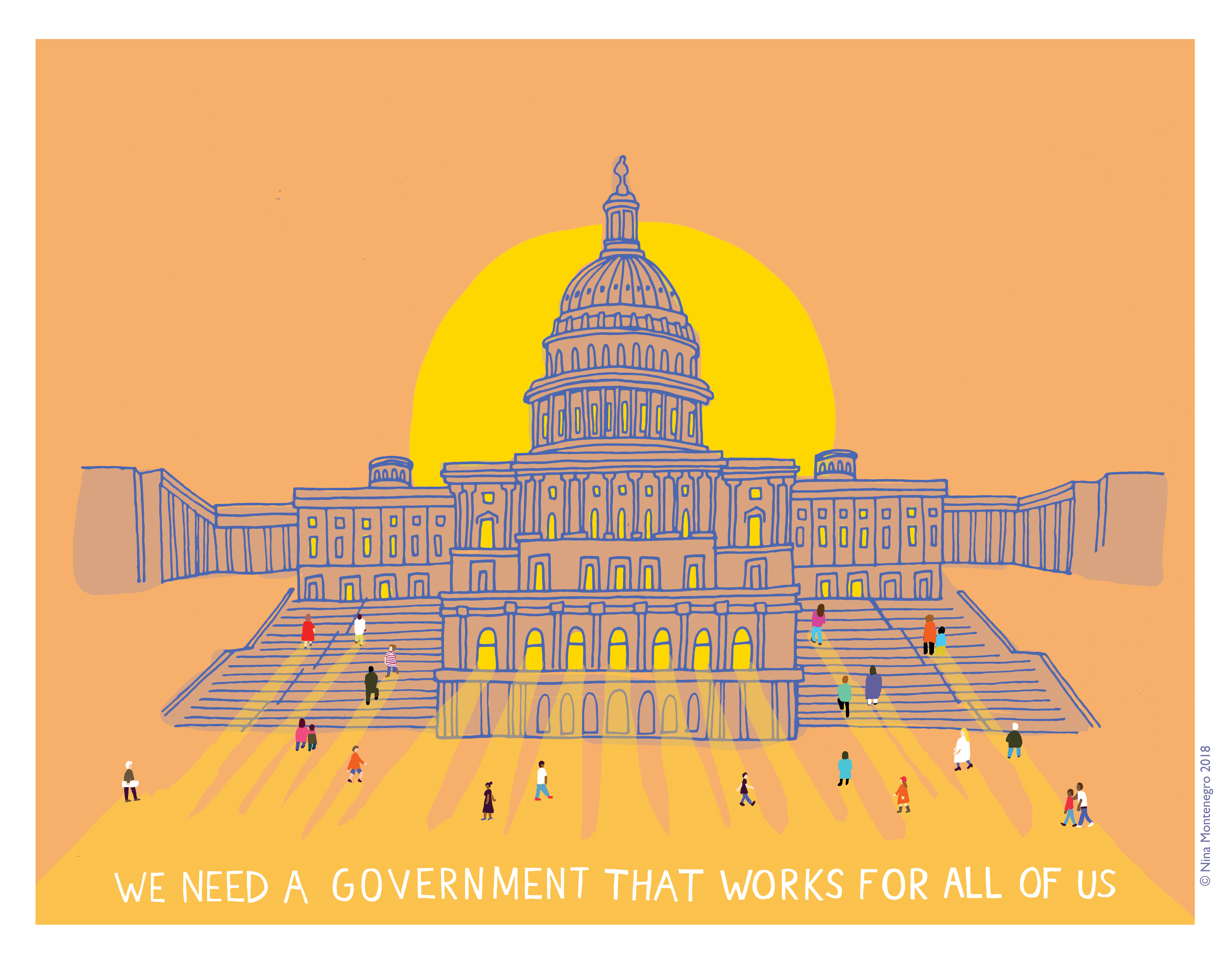
Poverty and economic opportunity are often difficult subjects for advocates to talk about, especially within today’s political climate. Instead of always refuting (and inadvertently re-enforcing) misinformation and stereotypes about people living in poverty, we need to reframe economic issues through values-based messaging and remind audiences that we can create an economy that works for all. To do that, we compiled the following three core messaging pillars in collaboration with some of our partners. These pillars offer tips for discussing shared values, naming systemic causes of poverty, and addressing common-sense solutions that work for everyone. Click on each pillar below for our suggested messaging language.

  • CONNECTIONS: We move forward together. Remind audiences that our destiny is shared, and that we are stronger when we work together.
  • SOLUTIONS:  We need to remind audiences that our economy and its effects on people are the result of deliberate policies that benefit some over others. We can create an economy that works for all, with our government playing a key role.
  • JUSTICE: In the past, powerful interests created and promoted economic policies (and continue to do so) that favored some populations and discriminated against others on the basis of race, ethnicity, and gender. We all have a responsibility to address systemic injustice.

Download the Economic Justice Pillars

Talking Border Issues Amidst the Government Shutdown

Headlines about the U.S.-Mexico border continue to fill our news feeds and screens as the government shutdown provides an inexcusable vehicle for the president’s obsession with building a wall. Accompanying – and sometimes undergirding — these headlines are distortions of the truth, misleading information, and outright lies. Worse yet are the heartbreaking and troubling stories about their impacts, including the administration turning its back on refugees, imprisoning and separating families, and tear gassing asylum seekers, along with – most importantly – the tragic deaths of two children while in government custody.

These are among the reminders of why our values must not be compromised when addressing current actions, and why this moment provides us with even more opportunities to uplift our values as effectively as possible.

Below are five tips on how to discuss the border region and the broader immigration, refugee, and border policies amidst the government shutdown and other current events.

1. Balance short-term and long-term thinking. Before engaging specific topics, such as the government shutdown, the rejection of refugees, or the tragedies that have occurred, take a moment to consider the long-term strategy. Sometimes this step is skipped in the heat of the moment. Yet, it’s very important to keep the long game in mind while communicating in the moment.

  • Consider the larger story we want to tell. While themes like national security and chaos dominate the headlines, providing another side of the story can help to balance audiences’ understanding of the region and its needs, and how the administration’s policies affect everyday life. Include references to the people, communities, economy, and traditions of the border region – even if they are short and in passing. It’s not necessary to tell a complete story, but setting a tone for what the border region actually looks and feels like, and what its residents aspire toward, can help strike balance with the theme of chaos that dominates many stories.
  • Determine which solutions you want to highlight. It’s not enough to repudiate false or exaggerated claims about the national crisis, terrorism or smuggling. We have to talk about what really makes communities safe: properly-trained law enforcement that works with communities, zero tolerance for racial profiling, bigger picture thinking about our place in the world and our responsibilities to it. These arguments are audience-specific and we need to consider how we hope to motivate each target audience.

2. Consider your audience. Once you’ve considered the larger story, and the solutions you want to highlight, consider how your target audiences are hearing current conversations.

  • If you are hoping to energize progressive audiences, for instance, a focus on the president’s harmful obsession with the region—particularly a wasteful wall—may be a good place to start. We already know that for the most part, people are not supportive of a wall.
  • For less receptive audiences, a focus on pragmatism helps. What does the region really need? How do we come up with a solution that protects the commerce of the region, the rights of those who live there and those passing through, and work to make sure that all of our communities can enjoy the safety that border communities already have? For these audiences, arguing about national security is less likely to be effective because doing so just evokes ideas about the military, law enforcement, and the expensive tools they use.

3. Link the shutdown to the president, not the border. If you’re addressing the shutdown specifically, try to move discussion away from the border as much as possible.

  • Frame the shutdown as an inexcusable move of a president who doesn’t understand how negotiation works and who is obsessed with over-simplified solutions that few experts agree will address the problems at hand. These tactics are currently focused on an unnecessary and immoral wall, but have been and will again be redeployed toward other pet projects he’s promised his base.
  • It’s better to redirect the frustration, anger, and uncertainty many audiences are feeling about these issues back at the president rather than further associate those feelings with the border region.

4. Always humanize the discussion. When talking about border region policies, stress the impact those policies have on the people living there. Do the same thing when talking about the shutdown.

  • When talking about refugee and immigration policies, show the impact – including the harms and even death caused by detention. Center on the values of compassion, dignity, respect, and that how we treat others reflects on our own identity as a country.
  • When focusing on the human impact, it’s crucial to be clear that these are system-level problems that require policy-level solutions. We need to ensure that audiences understand that their feelings of horror and sadness about one story or circumstance are not enough. They have a responsibility to translate those feelings into policy change.

5. Stress that border region communities need to have a say in decisions that affect them. Border communities’ voices have been drowned out or ignored in political debates around immigration.

  • Underscore that any policy must be responsive to the expressed needs of border residents. Too often, their voices are drowned out by political discourse and their needs sacrificed for impractical and harmful solutions to exaggerated problems.
  • It’s also important that we lift up the voices of our partners and impacted people in the region and listen to the solutions they are calling for. Some attempts to appeal to swing and conservative voters will start by acknowledging the need for border security. However, doing so suggests that the border region needs more security, which it does not. As our friends at the Southern Border Communities Coalition point out:

The longstanding national dialogue about “the border” has centered almost exclusively on notions of “security” and “enforcement” that should be addressed through increased militarization and a wall. Under this narrative, people outside of the region can only imagine a barren, dangerous, and chaotic wasteland — a patently false narrative that some policymakers and pundits exploit for political gain and to advance policies that are detrimental to the civil rights and quality of life for the millions of people who live, work and travel through the borderlands.[1]

Messaging Examples

On the border region:

The U.S. Southern border region is one of the most diverse, economically vibrant, and safest areas of the country, home to about 15 million people who aspire to enjoy life in a safe and prosperous environment. The Southern Border is a key engine of economic growth; an international trade hub that creates jobs and generates.

– Southern Border Communities Coalition

For more than a decade […] the U.S. government has failed to invest in border communities’ prosperity, opting instead to expand military-style, discriminatory policing of communities in the government’s 100-mile zone and deepen private prison corporations’ reach into taxpayer pockets through costly criminalization and incarceration of migrants—many who find themselves left with few options to return home to the U.S. citizen children and family they love.

– ACLU Border Rights Center

On the shutdown:

In 2013 during the government shutdown, we lost $1 million in federal revenue that we never recovered. We also lost medical providers because they didn’t realize their employment was predicated or dependent upon federal dollars.

– Aaron Payment, Sault Ste. Marie Tribe of Chippewa Indians

So far, Democratic leaders Chuck Schumer and Nancy Pelosi have stood strong against Trump’s bullying tactics and we urge them, as well as other members of Congress, to continue to listen to the voices of borderlanders and resist Trump’s destructive wall. The southern border is a place of hope and opportunity, not fear and conflict. It is one of the safest regions in the country, rich with culture, commerce and growth. We stand ready to work with legislators to ensure that border communities are not jeopardized by any further militarization of the region.

– Vicki Guabecca, Southern Border Communities Coalition

This government shutdown is due solely to Trump’s border wall obsession and his refusal to abandon his anti-immigrant agenda, even at the cost of denying hundreds of thousands of federal workers their holiday paychecks and impacting operations at several federal agencies. As negotiations continue, Congress should hold their ground against the border wall, stand up for border and immigrant communities across the country, and continue to reject Trump’s extortionist demands in any future funding negotiations.

– Lorella Praeli, ACLU


[1] https://www.southernborder.org/border_issues

Talking About Race and The First Step Act

The First Step Act, which recently passed the Senate with wide bipartisan support, can and should represent change in how our nation thinks, talks, and acts on criminal justice issues. While The First Step Act contains modest positive reforms that are welcomed, it is important to also address the act’s limitations. In particular, the act does not directly address issues of racial bias within the criminal justice system. Because it does not openly address the racial bias in the system, there is a risk that it will exacerbate existing racial disparities. This document provides advice for talking about the limitations of The First Step Act as they pertain to race.

1. Lead with Values, such as Equal Justice, Dignity, and Fairness.

Research and experience show that it is more effective to lead with shared values in advocating for criminal justice reform than policy details, statistics, or political rhetoric. When talking about The First Step Act and race, begin by uplifting the values of Equal Justice, Dignity, and Fairness. Highlight how positive criminal justice reform will uphold our society’s commitment to Equal Justice for people of all races. The First Step Act should aim to ensure that the criminal justice system treats individuals with the dignity and fairness we all deserve. Discuss how everyone should be able to benefit from the provisions of the act, including the many people who are currently incarcerated because of racially discriminatory policies.

2. Focus on Obstacles rather than Outcomes.

Experience shows that most criminal justice problems cannot be truly fixed without addressing questions of race. However, when talking about race, discussing racially disparate outcomes without a greater discussion of the obstacles or problems that lead to those outcomes may cause the listener to respond from an individualistic frame. This makes the listener more likely to blame the individuals adversely affected by the system instead of motivating them to address a problem with the system
itself.

Rather than leading with evidence of unequal outcomes alone, we recommend focusing on the obstacles people of color frequently face that lead to harsh and unequal treatment by the criminal justice system and provide concrete examples of these barriers. Discuss the structural and systemic barriers that have led to racial profiling, racial discrimination in how prosecutors choose whether to charge an individual with a crime, and racially discriminatory sentencing outcomes. These are systemic and structural issues that stem from implicit bias, a history of harshly policing communities of color, and widespread use of policies that do not adequately address either of these issues. Explain the need for additional legislation that openly aims to address racial discrimination in the criminal justice system, thereby better promoting equal justice.

3. Discuss Solutions, Not Just the Problems.

When discussing the various problems with The First Step Act, provide solutions that demonstrate the concrete ways Congress should build upon and fix the act.

A. Electronic Monitoring

The act relies heavily on relatively new and substantially unregulated electronic monitoring. This newly advanced, but little studied, method of supervised release tracks individuals’ daily movements and often requires that they ask for permission from a judge or probation officer to leave home. This type of intrusive monitoring perpetuates comic disparities in the system by making it difficult for individuals to maintain employment and requiring individuals to bear the costs of maintaining the monitoring system. Currently there is little regulation controlling the use of the electronic monitoring as a form of supervised release. The use of this technology on people of color creates an additional law enforcement intrusion into the very communities that are already over-policed because of racially biased policies, and may result in a new form of incarceration that will expand in time.

Consider highlighting the following solutions when discussing electronic surveillance:

  • Supervised release programs should avoid invasive monitoring techniques that are overly restrictive and replicate the conditions of incarceration.
  • Electronic shackles should only be used—if at all—once significant constitutional safe-guards and procedures for monitoring racial bias in implementation are put in place to protect against the misuse of this technology.
  • People should never have to pay for electronic monitoring. Electronic surveillance needs more flexibility to allow people to maintain employment and costs of maintaining the system should never be placed on the individual.

B. Racially-Biased Risk Assessment Tools

The act supports the use of risk-assessment tools that rely upon “evidence-based” algorithms to predict the likelihood an individual will commit crimes in the future. While the use of these tools originally aimed to eliminate the bias of judges and prosecutors, research has shown that the algorithms themselves may be tainted by the implicit bias of the creator, which in turn may perpetuate those biases. Thus, the algorithms often unintentionally give higher risk scores to people of color than to otherwise similar whites.

Further, risk-assessment tools, as currently designed, fail to consider the unique circumstances and traits pertaining to an individual. The use of risk assessment tools should be used very cautiously, and the algorithms that are the basis of these tools should be transparent and adjusted with community consultation. Risk-assessment tools should facilitate release and reduce racial bias, rather than exacerbate it.

Consider highlighting the following solutions when discussing the use of risk assessment tools:

  • The data and algorithms that underlie risk assessment tools should be transparent and available for community commentary.
  • Risk assessment tools should be subject to community input and eliminated or adjusted where there is evidence of racial bias in their implementation.

C. Sentencing Carve-Outs

While the act provides meaningful incentives for individuals to earn credit to reduce their sentences by participating in programming aimed to prevent recidivism, a large number of individuals, including immigrants, will be excluded from this opportunity. Excluding individuals convicted of more serious crimes and immigrants from eligibility to participate in programming to prevent recidivism ignores the very individuals who can benefit most from such programming. Our communities may be adversely affected by this exclusion.

Consider highlighting the following solution when discussing the excluded offenses:

  • Everyone deserves access to healing and justice. The First Step Act should be improved to expand the opportunity to earn time-off credits to all individuals who are incarcerated.

D. Lack of Fairness: Retroactivity

Criminal justice reform should benefit everyone—including those currently incarcerated as a result of racially biased policies, including racially discriminatory sentences. While the act provides some much-needed sentencing reform, only one of the sentencing provisions applies retroactively. Because many people were initially incarcerated due to racially discriminatory policies, without retroactive application, the act fails to remedy past racial injustices.

Consider highlighting the following solution when discussing the lack of retroactivity:

  • It’s only fair that people who are incarcerated get access to relief and sentencing reductions provided by reform legislation. Accordingly, all of the sentencing reform provisions should be retroactive.

E. Highlight the Demand for Equal Justice.

While it is imperfect in many ways, The First Step Act is the result of the advocacy of many groups and individuals who are committed to equal justice. Moving forward, we need to acknowledge that even though the Act has passed the Senate, there is still a need for continuing systemic change, and more can and should be done. The next step is for legislators and policymakers to continue to improve upon The First Step Act by explicitly addressing the racial discrimination that exists within the system.

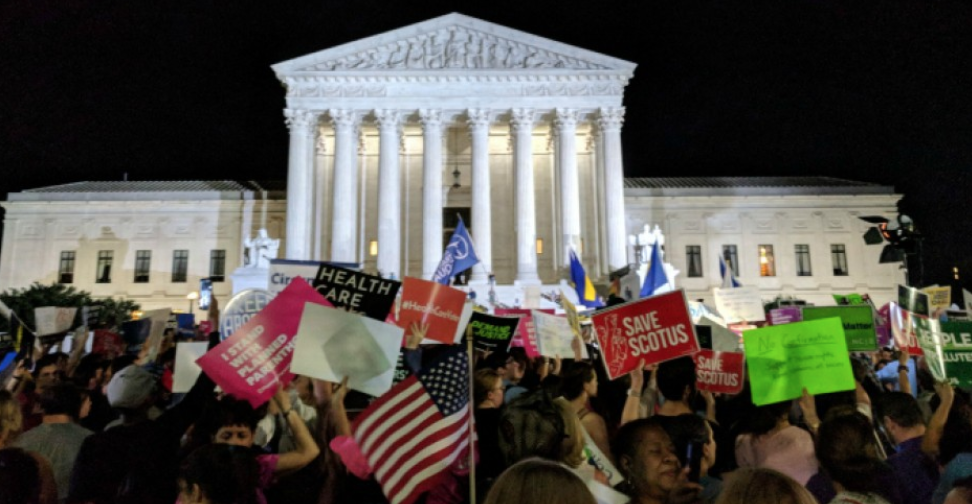
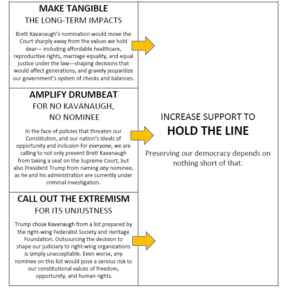
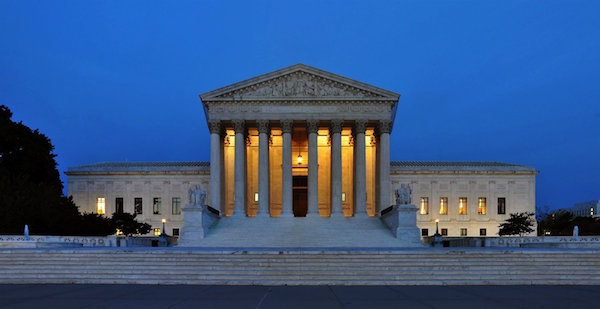
A Visual Flow Chart: How to Stop Kavanaugh and #SaveSCOTUS

Messaging Strategies:

  • Amplify the call for stopping Kavanaugh and for preventing any Trump nominee from moving forward while the president is under criminal investigation. Trump’s actions and the open investigations into his administration should disqualify him from naming any Supreme Court justice.
  • Call out the dangerous threat to democracy and to our system of checks and balances that the president presents to our nation. Make clear the solutions needed to right the ship.
  • Significantly step up criticism of the colossally inappropriate role—and extremist values—of The Federalist Society and The Heritage Foundation in selecting the judges who should rule fairly for the whole nation.
  • Remind relevant audiences (at every turn) of this president’s support for racism and bigotry, from his criticism of Judge Curiel based on his heritage, to his slander of Mexican-Americans, to his praise of neo-Nazis in Charlottesville, to his ties with the racist “Alt-Right” movement.

Say NO to Brett Kavanaugh and to Donald Trump. Join our SaveSCOTUS.org allies and oppose Kavanaugh, and push for what is truly democratic: no nominee

Six Tips for Responding to Supreme Court Decisions

  1. Be cautious.

    Don’t comment until you’ve seen the facts and the lead party’s statement. Remember, the first statement you make will be the most powerful. Comment to shape the conversation, not argue with the opposition about what the decision means. Consider your audience and the big picture of what those who read your statement will take away from it, and remember that if you jump in and don’t have a well-thought out point of view, that’s likely to be what your audience will remember.

  2. Focus on what the case means to our shared values.

    Consider the decision through your audience’s eyes. Most audiences are not at all familiar with – or even focused on – the outcomes of Supreme Court cases and their impressions will be shaped by headlines and topline rhetoric. It’s important to find ways to engage at that level, while providing detailed legal arguments only for audiences who want that. A great way to do this is to focus on values. Consider what the case suggests for the celebration or undermining of those values.

  3. Avoid jargon…

    In favor of plainspoken and accessible language that tells a story your audiences can digest, and that will spark action. Include stories, imagery, and metaphors that are memorable and stay with audiences longer than legal points.

  4. Try to comment on the case, not the court.

    If you don’t agree with a decision, it’s tempting to admonish the court for being out of touch. But remember that the Supreme Court is considering multiple cases impacting a range of issues across the social justice spectrum. Attacking the ideological profile of particular justices without discussing their alignment (or misalignment) of values in relationship to a decision can undercut a more favorable decision they may make on another issue. The way around this is to speak about what the case means to our shared values and national identity, and how decisions do or do not reflect those values. It may make sense to criticize the ruling, and specific justices’ opinions, but do leave room for the possibility that the court could rule more favorably on other cases. Try to refrain from comments that write off the court in its entirety.

  5. Don’t focus on what the decision isn’t.

    Discuss what it is. Explaining the legal details of what the case doesn’t mean is not as powerful as affirmatively stating what it does mean. Spending too much time telling audiences that the ruling does not outlaw abortion, for instance, only repeats the phrase and strengthens it in audiences’ minds.

  6. Pivot to solutions and action.

    While reporters covering the case may want “just the facts,” there are many opportunities to remind audiences of the solutions that the case highlights, and what they can do to make those solutions happen. Base audiences, in particular, will be fired up to do something whether in a celebratory or angry mood, so make sure to give them something concrete that they can do.

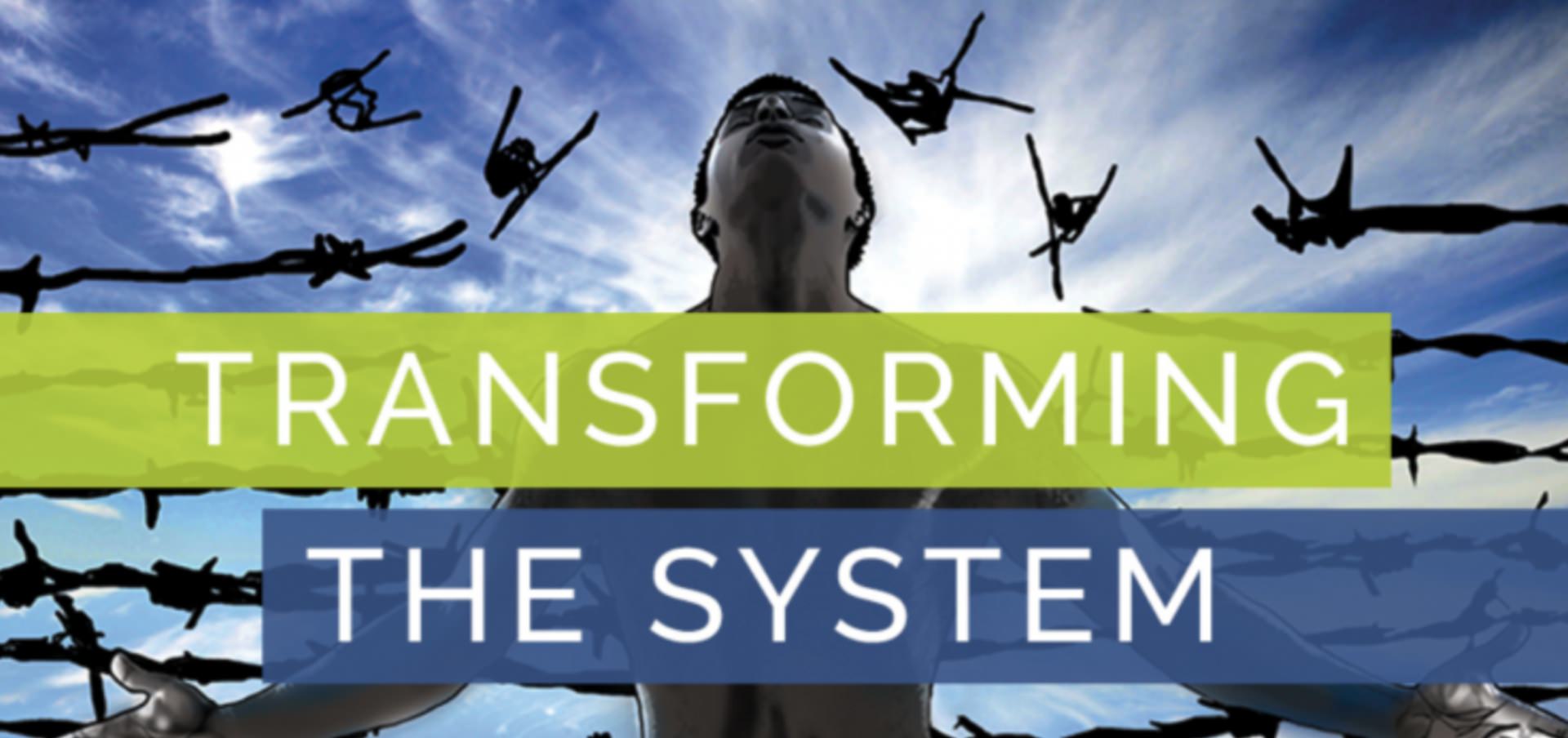
Transforming the System

Artwork by Alixa García


Our criminal justice system must keep all communities safe, foster prevention and rehabilitation, and ensure fair and equal justice. But in too many places, and in too many ways, our system is falling short of that mandate and with devastating consequences. The United States is saddled with an outdated, unfair, and bloated criminal justice system that drains resources and disrupts communities.

Law and order exist for the purpose of establishing justice and when they fail in this purpose they become the dangerously structured dams that block the flow of social progress.

– Dr. Martin Luther King Jr.

People of color, particularly Native American, black, and Latino people, have felt the impact of discrimination within the criminal justice system. Many immigrants experience mandatory detention, racial profiling, and due process violations because of laws and policies that violate their human rights—and the principles of equal justice, fair treatment, and proportionality under our criminal justice system. The good news is that we as a nation are at a unique moment in which there is strong public, bipartisan support for criminal justice reform; we see positive policy developments in many parts of the country; and mass action and social movements for change are growing, including the Movement for Black Lives. More is needed, however, to move from positive trends to transformative, lasting change. This report provides practical policy solutions and communication tools for building a shared narrative around criminal justice reform.

Visit The Resource

The Opportunity Agenda
Privacy Overview

This website uses cookies so that we can provide you with the best user experience possible. Cookie information is stored in your browser and performs functions such as recognising you when you return to our website and helping our team to understand which sections of the website you find most interesting and useful.

close search