During these times of crisis and uncertainty, it is critical to pull together as a community to ensure that we are all protected against the global threat of COVID-19. Our collective survival demands nothing less.
The COVID-19 pandemic exposes the systemic inequities in this country’s incarceration and detention policies. This crisis presents a stark moment to address a health and safety threat to all of us, as well as to strive for justice and address systemic inequities directly. For example, a patchwork approach to bail policies and pretrial detention means that too many people are detained without having been convicted of anything, leaving far too many people unjustly serving while also facing what are de facto death sentences due to prison conditions and the spread of the COVID-19 virus. Because there have been an increasing number of infections within the confined spaces of many jails, prisons, and detention centers, it is more important than ever to continue advocacy for justice reform and the release of people who have not had due process. Below are important values to uplift to ensure that your communications are rooted in shared values.
Our Shared Values
Highlight these shared values to illustrate the importance of releasing people from detention facilities during the COVID-19 pandemic.
Human Rights and Dignity. We must protect the human rights of everyone, including people who are currently detained or incarcerated. Our commitment to human rights and respect for the dignity of human life depends on immediate action. Failing to prevent avoidable death during this pandemic would threaten our commitment to basic human rights and respect for human dignity.
Our Identity. How we respond to this crisis will define our identity for generations to come. Ensuring that we respect the dignity of people who have been detained in our bloated detention system is critical to our legacy. We must be able to reflect on our collective response to this crisis and be able to say that we did the right thing, leaving no one behind.
Shared Responsibility/Community. We should come together as a community to protect the most vulnerable among us. Many people who are detained or incarcerated are especially vulnerable to COVID-19, and we have a responsibility to provide them with a safe environment and protect them. We need to band together as a community and develop a plan to quickly remove vulnerable populations from detention.
Community Safety. The COVID-19 pandemic makes clear that the use of detention and incarceration for social problems threatens actual public safety and public health as the virus spreads within the carceral system. Reducing incarceration and releasing people from detention facilities across the country would help us achieve true community safety by protecting the health and safety of everyone in our communities, including individuals who are detained.
Sample VPSA Message
In order to deliver a consistent, well-framed message, we recommend structuring messages in terms of Value, Problem, Solution, Action. In particular, leading with shared values instead of dry facts or hot rhetoric helps launch a conversation and provides a foundation to transition into more complex messages.
Value: The COVID-19 pandemic is a clarion call for communities everywhere to come together. We are all in this together because we are all only as safe as those members of our community who are most at risk.
Problem:People throughout this country are detained in crowded detention centers, jails, and prisons. These systems of detention and incarceration are unsafe, unsanitary, and unable to provide an environment of safe, physical distancing during this global health crisis.
Solution: Government officials should begin to rapidly release vulnerable people from our bloated and crowded detention facilities so that they can practice physical distancing and, at the same time, be able to experience due process — particularly those who have not stood trial but are still detained.
Action:Please call/email/Tweet/Facebook message your local politicians to demand that they release the most vulnerable people from prisons, jails and detention facilities.
In recent years, California has emerged as fertile ground for progressive criminal justice reform, with the passage of policies such as SB 439, SB 1319, and SB 10—just a few examples of activists, advocates, and policymakers’ recent success working within the state. Despite these many gains, challenges abound, including continued resistance to the adoption of policies that rectify the disproportional targeting of communities of color in the past. At the same time, the overt xenophobia in today’s political discourse has made fear-mongering and scapegoating more commonplace in law enforcement and other government agencies interactions with communities of color.
With the goal of gaining a better understanding of these state-level successes and challenges while also gathering insights that can be translated to messaging strategy for use in the field at large, The Opportunity Agenda and the ACLU of California engaged in a collaborative research project examining Californians’ attitudes and beliefs about the criminal justice system. This memo draws from the data from a statewide survey of 1,055 randomly sampled respondents representative of Californians administered in July 2018.
METHODOLOGY
This memo draws on the results of a collaborative research project with the ACLU of California conducted in July 2018. The insights are based on data from a statewide online dial survey administered to a total of 1,055 registered voters in the state. The margin of error is ± 3.1 percent for the overall sample and larger for subgroups.
In this memo, we make references to three populations defined as the base, opposition, and persuadables. Our base, opposition, and persuadables were created using a statistical cluster analysis that identified groups of like-minded voters based on the patterns of their responses to a series of questions about their attitudes toward the criminal justice system, discrimination, racial inequities, and a variety of related topics.
ACKNOWLEDGEMENT
The Opportunity Agenda wishes to thank and acknowledge the many people who contributed their time, energy, and expertise to the research and writing of this report. The survey was commissioned and designed in collaboration with Cheryl Alethia Phelps, Communications Director of the ACLU San Diego and Imperial County and Margaret Dooley-Sammuli. Data was collected, cleaned, and analyzed by Andrew Hart and Steven Riskey of Strop Insights and Kyle Francis of Qualtrics. Additional analysis of data and the drafting of this report was conducted by Lucy Odigie-Turley of The Opportunity Agenda. Recommendations were drafted by Julie-Fisher Rowe of The Opportunity Agenda. The graphics and illustrations were created by Lincoln Bovell. Final proofing and copy editing were conducted by Margo Harris. Finally, this report would have not been possible without the support of our generous funders: American Civil Liberties Union, John D. and Catherine T. MacArthur Foundation, Marguerite Casey Foundation, Nathan Cummings Foundation, The Annie E. Casey Foundation, The Ford Foundation, The JPB Foundation, The Libra Foundation, The Tow Foundation, Unbound Philanthropy, and W.K. Kellogg Foundation.
1. California has a strong base of support for wider criminal justice reform, and a significant portion of Californians are persuadable on a variety of reform issues
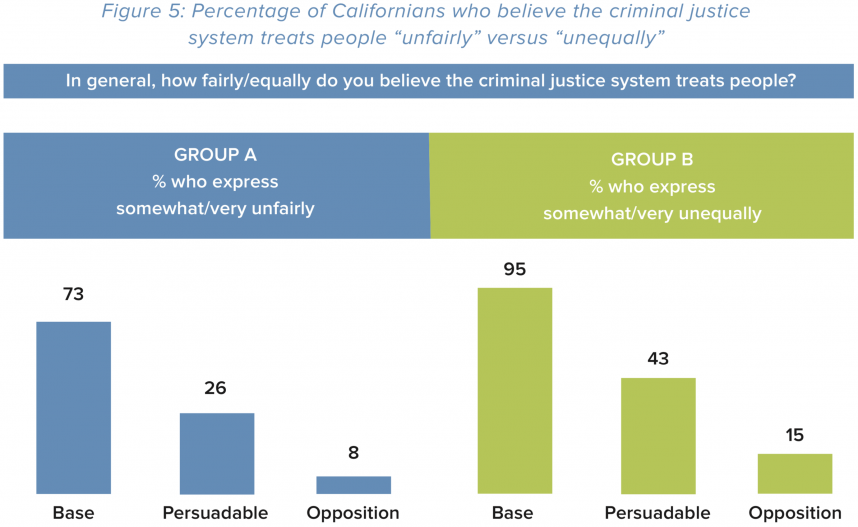
As of July 2018, 26 percent of surveyed Californians form part of the base of support for criminal justice reform, 57 percent can be described as persuadable on issues related to criminal justice reform, and 17 percent can be described as oppositional to widespread criminal justice reform. The base is significantly more likely to believe that the criminal justice system generally treats people “somewhat/very unfairly” (73% of the base support this statement, versus 26% of persuadables and just 8% of the opposition) and hold a strong belief that racial and income inequities are serious issues.
The opposition is defined by a strong belief in the fairness of the existing criminal justice system, a preference for harsher punishment over rehabilitation, and support for the profiling of specific racial/ethnic groups. Persuadables hold views that overlap with both the base and opposition but are most strongly defined by their self-reported lack of familiarity with most roles within the criminal justice system, including prosecutors and public defenders.
2. People of color, low-income adults, and the religiously unaffiliated are an important base of support for criminal justice reform in California
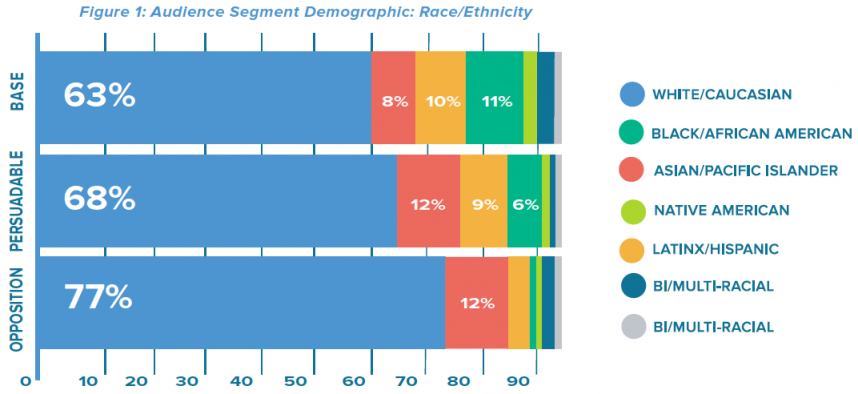
Although audience segments are based on respondents’ responses to a range of attitudinal questions, our research findings point to important demographic distinctions between the three segments. As seen in Figure 1, 35 percent of the base self-identified as Black (11%), Latinx/Hispanic (10%), Asian/Pacific Islander (8%), bi/multi-racial (4%), or Native American (2%). A significant portion of people of color also fall within the persuadable audience segment, with Asian/Pacific Islanders slightly more likely to fall into the persuadable (12%) or opposition (12%) than the base (8%) group. Alongside communities of color, those who express no religious affiliation also emerged as an important base of support for criminal justice, with 43 percent of the base self-identifying as having no religious affiliation compared to 26 percent of persuadables and 17 percent of the opposition. The base and persuadables are also significantly more likely than the opposition to be low-income. Twenty-eight percent of the base and 23 percent of persuadables earn less than $25,000 annually, compared to just 11 percent of the opposition. At the same time, just over a quarter (26%) of the opposition earn upwards of $100,000 annually, compared to 15 percent and 14 percent of the base and persuadables, respectively.
3. Base and persuadable audiences have distinct media consumption and engagement habits
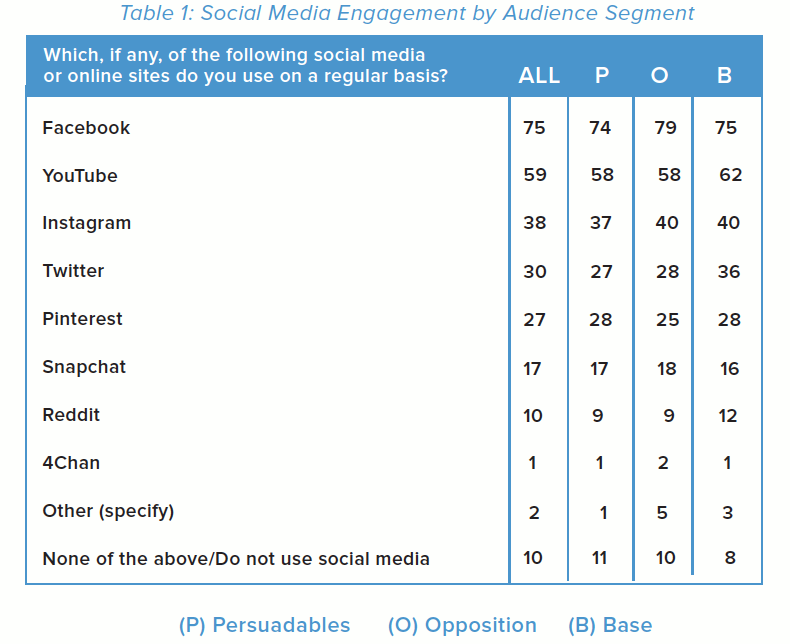
Base and persuadable audiences have distinct media consumption and engagement habits: Media consumption and usage habits are increasingly recognized as important predictors of political decision-making and attitudes related to a range of issues. To gauge their impact, if any, on Californians ’ attitude toward the criminal justice system we included a range of questions about participants’ engagement with news and social media and different genres of entertainment media. In terms of entertainment, all audience segments reported similar rates of regular use and engagement on Facebook, YouTube, and Instagram, but persuadables are slightly more likely to report that they make regular use of Twitter (36%) compared to the base and opposition (27% and 28%, respectively).
4. Police accountability is the highest policy priority identified among all segments
We asked respondents to rank a range of policy solutions intended to reduce unfairness within the criminal justice system from highest to lowest priority (with each respondent given the option to rank every item as a high, moderate, or low priority). Across all three segments “holding police officers who use excessive force accountable,” “addressing instances of police brutality,” “ensuring people of color are treated fairly by law enforcement and within the criminal justice system,” and “minimizing the interactions people suffering from substance abuse have with the criminal justice system” were ranked as the highest policy priorities.
5. Bail reform and issues at the intersection of homelessness and criminal justice are lower priorities among both base and persuadable audiences
Our survey findings indicate that despite widespread recognition of inequities within the criminal justice system and how these inequities disproportionately impact communities of color and those living in poverty, voters are less likely to see bail reform and the treatment of homeless Americans by law enforcement as a high policy priority. Just 47 percent of those surveyed selected “minimizing the interactions people living in homelessness have with the criminal justice system” as a high policy priority (67% of the base, 38% of persuadables, and 35% of the opposition). At the same time, just 45 percent of those surveyed ranked “reducing the cost of bail for low-income Americans” as a high policy priority (59% of the base, 39% of persuadables, and 37% of the opposition).
6. More than half of Californians report knowing someone who has been arrested, and nearly 50 percent know someone who has been incarcerated
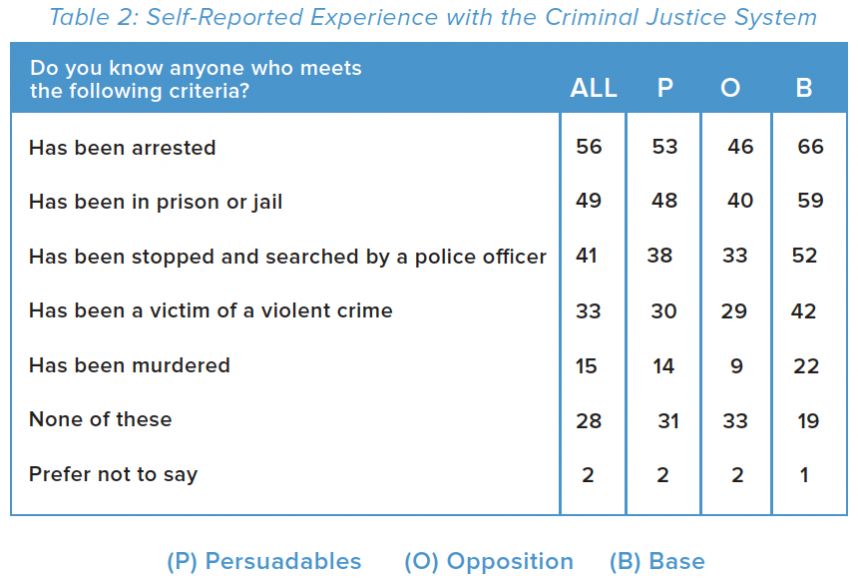
In July 2018, 56 percent of surveyed Californians reported that they personally know someone who has been arrested, 49 percent know someone who has been in prison or jail, and a third personally know someone who has been a victim of a violent crime (Table 2). The rate of self-reported experiences with the criminal justice system varies between audience segments, with the base and persuadables more likely than the opposition to report knowing someone who has been arrested (66% and 53% versus 46%, respectively), in prison or jail (59% and 48% versus 40%, respectively), or stopped and searched by a police officer (52% and 38% versus 33%, respectively). Alongside widespread first- and/or second-hand experiences with the criminal justice system, the base is significantly more likely than both persuadables and the opposition to report knowing someone who has been the victim of a violent crime (42% versus 30% and 29%, respectively) or murdered (22% versus 14% and 9%, respectively)—a finding that is one of the most significant variations between base and persuadable audiences in California.
7. Perception of physical safety is a key predictor of attitudes toward and perceptions of the criminal justice system
As noted in our analysis of existing public opinion research related to criminal justice, fear of crime and victimization have long been recognized as a driving force behind Americans’ attitudes toward criminal justice policy. In an effort to examine this relationship more closely in the context of California, we included a series of questions intended to gauge respondents’ level of fear related to their physical safety and the impact, if any, on their attitudes toward criminal justice. Respondents were asked how often they have serious concerns about their safety in a range of places, including at home, while driving, or in their neighborhood, and they ranked this concern on a 5-point scale, from “never” to “often.” We used participants’ responses to create a fear scale, with respondents grouped as low, moderate, or high fear based on their average score.
As of July 2018, 19 percent of Californians surveyed expressed low levels of fear, 68 percent moderate levels of fear, 13 percent high levels of fear related to their physical safety. Respondents’ score on the fear scale correlates strongly with their overall perception of the criminal justice system and proved to be a stronger predictor of attitudes toward the criminal justice system than party affiliation and ideological lean. Those who reported that they were generally “often ” or “nearly always” in fear of their safety and received a high score on the fear scale were also significantly less likely than those with moderate or low fear to believe that the criminal justice system treats people unequally (26% versus 55% and 47%, respectively).
8. Those who express high levels of fear are less likely to report having any direct contact with the criminal justice system, but are also more confident in their perceived knowledge of the criminal justice system
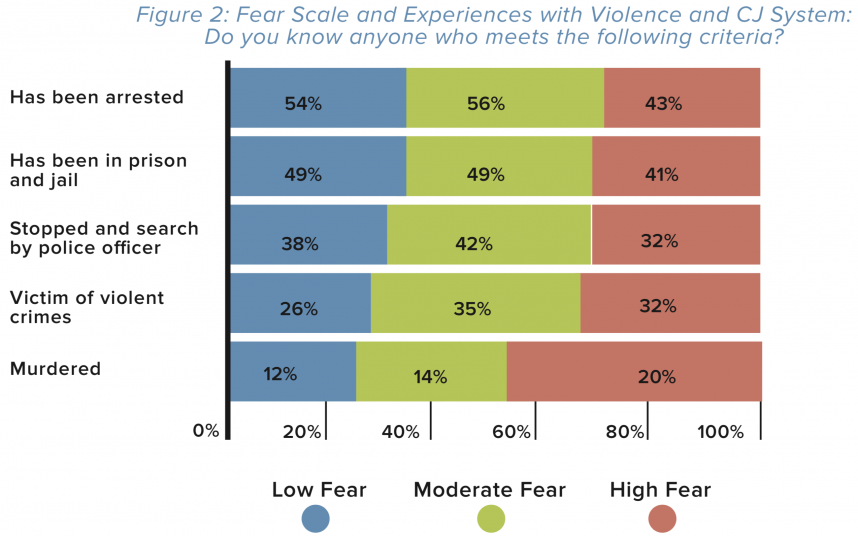
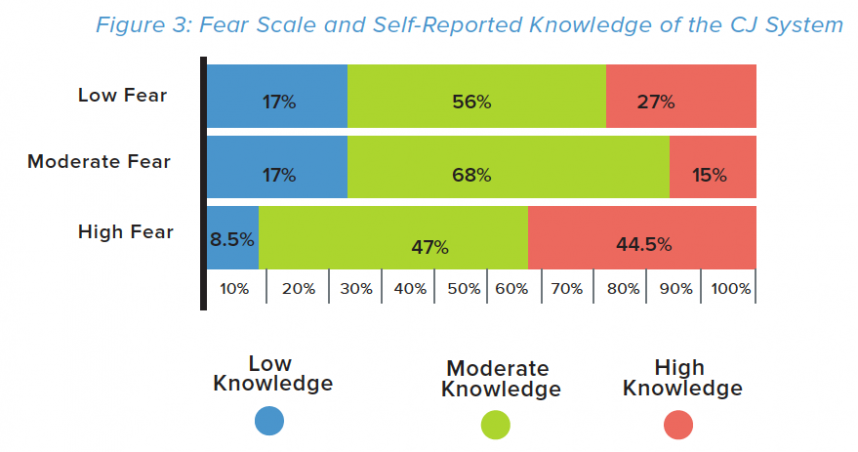
Alongside having a marked impact on people’s overall perception and attitude toward the criminal justice system, fear related to physical safety also correlated strongly with people’s experience with the criminal justice system and perceived knowledge of the criminal justice system. For instance, individuals who scored low or moderately on the fear scale were more likely than those who scored high to report knowing someone who have been arrested (55% and 56% versus 43%, respectively), in prison or jail (49% and 49% versus 41%, respectively). All three segments report similar rates of knowing someone who has been search by a police officer (38%, 42%, and 39%, respectively). However, those who scored high on the fear scale were more likely to report knowing someone who has been murdered, with 20 percent reporting knowing someone who has been murdered versus 14 percent of individuals with moderate fear and 12 percent of individuals with high fear (Figure 2). At the same time, individuals who scored high on the fear scale were also significantly more likely to rate their overall knowledge of the criminal justice system as high (Figure 3). For instance, 44.5 percent of those who scored high on the fear scale also scored high on the self-reported knowledge scale—that is, what they said they knew about or their familiarity with various components and roles within the criminal justice system, including judges, prosecutors, public defenders, and bail bond companies.
At the same time, those with moderate or low fear were also significantly less confident about their knowledge and familiarity of the criminal justice system, with only 27 percent of those who scored low on the fear scale rating their knowledge of the overall criminal justice system as high.
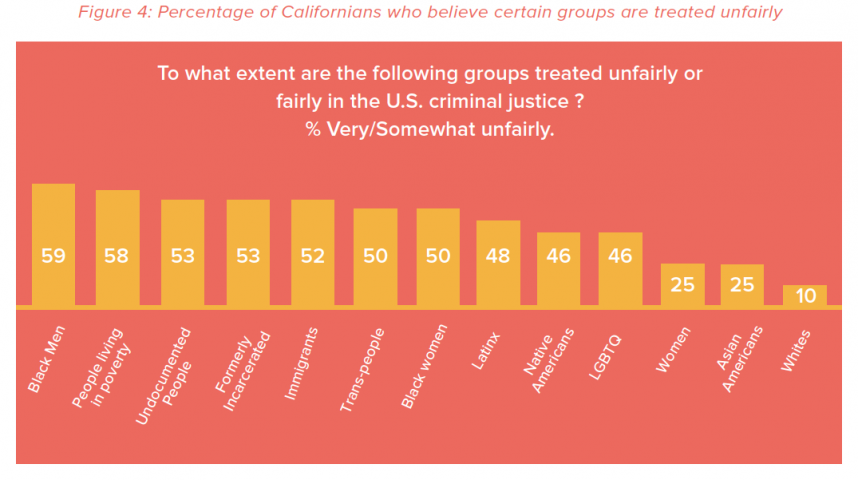
9. Californians believe that Black men, people living in poverty, people without documentation, formerly incarcerated people, and immigrants are the least likely to receive fair treatment within criminal justice
Our findings show that although a plurality of Californians believe that the criminal justice system generally treats people fairly, responses to this question varied significantly between audience segments and also when participants were asked more specific questions regarding who is more or less likely to receive fair treatment. When asked to what extent different demographic groups are treated fairly or unfairly by the criminal justice system, the majority of Californians expressed the belief that Black men (59%), people living in poverty (58%), undocumented immigrants (53%), people who have been incarcerated (53%), and immigrants (52%) are somewhat/very likely to receive unfair treatment in the overall criminal justice system (Figure 4).
10. All segments appear to make a distinction between “unequal” versus “unfair” treatment within the criminal justice system
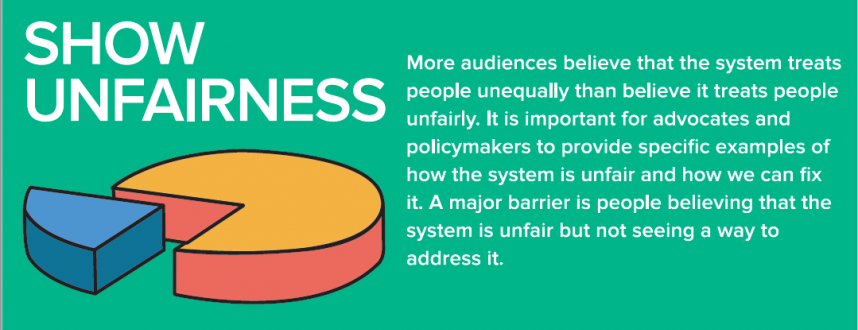
A key finding of our survey was that Californians across audience segments are significantly more likely to express the belief that the criminal justice system is “unequal” as opposed to “unfair.” Using a random split sampling, we asked 50 percent of respondents in general how “fairly” and the other 50 percent how “equally” they believe the criminal justice system treats people. As seen in Figure 5, whereas 73 percent of the base expressed the belief that the criminal justice system generally treats people “somewhat/very unfairly,” 95 percent of the base express the belief that the criminal justice system generally treats people “somewhat/very unequally,” representing a 22-point variation. A similar trend emerges among both persuadables and the opposition, with a 17-point variation among persuadables and 7-point among the opposition.
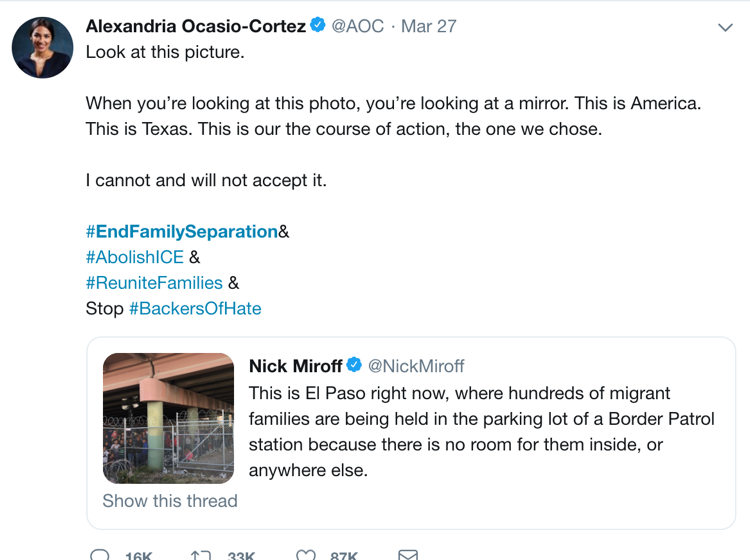
There is much to say about the horror of watching our government imprison and mistreat children. Responding to the outrage with solutions that will move audiences beyond feeling dismayed, disgusted and helpless is very difficult. But it’s crucial in pushing officials to not only end these practices, but also to move us toward productive and real fixes to our outdated and inhumane immigration policies.
The Opportunity Agenda suggests building messages using a Value, Problem, Solution, Action (VPSA) construction. Leading with values can help audiences see past rhetoric and centers the conversation on what really matters instead of disagreeing over the interpretation of news media coverage, politics, policy or the history of immigration laws. Then move to define the problem as a violation of those values and pivot quickly to solutions, both short- and longer-term. Finally, give your audiences a concrete action(s) so that they can see themselves move on the issue in some form right away.
VPSA Language Examples
Value: This is about our national identity, and what we aspire to be as a country. We should strive to be a compassionate and humane nation that respects the value of family and the dignity of migrants, particularly children. We claim a set of ideals that we’ve never lived up to, but we owe it to ourselves and future generations to do everything we can to achieve them now.
In our nation’s treatment of children and families seeking asylum, we are making critical choices about who we are as a nation. This is a historic moment where WE can help shape our own legacy and the type of nation we leave for future generations.
Define American
This is not a perplexing scientific puzzle. This is a moral disaster. There has to be some way to communicate, in unequivocal terms, that we are inflicting punishments on innocent children that will have lifelong consequences.
Dr. Jack Shonkoff, Center on the Developing Child, Harvard University
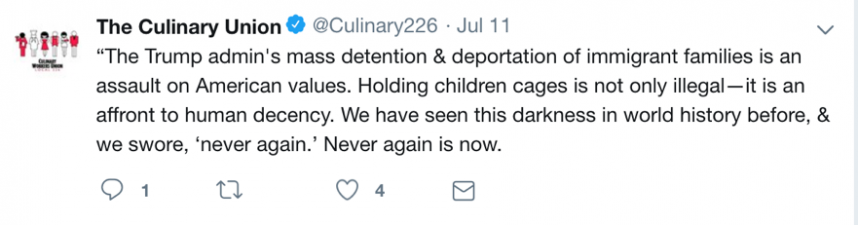
Problem: This administration’s anti-immigrant and racist policies and actions are setting us back morally and ethically. It should go without saying that we should not treat children, or anyone, this way, and yet the administration continues to defend its practice and argue for more funds to support it. Throwing money at brutal and inhumane conditions under the guise of “making our country great again” is not only not the answer, it is wholly unacceptable. This assault on our values harms not just the families and children at the border, but all of us watching what our country is condoning. This is a systemic problem that requires action from all of us.
In my time as a border patrol agent, I’ve developed a unique perspective on twenty years of border policies. I resigned from the border patrol due to corruption, and a lack of ethics and morality. What we’re seeing today is the result of an agency allowed to run with no oversight whatsoever. Years of walls, more agents, guns, planes, detention camps and trillions of dollars has done nothing to make our border communities safer. Using law enforcement to address a humanitarian need has never worked and never will. The Border Patrol needs to be held accountable, border communities have the right to have a voice in how they are governed.
Jenn Budd, former border patrol agent
CBP, along with ICE, have a culture of impunity and we are witnessing the consequences in the stories being told by children who are being abused. Cruelty at the micro level of individual officers treating individual detainees abusively is reflective of the cruelty that starts at the top, in the White House and at DHS and CBP HQ. Let’s be clear, the revelations follow a consistent and disturbing theme that has more to do with dehumanizing cruelty than it does with a lack of resources or overcrowded conditions.
Douglas Rivlin, America’s Voice
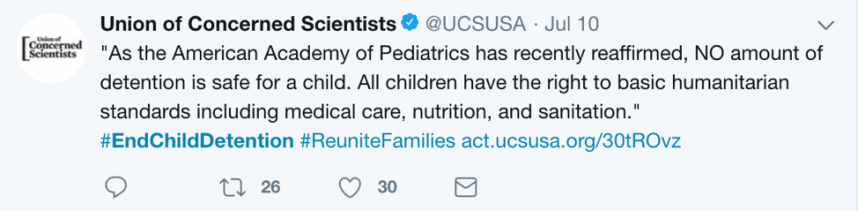
Solution: The government must release these children immediately. And in addition to the range of crucial short-term fixes to the outrageous imprisonment of children, we need long-term solutions to the outdated immigration and asylum policies that allowed this situation to happen in the first place.
Border policies should focus on genuine threats and recognize that migration, in and of itself, is not a threat, nor should it be a crime. Migration is the human experience of seeking life, liberty, and the pursuit of happiness. Facilitating the humane and orderly movement of people across the border increases public safety.
Andrea Guerrero, Alliance San Diego
Communities along the U.S.- Mexico border are vibrant, warm and welcoming. However, because of the current enforcement-only policies, at least seven children have died in recent months either while in U.S. Custody or after being detained. Meanwhile migrant families are crammed in dangerously overcrowded cells for days at a time, sometimes in soiled clothes and without access to adequate hygiene. This is unacceptable. A New Border Vision calls for an appropriate humanitarian response to current human needs. A non-law enforcement approach must include sufficient, trained personnel who can provide adequate and efficient medical assistance, resources and support, and welcome residents and newcomers alike to our region.
Cynthia Pompa, ACLU Border Rights Center
Immigration detention is not the answer: not for asylum seekers, or for anyone else. It’s a punitive system where lives are in jeopardy. Instead of overcrowding and expanding the deadly system, people need to be released now. Congress must cut funding for detention in FY20, reject the administration’s supplemental request for detention funding and put an end to Trump’s massive expansion of immigration detention now.
Silky Shah, Detention Watch Network
Action: The urgency for action is now. We must mobilize, call our representatives, and vote. We need to bring along the final persuadable skeptics who have resisted the idea that this administration is dangerously anti-immigrant.

Full VPSA Example
As a company that helps children become their best selves—curious, creative, caring, and confident—we want kids to understand the importance of having moral courage. Moral courage means standing up for what we believe is right, honest, and ethical—even when it is hard.
Our company’s core belief, stated each month in Highlights magazine, is that “Children are the world’s most important people.” This is a belief about ALL children.
With this core belief in our minds and hearts, we denounce the practice of separating immigrant children from their families and urge our government to cease this activity, which is unconscionable and causes irreparable damage to young lives.
This is not a political statement about immigration policy. This is a statement about human decency, plain and simple. This is a plea for recognition that these are not simply the children of strangers for whom others are accountable. This is an appeal to elevate the inalienable right of all children to feel safe and to have the opportunity to become their best selves.
We invite you—regardless of your political leanings—to join us in speaking out against family separation and to call for more human treatment of immigrant children currently being held in detention facilities. Write, call, or email your government representatives.
Let our children draw strength and inspiration from our collective display of moral courage. They are watching.
Highlights Magazine
Additional Messaging Suggestions
1. Stay out of the legal and political weeds. It’s important to underscore that the lengthy and inhumane detention of children, often separated from their families, is not only morally indefensible, but also illegal. That said, a too-involved description of the laws that should be protecting migrants, asylum seekers, and all children will only give the impression that the situation is legally complex and therefore difficult to fix. Provide a brief and straightforward explanation of the law or policy in question:
Roughly one year ago, the administration’s family separation policy supposedly came to an end, following an executive order and subsequent court order banning the practice. The court’s decision, however, applied only to some parents traveling with children. It therefore did not prevent the U.S. government from continuing to separate children from other adult relatives and caregivers, including aunts, uncles, and older siblings.
Unitarian Universalist Service Committee
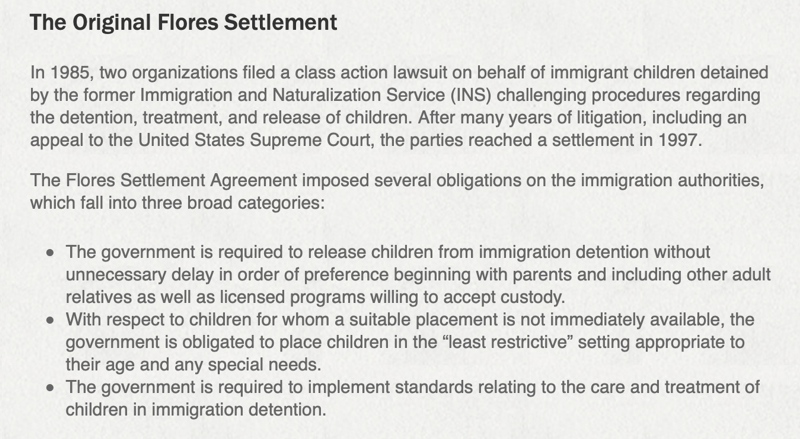
We believe our nation and its leaders have both the moral and legal responsibility on behalf of those who seek safety in our land. The U.S. has an international legal obligation to do so by virtue of having acceded to the 1967 Protocol Relating to the Status of Refugees and, therefore, must implement those duties in good faith. It also has an obligation to do so under its own domestic law, and executive orders should not attempt to set aside these legal responsibilities.
Evangelical Lutheran Church in America (ELCA) with ELCA ecumenical and inter-religious partners
Then move quickly to the solution including what needs to happen, and who needs to do it:
Detention of children and adults alike is not the answer. Rather than building up the infrastructure of a system that is riddled with abuse where lives are in jeopardy, Members of Congress should be calling for the closure of detention centers across the country and advocating for people to be released.
Silky Shah, Detention Watch Network
2. Avoid implying that the detention of children and separation of families is a new, or recent, phenomenon or something “we just don’t do.” Talk about who we should be without repeating historical (and current) myths about adherence to ideals. It’s important to remember that there are many instances in our country’s history during which our government separated children from their families, and imprisoned people unjustly.
What I saw today is simply not who, we, as a country should be. This is cruel and inhumane treatment and we cannot allow it to continue on our watch.
Representative Pramila Jayapal, (D) Washington
Instead, use history to show how backwards and shameful our obsession with detention and incarceration is, and what it’s led us to do or accept in the past.
Fort Sill is a site steeped in layers upon layers of historical trauma. Over 700 Japanese Americans were detained there during WWII, and one man, a Japanese immigrant and father of 11, was shot and killed while suffering a nervous breakdown and trying to escape. Before that, Fort Sill was a prisoner of war camp for members of the Chiricahua Apache tribe who were forcibly relocated there from the Southwest. It also housed a boarding school where Native American children were separated from their families and subjected to cultural genocide. Fort Sill has always been a violent place — and it is time for that violence to end. “Never Again” is right now. It’s happening all around us, every day. We must be vigilant in showing up and demanding that sites like Fort Sill be shut down. No one showed up for Japanese American families like mine in 1942, but we can and we must show up for immigrant children and families today.
Tom Ikeda, Densho
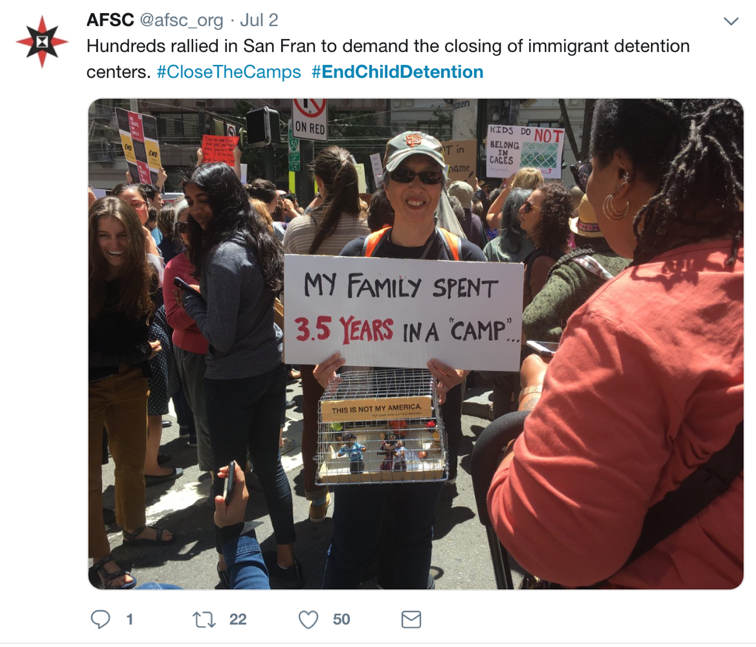
Forcibly yanking children from their parents is of a piece with some of the darkest moments of American history: the internment of Japanese Americans; the forcible separation of American Indian children into special boarding schools; slavery.
Ashley Fetters, The Atlantic
3. Link the separation of families at the border to the separation of families that raids and deportation cause. Paint a broader picture of the intended effects of the administration’s anti-immigrant and inhumane policies and rhetoric.
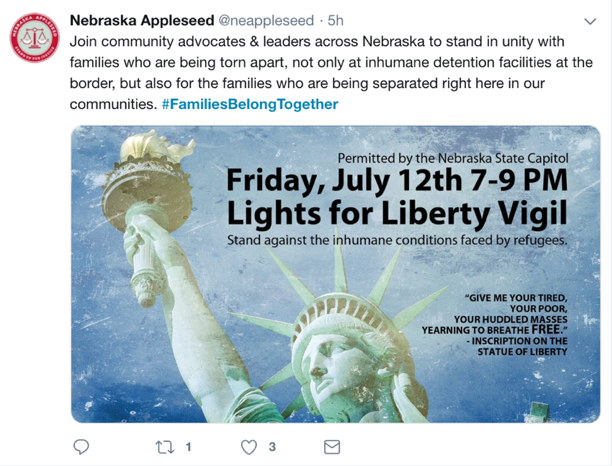
The Trump administration has been making changes both small and drastic to U.S. immigration policies. While Trump’s cruel policies at the border and his ramping up of deportations and ICE raids have garnered the most attention and outrage, his other efforts to transform legal immigration have been no less radical. As administration officials andconservative commentatorshave said, deportations alone may not halt the demographic changes taking place in the country — so the administration is aggressively reshaping the legal immigration system.
American Friends Service Committee
4. Keeping families together is not enough. While insisting ICE and Border Patrol not take children from their families is important, we need to insist that the alternative of locking up families together is also not acceptable. In fact, we should question if any detention at all is acceptable.
I should note that there is a big distinction between having access to a caring, supportive adult in a home setting versus a detention facility. While a parent may technically be present in family detention centers, the conditions of confinement and a parent’s limited power to parent their children all have adverse impacts not just on the child, but on the parent-child relationship. In fact, studies on family detention have shown that both parents and children frequently view staff as the ones who have control in these settings, sometimes even in disciplining children. It is important for children to feel safe, and children primarily look to their parents to provide them protection so that they feel safe. Yet, in detention settings, children actually watch their parents lose power. They see the way that their parents are humiliated either through direct insults or by being refused simple requests—like access to drinking water or to use the restroom. Often, children lose respect for their parents, feel resentment and anger towards them, and ultimately lose their sense of security.
After weeks of testimony and debate in both the House Intelligence and Judiciary Committees, last night the House of Representatives took two historic votes on articles of impeachment, making President Trump the third president in U.S. history to be impeached. The full House bitterly debated the two articles, which address abuse of power and obstruction of Congress, and were approved largely along party lines.
Next, as required by the Constitution, the U.S. Senate will soon begin its trial to determine whether to convict the president of the high crimes and misdemeanors outlined in the articles of impeachment passed by the House. Whether or not the Senate decides to convict the President, this moment in history calls for social justice advocates to weigh in on the importance of interrogating the values of this president and his administration.
The following four tips should be kept in mind when communicating about these monumental votes:
1. Keep the messaging goal in mind: center the importance of our Constitution and democracy, and highlight the threats this administration poses to both.
Provide examples of the principles at stake, such as the importance of the balance of power and the suggestion laid out by the Constitution that everyone[1] in our country is represented by the House of Representatives, which has a duty to ensure that no presidential action should impede fairness and accountability by a government that is formed by and for the people.
2. Stick to the news: the president has now been impeached.
The actions taken by this president over the last three years have amounted to one afront to our values after another. But now the focus is on the narrowly made case for impeachment, which has just been affirmed by the House of Representatives. The votes have been cast, and it’s time to share why these actions are important to support, and why President Trump should be held to account.
3. Don’t get sidetracked by distractions.
This administration – and the debate in Congress – has thrown us many, many egregious and angering distractions that are tempting to address. Stay the course and use this moment to underscore that we must never concede the democratic principles laid out in the Constitution, as hard won and as imperfect as they may be. This is particularly true when it comes to a demagogue who is trying any means necessary to use the power of his office to advance his own political gain.
4. Pivot to the power of action – use VPSA to make your points and quickly call for action.
There is now a new level of urgency for action as the House of Representatives has validated that President Trump should be held to account. Here is a sample VPSA to use to further the conversation and move quickly to call on audiences to take action:
V – Value: Our country’s democratic principles underscoring the importance of government fairness and accountability for and by the people are among those that the march for justice has shown must be secure and accessible to everyone. This is enshrined in our Constitution and our government is organized so that it has the mechanisms needed to adhere to these principles.
P – Problem: President Trump has demonstrated over and over again that he is unfit to uphold these principles. The leader of the free world – our president – has just been impeached as a result of this inability and lack of fitness.
S – Solution: According our Constitution, the U.S. Senate now must hold the president to account for his actions and determine whether to convict him, which could result in his removal from office. It is essential that our elected officials take their oath to serve as impartial witnesses seriously and consider every option for ensuring that President Trump be held accountable for his actions and that our country’s democratic principles – and security – are protected.
A – Action: We must push senators to heed the call of the Constitution and take their responsibility seriously, not politically. They must focus on the promise of our democratic principles and serve their duty by taking the necessary steps following the House’s historic votes and hold this president to account.
[1] Everyone, with the exception of the people who reside in the District of Columbia, who still do not have representation in Congress.
Based on the acclaimed Broadway play, the Netflix Television Event American Son tells the story of Kendra Ellis-Connor (Emmy-nominee Kerry Washington), the mother of a missing teenage boy, as she struggles to put the pieces together in a South Florida police station. Steven Pasquale, Jeremy Jordan, and Eugene Lee also reprise their roles in the adaptation which presents four distinct viewpoints, while also navigating the unique dynamic of an interracial couple trying to raise a mixed-race son. AMERICAN SON delves into the tensions around implicit bias, police-community relations, and families at a time when this nation is deeply divided on these issues.
In an effort to facilitate a broader conversation about race, racism, and the criminal legal system in this country, we hope that Raising American Son: A Discussion Guide proves useful in framing the discussion and guiding you towards useful resources to learn more and to take action.
The discussion guide can be used after viewing the Television Event and in other settings to foster productive conversations about race, policing, and identity. It should also be viewed as only the beginning to what is a conversation that must be thoughtfully continued. American Son and The Opportunity Agenda are working together to provide pathways for civic engagement, action, and online conversations for audience members who are so moved. Follow the conversation using the hashtag #AmericanSon and #FutureOverFear.
American Son premiered on Netflix on November 1st.
American Son by Christopher Demos-Brown is directed by Tony Award-winner Kenny Leon. Washington and Pilar Savone executive produce under Washington’s banner Simpson Street. Jeffrey Richards and Rebecca Gold also serve as executive producers.
“Raising American Son: A Discussion Guide” originated in a collaboration between The Opportunity Agenda and American Son, which premiered on Broadway at the Booth Theater on November 4, 2018.
Talking About the Values of a Just and Inclusive Democracy
The recent impeachment inquiry announced by House leadership presents social justice advocates with a unique opportunity to weigh in on why this administration and its values must be interrogated. While it is important to continue to rebuff the many actions of unfitness of this president, we should use this period when the media is focused on the impeachment inquiry to express as effectively as possible the values that the inquiry is demanding. Articulately expressing this is as important as the impeachment inquiry itself, and the facts and evidence that it will eventually reveal.
The Opportunity Agenda is providing this messaging memo as a reminder that the impeachment inquiry presents us with a unique opportunity to reinforce the story of the Constitution’s inherent values, and why we must not allow them to be taken for granted or disregarded by anyone, most especially the President of the United States. The tips below are intended for doing so.
When Talking About Impeachment, Do:
1. Start communications with the values at stake. It’s easy to get lost in the panoply of troubling actions this administration has undertaken, let alone those that have risen to impeachable offenses. Remind people that our country has proven that it can rise above injustice when we all work together to do so. And as the most effective communicators remind us, it’s important to show audiences what we are for more than what we are against, consistently focusing on the value and aspiration of an inclusive democracy. It’s crucial to show that it’s not just about being against this administration, but more importantly, organizing to protect our democracy from the threats the administration presents over and over again.
Value statement: Our country has risen above before, and we must rise above now.
2. Emphasize the variety of solutions we can undertake to protect our democracy from this administration, but during this time, keep coming back to the option that is being discussed most: the impeachment inquiry. As social justice leaders in our history have shown us time and time again, the clarion call that enunciates the values that we believe in — and why those values must never be conceded — is critical to our country’s long and complicated march toward justice. During this unusual time, it is also important to remember that there are many interventions and solutions that can be applied simultaneously. In fact, there is nothing in the Constitution that precludes a president from being held to account, or even impeached, over multiple actions at the same time, nor is there anything that suggests that actions falling short of high crimes and misdemeanors should not also be held to account with censure, and proper oversight or litigation. Clarify what the current option – the impeachment inquiry – is intending to do. The framers created our divided system of government with an executive, judicial, and legislative branch for this sole purpose: to advance a separation of balanced powers so that each branch could be given ways to check the power of the other. It is essential that we continue to remind audiences of this important point, and that we stay the course.
Value statement: The impeachment inquiry is one important tool to expose evidence and get to solutions.
3. Shine the light on, and underscore, the democratic values laid out in the U.S. Constitution for the role of power in a balanced government. Although the framers were most certainly exclusive in their own right, the theories and intentions they memorialized in the Constitution for the most part were not. It’s important to present the values that we aspire to in our democracy, which are framed in the Constitution. This is again an opportunity to note the progress that we have historically made toward the integrity of inclusivity of all people, while at the same time recognizing that we are on a journey toward justice that this president must respect. It is important to remind audiences long before the 2020 elections that the duty to adhere to the democratic principles, values, and themes outlined in the Constitution is for all of us to do, particularly the members of The U.S. House of Representatives as they use their power to launch the impeachment inquiry.
Value statement: The U.S. House of Representatives is meant to be the peoples’ House, the body that should be about representing all of us and using everything in its power – including the impeachment inquiry – to impugn anything that gets in the way of fairness, accountability, and government for the people.
4. Talk about the ways in which this country should be setting the standard for – not shirking responsibility or disregarding – the integrity of the office of the presidency. Underscore that corruption and disregard for the Constitution or the judicial and legislative branches is an attack on our values, our democracy, and ultimately on all of us. Share why and how you think the United States should be leading the way in these areas, and how we cannot concede anything less until we do.
Values to uplift: Integrity, Rule of Law, Accountability
5. Share the ways in which this president and the administration should be held to account for a range of actions, and how the impeachment inquiry is one way to do so on the issue of President Trump’s involvement with Ukraine, and the integrity of our elections and democracy. Make sure that when talking about the impeachment inquiry, the issue of the integrity of our elections and democracy are central to what you discuss. Remember that the issue that the impeachment inquiry is considering is whether the president called for a foreign leader to meddle in our system of democracy for his political gain. Don’t stray from the message that this is at odds with what our democracy stands for and use it as an opportunity to call out the values that we aspire to. You can point to the other injustices not being investigated in the inquiry – just make sure to pivot back to the point.
Remember to: Keep communications focused on the values that the president has and how he continues to violate those inherent to our democracy: The Constitution’s provision of checks and balances; a responsible and accountable government.
When Talking About Impeachment, Don’t:
1. Just call for impeachment without laying out why. Again, laying out the facts and evidence for impeachment, along with the compelling case for how our values must be upheld with the impeachment inquiry as a tool to ensure doing so, is critical.
Remember to: Stay focused on the impeachment inquiry’s objectives.
2. Assume your audience understands the impeachment inquiry, or the process. The impeachment process is confusing, takes time and is structured in a way in which both the House and Senate take action. First, the House conducts the inquiry, and then a vote to impeach is considered. The Senate determines whether to hold a trial and vote on the president’s fitness and removal, which is in no way guaranteed to happen given the politics of doing so, Senate leadership, and other dynamics. Audiences should be reminded that their statements and actions are critical in this process as a way to underscore the importance of the inquiry.
Remember to: Provide people with the basics about the impeachment process.
Core Message: Due process is a human right central to the American justice system. American values of justice and fairness only stand strong when we uphold the right to due process.
Most audiences believe that due process in the legal system is a basic human right, central to preserving and upholding American values of security, fair treatment, and freedom from government persecution. However, while audiences hold the concept dear, they don’t always accept that violations occur, or understand how due process applies to immigrants or asylum seekers. Nonetheless, their embrace of due process as integral to our nation’s identity is an opportunity to tell a story of American values in peril, and to make the case for how to protect and restore them through a commonsense approach to our immigration policies.
Lead with Values. Fairness, equality, America’s founding principles. Assert that the United States should protect due process in order to stand up for American values.
It’s About All of Us. Research shows that arguments focusing on the goal of protecting our core values resonate better than a focus on protecting the specific rights of specific groups. Emphasize that due process is central to the credibility of our justice system, and that once we start denying rights for one individual or type of people, it puts all individuals’ rights at risk.
Define the Term. While audiences are committed to the concept of due process, not all immediately understand the term itself. Describing due process as giving someone a fair trial, or access to courts and lawyers, or a set of standardized rules and procedures to protect individuals from being unfairly treated or imprisoned helps to make the term more accessible.
Include positive solutions. This is an opportunity to talk about what does work, not just attack policies that don’t. We should always describe what needs to happen in order to restore and protect due process, and what audiences can do to support positive and effective changes to our immigration policies.
Include key information about how the current system denies due process rights to immigrants. Participants are not aware of how laws can violate due process and have a hard time believing that this could be happening. Therefore, it is important to keep the language simple and straightforward. If the rhetoric strays from a simple description, the message may be lost.
Include the Right Pieces of the Story. Past research showed that the elements of due process that audiences value the most include timeliness in granting due process, being allowed to call a loved one and a lawyer, and fair treatment.
Sample Language
Due process – access to courts and lawyers and a basic set of rules for how we’re all treated in the justice system – is a human right and central to our country’s values. We should reject any policies that deny due process, for undocumented immigrants or anyone else. Our values of justice and fairness only stand strong when we have one system of justice for everyone. If one group can be denied due process, none of us will be safe to enjoy the rights that this country says it stands for.
When it comes to our outdated immigration laws, we need real solutions that embrace fairness, equal treatment, and due process. Current laws are badly broken, but disregarding our values is not the answer to fixing them.
Racial Profiling
Core Message: The administration’s new policy recklessly promotes the practice of racial profiling, which violates human rights, as well as our core values of fairness and justice. It’s a flawed policing strategy that hurts communities, and most importantly, threatens our values.
Lead with values: Equal justice, fair treatment, freedom from discrimination, public safety and accountability.
Define the term and fully explain that racial profiling is based on stereotypes and not evidence in an individual case. Explain why racial profiling is not an effective policing tool and is a rights violation. Challenge the notion that racial profiling may be acceptable if it somehow keeps communities safe.
Too often, police departments use racial profiling, which is singling people out because of their race or accent, instead of based on evidence of wrongdoing. That’s against our national values, endangers our young people, and reduces public safety.
Explain why profiling harms us all, not just people of color or immigrants. This includes harm to our national values of fairness and equal justice, harm to public safety, and harm to anyone who is wrongly detained, arrested, or injured by law enforcement.
To work for all of us, our justice system depends on equal treatment and investigations based on evidence, not stereotypes or bias.
Move beyond denouncing racial profiling alone and also highlight positive solutions and alternatives that ensure equal justice and protect public safety like the End Racial Profiling Act and training for law enforcement agencies.
Racial profiling is an ineffective and harmful practice that undermines our basic values. Far too many immigration enforcement policies recklessly promote the practice. Any immigration policy reform needs to zero in on, and eliminate, this outdated and harmful practice.
We need to ensure that law enforcement officials are held to the constitutional standards we value as Americans—protecting public safety and the rights of all.
Offer multiple real-life examples. The idea of racial profiling is theoretical for some audiences. It’s important to provide multiple examples that include a variety of people who’ve been wrongly stopped.
Sample Language
Racial profiling harms all Americans. It violates our values of equal justice that we all depend on. It disrespects and discriminates against millions of young people and others around the country. It threatens public safety and can ruin people’s lives. It’s time to end racial profiling and focus law enforcement on evidence and public safety.
We need to be clear: it is unacceptable for those who enforce our laws to stereotype people based on the color of their skin, religion, or nation of origin. Law enforcement should act on facts and evidence, not racial bias. If one group can be singled out based on race or ethnicity or religion, none of us will be safe to enjoy the rights that the United States stands for.
We are stronger when we find ways to encourage participation and contribution, not ways to divide, exclude and discriminate. We have to condemn, in the strongest terms, those who engage in and encourage racist tactics.
Is it right for a military veteran to be asked for his papers just because he’s of Mexican heritage? Is it right for a mother of Asian or Latino background who speaks with an accent to get asked for her papers—right in front of her children—when her white friend next to her does not? Is it right that immigrants who work hard and aspire to be citizens live in daily fear of being stopped, arrested, and deported away from their loved ones? Is it right to create a culture of suspicion in an America that becomes more diverse every day? No. Anyone who engages in or encourages discrimination is flat out wrong. That’s not who we should be as a country.
Our nation can and should be a place where everyone enjoys full and equal opportunity. We are strongest when we all have a fair chance to achieve our full potential, contributing fully to our economic engine and social fabric. When everyone has the tools to support themselves and their families, the benefits flow to individuals, communities, and our nation as a whole.
Key to that full and fair opportunity is the ability to pursue gainful work while maintaining a safe and healthy life for one’s children and family. Yet, in our changing economy, that opportunity is increasingly at risk as Americans must make the unacceptable choice between caring for sick family members and earning the full salary needed to support that family. Access to paid family and medical leave determines whether parents can care for a new baby or sick child, whether a dedicated worker can also dedicate time to an ailing or dying elderly parent, and whether a family health emergency will also become an economic catastrophe. Despite significant public support, political will has been lacking, leaving working families and national economic opportunity at risk. According to the National Compensation Study, only 14% of civilian workers had access to paid leave in 2016. Federal law has remained stagnant on the issue since the Family and Medical Leave Act (FMLA), which requires unpaid leave, passed in 1993, and state and local progress has been slow and uneven. The lack of paid family and medical leave burdens families of all backgrounds. It also worsens patterns of unequal opportunity based on race, ethnicity, gender, and income.
On behalf of the Opportunity Agenda, Lake Research Partners (LRP) conducted a review of research studies related to paid family and medical leave. This literature review synthesizes and summarizes relevant opinion research findings about attitudes toward paid family and medical leave. This report provides a detailed overview of gaps in existing internal and external public opinion research alongside a summary of what messages, messengers, mediums, and platforms have been most effective to date.
Findings
Current Paid Family and Medical Leave Legislation
States are leading the way in implementing legislation to provide paid caregiving, parental, and medical leave.
On the national level, both Democratic and Republican legislators want federal paid family and medical leave legislation but disagree over what to cover and how to fund it.
Democratic voters tend to be more supportive of paid family and medical leave than Republican voters. However, there is a gender gap among Republicans.
Attitudes on Paid Family and Medical Leave: Small Business Community
Small business owners are supportive of paid family and medical leave, which could give them a competitive advantage, but many would prefer that employers be allowed to choose whether to provide paid family and medical leave.
Polls show that there is a great deal of support for paid family and medical leave in the United States and the support is bipartisan.
In addition to supporting a national paid leave policy, most Americans are also willing to contribute to funding for such a program.
Insights from dyads and focus groups conducted by Lake Research Partners suggest there may be opportunities to build support for paid family and medical leave among women of color and Independent/weak Republican women.
Working families respond best to messaging around paid family and medical leave that talks about helping your family and being there for them and that addresses the caregiving needs a person may have beyond simply parental leave.
Attitudes on Paid Family and Medical Leave: Caregivers
As the elderly population continues to grow, so does the number of people who are involved in informal caregiving of older family members. According to the Bureau of Labor Statistics, 16% of the employed civilian population provided unpaid care to someone with an aging-related condition.
A growing number of Americans are recognizing the need to provide paid leave to care for an elderly family member who is seriously ill, injured, or disabled.
Access to paid family leave has demonstrable economic impacts, and lack of access has consequences.
Attitudes on Paid Family and Medical Leave: Communities of Color & Non-Traditional Families
A disproportionate number of those in communities of color do not have access to paid leave. A national paid leave policy would ensure equal access to paid leave.
FMLA does not recognize same-sex relationships, so employers are not required to provide leave to care for a same-sex partner or spouse. Access to paid leave is a major concern for LGBTQ workers.
Effective Messaging for Paid Family and Medical Leave
Determining the best messaging and language that will move voters from support to action on a national paid family and medical leave policy is critical as both Democrats and Republicans prepare for the 2020 election cycle.
Voters respond well to several of our key values in messaging, including the importance of family, the freedom to do what is right, and the recognition that caregiving is part of life.
Statements that focus on the positive impact of paid leave on economic security and not having to choose between giving care and getting a paycheck have a powerful and positive effect on voters and activists. Word choices like “workplace” or “public” do not affect results much.
The words used in a message, especially the first few words or “kickoff phrase,” can increase or decrease support. It is important to know how different audiences respond to particular words and statements.
This memo is intended to help journalists and media organizations produce fuller and more accurate reporting on African-American boys and men while reducing bias and stereotyping in their coverage. It is designed to inform coverage around the release of the new film, When They See Us, and the 30th Anniversary of the Central Park Five case in 1989.
The Central Park Five case involved the assault and rape of a white female jogger and the wrongful arrest and conviction of four African-American and one Latinx teenager—Kevin Richardson, Antron McCray, Yusef Salaam, Kharey Wise, and Raymond Santana—for the crime. The young men spent between 6 and 13 years in prison before being exonerated in 2002 when another man confessed to the crime.
Created by Ava DuVernay for Netflix, When They See Us, depicts the story of the Central Park Five and highlights how biased media coverage and harmful stereotypes contributed to the young men’s unjust incarceration.
Why Coverage Matters
Media coverage powerfully shapes the ability of individuals and communities to receive fair and equal justice. Politicians, prosecutors, police, juries, and everyday people are influenced not only by the facts reported in stories, but also by the images, labels, framing, and narratives that those stories convey. Decades of research reveal a persistent trend of distorted media depictions of Black men and boys that contribute to negative stereotypes, inequitable treatment, and unequal opportunity in areas ranging from employment, to education, policing and sentencing.
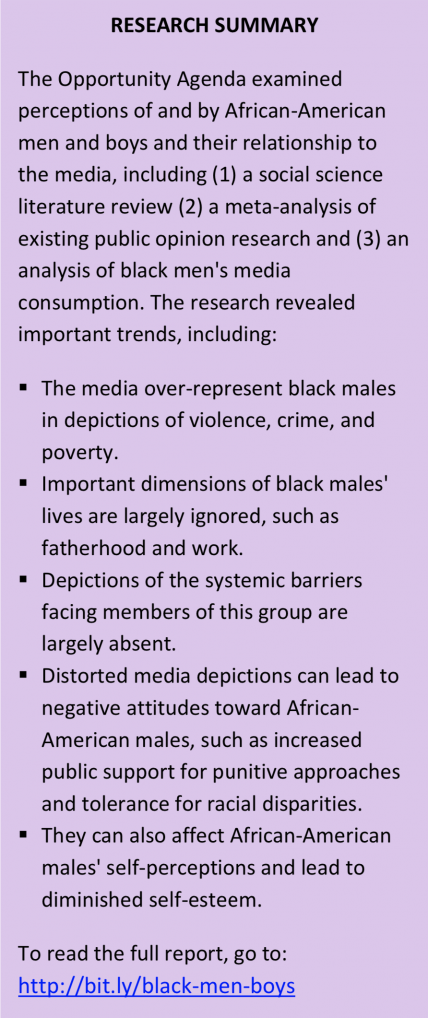
Research by The Opportunity Agenda1 reviewing hundreds of studies over several years found: that news coverage and other media depictions overrepresent Black boys and men in stories of violence, crime, and poverty; underreport important dimensions of Black males’ lives, such as fatherhood and work; and lack coverage of systemic barriers facing members of this group. The research further found that distorted media depictions can lead to negative attitudes toward African-American boys and men, such as increased public support for punitive approaches and tolerance for racial disparities. Subsequent research on depictions of African-American families2 similarly found that news and opinion media significantly overrepresent the association between Black families and criminality while significantly underrepresenting White families’ association with criminality.
Improving the Quality and Accuracy of Coverage
The release of Ava DuVernay’s When They See Us and the 30th anniversary of the Central Park Five case represent a moment for national reflection and coverage, not only on the show and wrongful convictions, but also on the societal and media biases that allowed that tragedy to happen. Based on our research and analysis and best practices from the journalism field, The Opportunity Agenda recommends six ways that news outlets and journalists can more accurately portray Black life and adhere to the media’s fundamental role in informing the public and furthering our democracy.
Acknowledge and Review for Bias. Research shows that we all harbor subconscious or implicit racial and ethnic biases that do not necessarily align with our stated beliefs. Those biases can enter into reporting in the form of stereotyped vocabulary, images, framing, and story choice. Assumptions about people and neighborhoods that are “dangerous,” “violent,” or deserving/undeserving of attention are just a few examples. Reviewing story choices and content for tropes and stereotypes is important to quality reporting. The Perception Institute3 and Harvard’s Project Implicit4 provide two useful starting points for assessing unintentional bias.
Look at the Big Picture. Monitor the amount of coverage, type of coverage, and the nature of the coverage that different communities, topics, and types of sources receive. Who is quoted as an expert? With whom is the reader or viewer supposed to identify? Are African-American individuals and communities featured, and if so in what roles? A quarterly review of stories in the aggregate can reveal and address trends of bias or stereotypes that are not readily apparent when consuming stories one at a time.
Foster Diversity. One of the factors that media scholars see as contributing to distorted and incomplete coverage is the paucity of African-American media owners, producers, journalists and experts invited to contribute content. Encouraging diversity and inclusivity at every stage of the media content process will make it far more likely that varied experiences and fresh perspectives are incorporated.
Cover Obstacles as Well as Outcomes. Research shows that stories about the unique and disparate obstacles facing African-Americans are few and far between—giving many news consumers the impression that these individuals simply lack the drive, honesty, or talent of their white counterparts. Provide audiences with the information and context to make informed decisions about causes and solutions. And before reporting on unequal outcomes in criminal justice, for example, consider explaining the documented inequities in policing, prosecution, and sentencing, and opportunities to re-enter society that African Americans frequently face.
Capture the Missing Stories. In addition to stories about systemic obstacles and solutions, media analysts find a paucity of stories featuring African-American boys and men who are workers, problem solvers, innovators, or even users of technology. Those underreported stories can break through the clutter while avoiding the stereotypes found in a large volume of past reporting.
Be Responsive and Accountable. In-person engagement and digital input from diverse communities are crucial to finding and telling fresh, accurate stories that reflect a diversity of lived realities. They are also critical reality checks on tired tropes or inaccurate storylines. Soliciting and listening to community and audience input is another crucial tool for full and accurate journalism.
Conclusion
As When They See Us makes clear, improving the quality of media coverage of Black men and boys is critical because the stakes are so high. Distorted media coverage and portrayals contribute to the perception that Black men and boys should be viewed as threats and burdens instead of valued and participating members of our society. Those perceptions play out in our justice systems, in employment, in education, and in other contexts that are crucial to opportunity, health, and happiness.
Through full and accurate reporting, journalists can counter these trends and be part of the solution. Just as individual stories must be fair and accurate, we hope that patterns of distorted reporting will trigger changes in story assignment, reporting, and editing practices.
This memo provides tips and resources to people advocating for fuller and more accurate reporting on African-American boys, men, and families, and reducing bias and stereotyping in media coverage. It accompanies the release of the film When They See Us and marks 30 years since the Central Park Five case. The film and 30-year anniversary present important opportunities to advocate for improvements in reporting and mass communications, as well as equal justice.
The Central Park Five case involved the assault and rape of a White female jogger and the wrongful arrest and conviction of four African-American and one Latinx teenagers—Kevin Richardson, Antron McCray, Yusef Salaam, Kharey Wise, and Raymond Santana. The young men spent between six and 13 years in prison before being exonerated in 2002 when another man confessed to the crime.
Created by Ava DuVernay for Netflix, When They See Us depicts the story of the Central Park Five and highlights how biased media coverage and harmful stereotypes contributed to the young men’s arrest, public vilification, and unjust incarceration.
What’s at Stake?
As the film When They See Us makes clear, improving media portrayals and coverage of Black boys, men, and families is critical because the stakes are so high. Media coverage powerfully shapes the ability of individuals and communities to receive fair and equal justice. Politicians, prosecutors, police, juries, and everyday people are influenced not only by the facts reported in stories, but also by the images, labels, framing, and narratives that those stories convey.
A large body of research (discussed later in this memo) finds a persistent trend of distorted media depictions of Black men and boys that contributes to negative stereotypes, inequitable treatment, and unequal opportunity in areas ranging from employment, to education, to policing and sentencing.
Help Improve Media Coverage
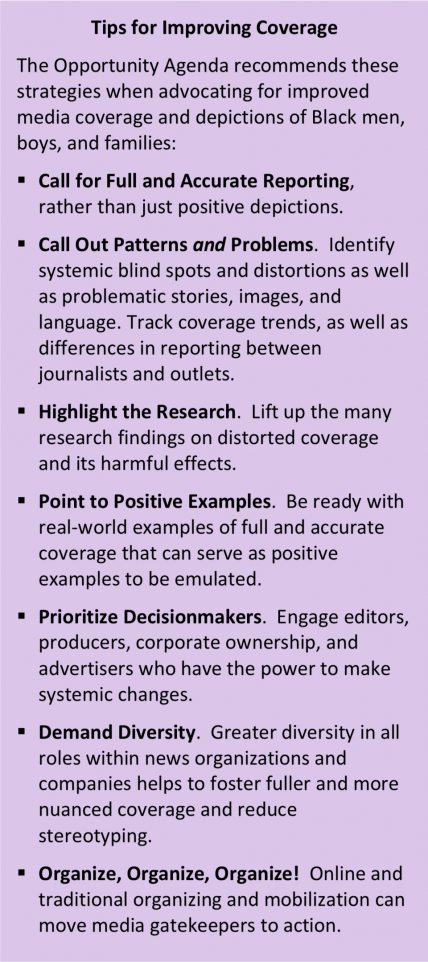
There is much that we can do together to improve media coverage of African-American boys and men, as well as of other communities that are often marginalized or caricatured in media coverage. Here are six tips for making a difference:
Call for Full and Accurate Reporting. Most journalists are wary of demands for positive or negative coverage, which they see as conflicting with their proper role. But most aspire to report on stories fairly, accurately, and without bias. Most news outlets, moreover, seek to report fully on the issues, communities, and people whom they cover, especially across multiple stories.In pushing for improved reporting, focus on a standard of full and accurate reporting. For example, the American Society of News Editors Statement of Principles states that “[g]ood faith with the reader is the foundation of good journalism. Every effort must be made to assure that the news content is accurate, free from bias and in context, and that all sides are presented fairly.” Remind editors and producers that demands for fair presentation, elimination of bias, accuracy and context are, in fact, demands that they live up to their own articulated values.
Monitor and Discuss Coverage Over Time. Identify systemic blind spots and distortions as well as problematic stories, images, and language. While individual problem stories should be called out, patterns of bias or distortion are easiest to see when looking at multiple stories over time. Repetition of tropes and stereotypes also causes the greatest harm. Review multiple stories with an eye toward trends like over-association with violence, descriptions of neighborhoods and communities, and the context that is or is not provided. Get specific about different outlets and journalists, noting differences in their reporting.
Highlight the Research. Many media gatekeepers are still unaware of the large body of research on media coverage trends. In advocating for improved local coverage, combine your own specific observations with the many research findings on distorted coverage and its harmful effects. A number of organizations regularly produce or commission research on media depictions and other industry metrics, including The Opportunity Agenda; the American Society of News Editors; the Shorenstein Center on Media, Politics and Public Policy; and the Columbia Journalism Review.
Point to Positive Examples. Be ready with real-world examples of full and accurate coverage that can serve as positive examples to be emulated. In addition to pointing out distortions and problematic trends, it’s important to identify and—where appropriate—to praise exemplary coverage and best practices. Many outlets track positive and negative social media comments, and all take note of direct audience feedback. In addition, providing positive examples from their peer institutions can both provide practical guidance and spark friendly competition from other outlets.
Prioritize Decisionmakers. Engage editors, producers, corporate ownership, and advertisers who have the power to make systemic changes. While news ombudspersons and community liaisons can be a good starting point, it’s frequently necessary to demand meetings and action from more powerful decisionmakers and gatekeepers. The successful campaigns to oust biased media figures like Bill O’Reilly and Lou Dobbs by targeting their advertisers show that mass campaigns to demand fair reporting can be successful.
Demand Diversity. Greater diversity in all roles within news organizations and companies helps to foster fuller and more nuanced coverage and reduce stereotyping. Five decades ago, the Kerner Commission, appointed by President Lyndon B. Johnson to examine the cause of racial strife in America’s cities, concluded that the lack of diversity in newsrooms was partly responsible for the pernicious stereotypes, neglect, and discrimination that led to the era’s urban uprisings: the Commission declared that “the journalistic profession has been shockingly backward in seeking out, hiring, and promoting Negroes.” It added that “the press has too long basked in a white world looking out of it, if at all, with white men’s eyes and white perspective. That is no longer good enough. The painful process of readjustment that is required of the American news media must begin now.”1 Yet, in 2017, for example, only 16.6% of journalists at daily newspapers were people of color, whereas the U.S. population was more than 37% non-white. Representation in broadcast media is similarly abysmal, and diversity of media ownership is still worse.
Pressing for greater diversity throughout the industry, though a tough and lengthy slog, is crucial to long-term improvement of coverage. One step is demanding that media organization make public the (anonymous) demographic breakdowns of staff and leadership that most are already required to collect under federal law. Transparency and accountability regarding proactive diversity efforts are crucial, as is advocating greater attention to this issue by the Federal Communications Commission, which regulates the industry.
Sample Messages to Media Decisionmakers
In order to deliver a consistent, well-framed message, we recommend structuring opening messages in terms of Value, Problem, Solution, Action. In particular, leading with shared values instead of dry facts or hot rhetoric helps start a conversation and provides a foundation to transition into more complex messages.
Value
Principles of accuracy, impartiality, and fair play are critical. They are also core to the journalism profession. The American Society of News Editors’ Statement of Principles, for example, requires that “[e]very effort must be made to assure that the news content is accurate, free from bias and in context, and that all sides are presented fairly.”
Problem
But a decade of research2 shows that too many news organizations are falling short of that standard when it comes to coverage of African-American men and boys. Trends include over-representing Black males in stories about crime, violence, and poverty— far beyond their actual association with those problems—and under-representation in their roles as fathers, workers, and problem solvers. Those patterns paint a picture of Black males that is inaccurate, biased, and harmful, contributing to racial stereotypes, discrimination, and other barriers.
Solution
Journalists and editors must strive for greater intentionality, accuracy and authenticity in how they are depicting the people featured in their coverage. They should provide information not only on the stories of individuals, but also on the systems that these individuals have – or don’t have – access to. Just as individual stories must be fair and accurate, patterns of distorted reporting must trigger changes in story assignment, reporting, and editing practices. Greater in-depth reporting on systemic obstacles, prevention, and success stories are notably missing and important.
Action
Contact journalists and editorial boards and push them to learn more about how media portrayals impact Black male outcomes. Tell them that they should work to provide unbiased representation of the stories they cover. Watch When They See Us and have a dialogue about how the media portrayals then, and now, are impacting perceptions of Black men and boys such as the Central Park 5.
…
Value
Our country’s population is becoming increasingly diverse. If broadcasters want to compete for audiences in a more diverse America, their programming has to both reflect and respect our nation’s diverse communities; their hopes, aspirations, struggles, and experiences.
Problem
After studying programming over many months, we’re not seeing adequately representative depictions of African-American men and boys. Black male characters can tend to be more often depicted engaging in anti-social, dysfunctional, and violent behavior than other groups, and more so than in reality as well. That’s irresponsible and harmful, and it’s also bad business for any network struggling to build an audience in the 21st century.
Solution
Balance and fairness are critical in representation of all people, most primarily in how people of color, particularly Black men and boys, are depicted. Show the spectrum and fullness of the lives of Black males, just as is done with White characters.
Action
Call on networks to update Broadcast Standards and Practices systems to periodically review, identify, and avoid harmful stereotypes and one-dimensional portrayals as themes in programming.
The Research and the Central Park Five
Stereotypes and popular myths. Distorted media coverage and portrayals have contributed to the perception that Black men and boys should be viewed as threats and sources of violence. Our research shows that Black men and boys are more likely to be depicted as threatening, and news outlets are more likely to depict Black men and boys as committing crimes when compared to their arrest rates. These media stories contribute the myth of Black criminality contrary to what research shows.

For example, in 1989, the defendants in the Central Park 5 case were routinely labeled “a wolf pack” and worse. Donald Trump took out newspaper ads calling for restoration of the death penalty. And then-mayor Ed Koch routinely referred to the young men as “monsters.” The media picked up these examples, and others, countless times.
Systemic bias in the criminal system. As noted in our report on the topic, the “media world can be mistaken for the real world.”3 Distorted media coverage contributes to systemic bias. For example, when members of the public serve on juries, where they are expected to make objective judgments about the quality of evidence, media stories about Black men and boys as threatening criminals inform their perceptions of Black men and boys who are accused of crime, even when there is evidence of injustice in their prosecutions. Media stories shape popular perception and contribute to implicit biases that suggest that White people are more likely to be innocent victims and Black people are more likely to be guilty of crimes. These perceptions help to explain the persistent racial disparities in all areas of the criminal system, including unjust policing, overzealous prosecution, and harsh sentencing practices.
Justifying inequality. Unfair media coverage may be used as an excuse for systemic inequality in our criminal justice system. Some commentators may claim that racial disparities are justified and are a natural consequence because they believe that Black men and boys are inherently more criminal. The racial disparities appear inevitable and a likely consequence of inferiority—rather than the result of historic inequality in this country— because biased media coverage is consistent with ensuing and persistent racial bias.
This justification was especially pronounced in the coverage of the Central Park 5 case, such as in Pete Hamill’s April 23, 1989 piece in the NY Post, which painted a menacing backdrop that would color the coverage of the defendants, and the case, to come:
They were coming downtown from a world of crack, welfare, guns, knives, indifference and ignorance. They were coming from a land with no fathers … They were coming from the anarchic province of the poor.
Conclusion
As When They See Us makes clear, improving the quality of media coverage of Black men and boys is critical because the stakes are so high. Distorted media coverage and portrayals contribute to the perception that Black men and boys should be viewed as threats and burdens instead of valued and participating members of our society. Those perceptions play out in our justice systems, in employment, in education, and in other contexts that are crucial to opportunity, health, and happiness.
Through full and accurate reporting, journalists can counter these trends and be part of the solution. Just as individual stories must be fair and accurate, we hope that patterns of distorted reporting will trigger changes in story assignment, reporting, and editing practices.