Taking Action & Responding to the Attacks on Honest and Inclusive Education

In Brown v. Board of Education, the United States Supreme Court recognized the strong importance of education in the formation of a civic society:

[Education] is the very foundation of good citizenship. Today it is a principal instrument in awakening the child to cultural values, in preparing him for later professional training, and in helping him to adjust normally to his environment. In these days, it is doubtful that any child may reasonably be expected to succeed in life if he is denied the opportunity of an education.

With this statement, the Court foreshadowed some of the strongest arguments for an education that provides an honest accounting of our past, including past injustices. Learning about racism and the triumphs of civil rights activists instills in students the cultural values of freedom, justice, and progress. Learning about racial differences also prepares students for the professional world, where they will encounter and work with people of diverse backgrounds. Perhaps most importantly, learning about racial differences, racism, and historical events prepares students to engage in political and civic life with a deeper understanding of themselves and those around them.

The current attempts to prevent the discussion and examination of our history and the legacy of racial inequality threaten the values named by the Brown court, weakening students’ abilities to succeed professionally and engage politically and civically. This tool provides guidance for responding to the attacks on critical race theory and for building a narrative that advances an honest and inclusive education.

Building a Narrative to Support Honest, Inclusive, and Diverse Education

There are several key points to keep in mind when advocating for an inclusive and honest education:

1. Define what critical race theory is. Many people, including progressives, are hesitant to use the term critical race theory. They worry that conservatives have made it too divisive. However, preliminary research shows that more Americans support critical race theory than oppose it, and that many are simply undecided about it. Research also suggests that when some audiences are told that it is a tool for analyzing and understanding racism, they are more likely to support it. Conservatives have been defining their attacks on honest and inclusive education by focusing on critical race theory, and progressives should respond to these attacks directly.

2. Emphasize the need for education to go further. One of the strengths of this country is its diversity, and today’s schoolchildren will be adults in an increasingly diverse society. Teaching students about diverse perspectives will help them grow into engaged, informed, and empathetic adults. The education system should be doing more to prepare students for this future and to inform them about the lingering effects of racial inequality in this country, so they can address these harms. Rather than respond to attacks on critical race theory by stating that it’s not taught in K-12 schools (which is true), build a narrative for why it and other tools for providing race conscious education should be adopted in all our schools.

3. Appeal to shared values. Research shows that people are more open to different, unfamiliar arguments when these arguments are framed by common values. In fact, appealing to values and beliefs is often more effective than statistics in combatting misinformation.[1] When crafting ways to respond to politicians trying to politicize education, you will need to interrogate the intentions and values that lie behind the myths being spread about CRT and anti-racism education in classrooms. In this memo, we have identified several fundamental American values that are shared by most people across the political spectrum and that are served by teaching CRT and systemic racism in schools.

4. Don’t “myth-bust.” Research shows that myth-busting, or restating a claim just to “debunk” it or explain why it is not true, is ineffective in persuading people to change their minds about a topic. In fact, stating a false fact actually encourages people to misremember the false statement as fact—even days later and if they were repeatedly told the statement was false.[2] So, instead of myth-busting, just affirmatively state the truth. Affirmative statements will always be more powerful and memorable than defensive statements. When you engage in conversation with an opponent of CRT, you may feel like you are fighting an uphill battle, so you should use you best weapon: truthful affirmative statements.

5. Explain how learning about our past leads to progress. An honest and inclusive education will help students learn from our past mistakes as a country, so we can build a better future. While we have come far, we have further to go in order to reach our ideals as a country.

6. Use storytelling. Storytelling is an effective tool for persuasion and as a means of confronting racism and the status quo. “Counterstories,” or the stories of people from groups that have historically been marginalized, can be used to effectively challenge perceptions.[3] Effective, powerful counterstories do the following:

  • Use narrative — everyone loves a good, engaging story!
  • Encourage the listener to see things from the storyteller’s point of view. The listener should be pushed, by the end of the story, to compare their beliefs and their reality to the experiences of the storyteller or the counterstory’s characters.
  • Challenge mindsets, not individuals.
  • Use generalizations and exaggerations to highlight key points.[4]

7. Don’t make parents and teachers who oppose critical race theory into villains. Instead, emphasize how politicians are sowing divisions in our communities. Politicians and outside actors initiated the advocacy against an honest and inclusive education and spread misinformation to parents and community members. They should be the focus of communications on this issue.

8. Use VPSA when communicating about this issue. VPSA is a communications structure – Value, Problem, Solution, Action – that guides the creation of values-based messages that motivate audiences to action.

Leading with VALUES creates broad points of agreement and shared goals that will resonate with nearly any audience. Being explicit about the PROBLEM, and how it threatens shared values, creates a sense of urgency and connects individual stories to broader systems and dynamics. Offering a SOLUTION gives audiences a sense of hope and motivation. The best solutions are connected directly to the problem offered and make clear where the responsibility for change lies. Assigning an ACTION gives the audience a concrete next step that they can picture themselves doing and creates a feeling of agency.

Sample VPSA Messages

Sample Message 1

Value: America was founded on the principle that all people are created equal. As Americans, it is important that fairness and equality are viewed as a central part of the American experience for everyone, and this includes the American legal system.

Problem: In order to uphold one of the founding principles in America, the legal system should be expected to deliver fair and equal results to all people. Decisions within the American legal system, from prosecutorial discretion to sentencing, have racial disparities. These racial disparities create additional divisiveness within the country.

Solution: Schools should embrace a curriculum that acknowledges that we have fallen short but remain committed to making racial progress.

Action: Share your views at events as small as school board meetings, to local or city council meetings, to calling state and federal officials and representatives, to voting in local, state, and federal elections. Make it known that you support equality and fairness in America.

Sample Message 2

Value: American society thrives when we acknowledge and grow from the challenges and conflicts of past generations.

Problem: Unfortunately, many states and school districts have been pushed to ban discussion on certain aspects of our shared history in schools. Topics of slavery, the civil rights movement, and the women’s rights movement are under attack.

Solution: Learning, accepting, and growing from our shared history is important in ensuring we do not repeat the mistakes of our past, and can work to remedy issues in our current era. These efforts to ban discussion in schools are un-American and must be stopped.

Action: You can be a part of protecting our history and preserving the ability of students to learn from it in its entirety, with both the good and the bad. Speak up against disinformation in your community, engage in your local school board meetings, and push back against efforts to muzzle our teachers.

Sample Message 3

Value: America is built on two major values—freedom and liberty. The respect and protection of the fundamental civil rights of all American citizens are core to our values and beliefs as a country. The protection of every American citizen’s right to be free from discrimination allows all Americans to preserve their freedom and liberty; these are two tenets that serve as the foundation of American ideals. Furthermore, in pursuit of freedom, American citizens are also guaranteed a right to free speech and the right to petition the government to address their grievances.

Problem: However, this freedom is at risk when topics and events that actually occurred are prevented from being taught in the classroom. This freedom is further jeopardized for students of color who must weigh the benefits and risks of participating in the classroom. When we have members of society who feel like their voices are not as important, then our entire democracy is at risk.

Solution: Race conscious education provides the language to allow all Americans to be able to speak about issues of race, providing a common foundation for the preservation of the right to free speech. It also provides students of color with the opportunity to “challeng[e] the status quo of racial inequality that has persisted for far too long in this nation…” [5]

Action: Reach out to local decision makers and inform them of the importance of CRT to students’ civil rights. If your state legislature, city council, or local school board are considering a ban on race conscious education, consider making a call, sending an email or letter to your representative describing your support for inclusive and diverse education. Attend school board or city council meetings and speak on the topic directly. Encourage friends, family, and members of the community to do the same. Communicating support—especially in large numbers—for the positive implications of honest and inclusive education for civil rights can help key decision makers understand what is at stake.


Special thanks to those who contributed to the research, analysis, review, and editing of this report, especially the students in I. India Thusi’s Fall 2021 Critical Race Theory seminar at Indiana University Maurer School of Law: Abby Akrong, Ethan Dawson, Erin Deckard, Rebeca Dorantes, Mary Kate Dugan, Lydia Elmer, Erica Fields, Kat Grant, Zoe Kolender, Emily McConville, Celia Meredith, Zoe Morgan, Kelsey Napier, Gabriel Retz, Maddie Satterly, Lainey Sezer, Hadley Smithhisler, Luke Steffe.


[1] Simon Oxxenham, When Evidence Backfires, Big Think (Apr. 15, 2014), https://bigthink.com/articles/when-evidence-backfires/.

[2] ‘See e.g., Ian Skurnik, Carolyn Yoon, Denise C. Park & Norbert Schwarz, How Warnings About False Claims Become Recommendations, 31 J. Consumer Rsch. 713, 718 (2005).

[3] Richard Delgado, Storytelling for Oppositionists and Others, in Critical race theory, supra note 8, at 71–72.

[4] Id. at 79

[5] Janel George, A Lesson On Critical Race Theory, ABA (January 11, 2021), https://www.americanbar.org/groups/crsj/publications/human_rights_magazine_home/civil-rights-reimagining-policing/a-lesson-on-critical-race-theory/.

What Now?! Talking About the Supreme Court

How to Talk About the Leak & the Purported SCOTUS Decision to Overturn Roe v. Wade

As you have no doubt heard by now, a draft opinion that would overturn Roe v. Wade and roll back the Constitutional precedent that guarantees a woman’s right to choose has been leaked to the media. Upon initial analysis, if this draft becomes the official majority opinion, it could have alarming impacts well beyond abortion rights.

We must use this moment to pronounce a vision of what full rights look like for all of us, for our children, and for generations to come, while at the same time repudiating this leaked decision. We must uplift the need to protect hard-fought, historic gains in promoting and preserving opportunity, and we must remain both vigilant and strategic in pushing back against legal decisions and legislative policies that undermine these gains.

The Opportunity Agenda believes that this starts with stories, with what we say, and how we say it.

Some Quick, General Tips

1. Remember that this is NOT the SCOTUS decision. It is a draft document – what could be a preview of what a Supreme Court decision might look like.

The draft opinion has no legal effect right now. Women’s, family planning, and abortion clinics are still operating. Don’t spend time discussing this as settled law, because it isn’t and may confuse people who are still struggling to access reproductive care in their communities.

Avoid communicating as though what’s done is done, because it isn’t.

2. If this becomes the Court’s final decision, its impact could extend far beyond the right to access abortions.

The language in the draft opinion suggests that it would pave the way for eliminating a range of rights that most Americans have come to take for granted. It suggests that only those rights from the time of this country’s founding should be protected, thus opening the door for states to criminalize access to contraception, interracial relationships, same-sex marriage and sexual relationships, and parents’ right to educate their children as they see fit. The opinion might even open the door to question the continued relevance of cases like Brown v. Board Education, which held that legalized racial segregation was unconstitutional.

Communicate the potential reach of this draft opinion and its profound consequences, should it be handed down.

3. Pivot to solutions and action.

Despite the anxiety generated by this draft opinion, remember to pivot to solutions. Now is the time to recognize the power of voices coming together. Encourage audiences to take action, whether that’s demanding passage of the Women’s Health Protection Act or the Equal Rights Amendment, demonstrating outside the Supreme Court or at state courts and capitol buildings, or taking to the streets and the voting booth in order to convey and protect our values.

There is much we can do in this moment, and we have a duty to do it right now.

4. Uplift these values

Pragmatism, Common Sense, Innovation, Determination to Do The Right Thing, Shared Responsibility to Fix Flawed Policies, Solidarity, Full Inclusion.


P.S. Click here or here or to find a list of local and state-wide abortion access organizations to support, and here for resources and tools to take action on abortion access as well as an “Adopt-A-Clinic” Program.

Criminal Justice Reform Phrase Guide

Five Tips for Language That Changes Hearts & Minds

Momentum has grown for policymakers to improve the criminal system and adopt strategies that keep all communities safe; prevent harm; and uphold the values of fairness, equal justice, respect, and accountability. But we know that current conversations often perpetuate misconceptions, reinforce stereotypes, and hamper improvement of the system.

This tool includes tips to promote a more equitable and more accurate discourse that is respectful and effective at addressing the harms of the system.

Whether you are a public defender, legislator, community organizer, judge, professor, or communicator, adopting harmful language can impact the discourse and policies that affect people and communities.

Our words matter. The goal of this document is to provide suggestions for effective and appropriate language to move the needle toward transformation. The Opportunity Agenda welcomes your experiences, reactions, ideas, and insights.

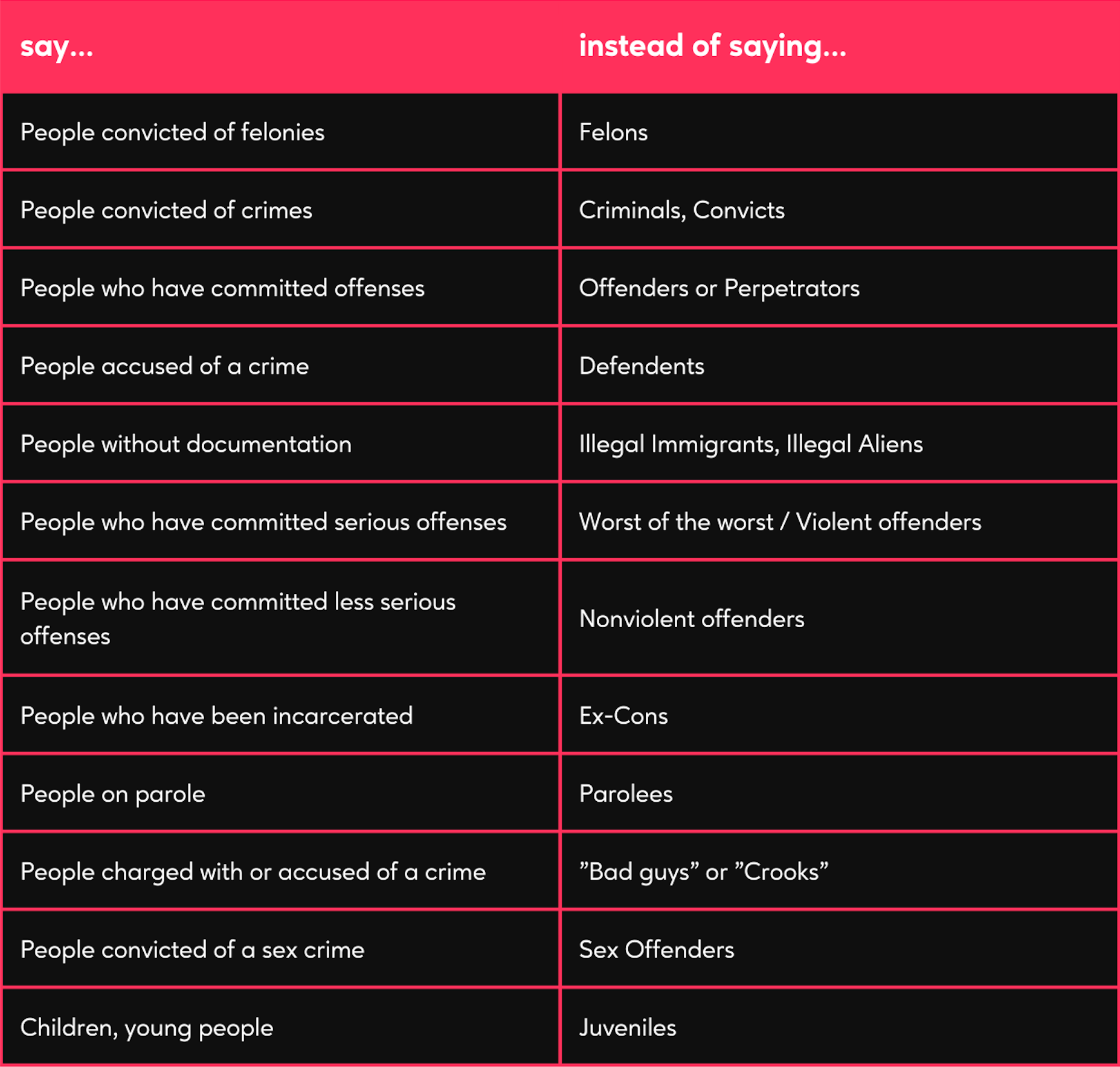
1. People, Not Labels

The traditional language of the criminal justice system is often dehumanizing and fosters stigma, stereotypes, and fear. Instead of labels, talk about the people touched by the system; they are members of our community and nation.

For all of the above, depending on how specific the description needs to be, say: People who have been caught up in the criminal justice system.


2. Connect the Harm to Systemic Solutions

Conversations about the criminal system often respond to individual examples, which the media frequently sensationalizes. These accounts contribute to a public culture of fear about crime, and often feature individualized responses rather than systemic reform. To promote a new narrative about what community safety looks like, try to reframe the conversation and remind people that reforming the system is a path toward true community safety. We don’t need to rely on punishment and harshness to keep everyone safe.

When they say: we need more police and criminal laws.

YOU SAY: We need real community safety. That happens when we provide the resources communities need to thrive, particularly those who are suffering from a lack of investment.

When they say: violent crime is skyrocketing.

YOU SAY: Working toward real community safety will always be our priority. We know that most harms happen between people who know each other or who are family and are experiencing stressors. We encourage investment in programs that alleviate the financial and emotional burdens of the moment.

When they say: We need to return to more law and order.

YOU SAY: Safe communities mean that personal security and equal justice co-exist. We are safer when we invest in social welfare programs and community-based anti-violence programs.

When they say: X person committed this violent crime, so criminal justice reform policies should be abandoned.

YOU SAY: We have to be smart about the way we approach something as important as community safety. It makes no sense to throw out carefully considered policies that have helped so many communities based on one instance. If ever there were a time to dig deep for solutions, that time is now.

We are all safer when we look at the system as a whole; when we support people as they reenter their communities; and when we adopt policies that keep people within their social support network. We should examine criminal policies by looking at their effects on the whole system. We should not allow politicians to sensationalize individual instances to promote policies that do more damage than good.

When they say: Calls to defund policing will result in chaos.

YOU SAY: We should welcome any calls to examine a system that is causing people harm. When we take a closer look at how police interact with communities and how we can better approach community safety and prevent harm, we get closer to true community safety – our shared goal.

We can help communities become even safer by investing in programs and policies that allow them to hold individuals accountable for harm while providing alternatives to incarceration.

When they say: We need to punish people for their crimes.

YOU SAY: We know there are many ways to hold people accountable without relying on outdated or dehumanizing forms of punishment. For example, restorative justice programs have proven to provide a process of accountability while allowing people affected by harm to fully participate in the process.

When they say: Our cities will become dangerous if we don’t punish violent offenders.

YOU SAY: We can best keep our cities safe by increasing our investments in education, housing, food, access to recreation and other programs that allow people to thrive.

When they say: We need police to protect us from criminals.

YOU SAY: Whatever our perspective, our shared goals should be community safety and harm prevention. As the deaths of George Floyd and Breonna Taylor show us, we need to rethink our approach to preventing harm because police violence also makes communities unsafe. We can do this by looking at effective programs that have managed to prevent harm and support communities without relying on police.

3. Obstacles Before Outcomes

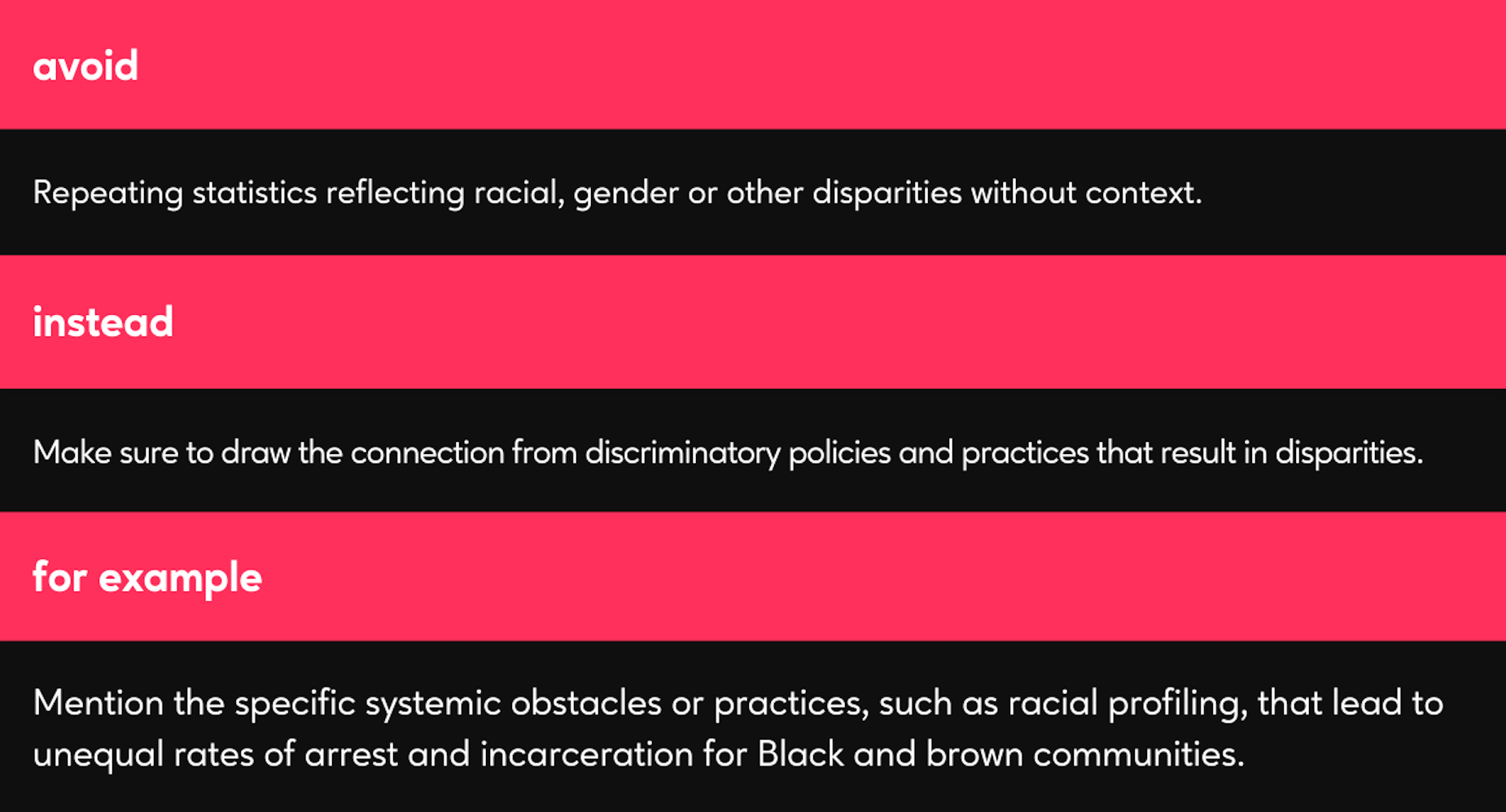
Instead of jumping straight to unequal outcomes, take the time to explain the unfair systems and inequitable treatments that lead to those outcomes. Otherwise, many audiences will inaccurately assume that unequal outcomes happen because some groups are simply more prone to crime.

Black man waves Black Lives Matter flag set against pink-blue gradient.
Photo by Clay Banks

4. Break Stereotypes

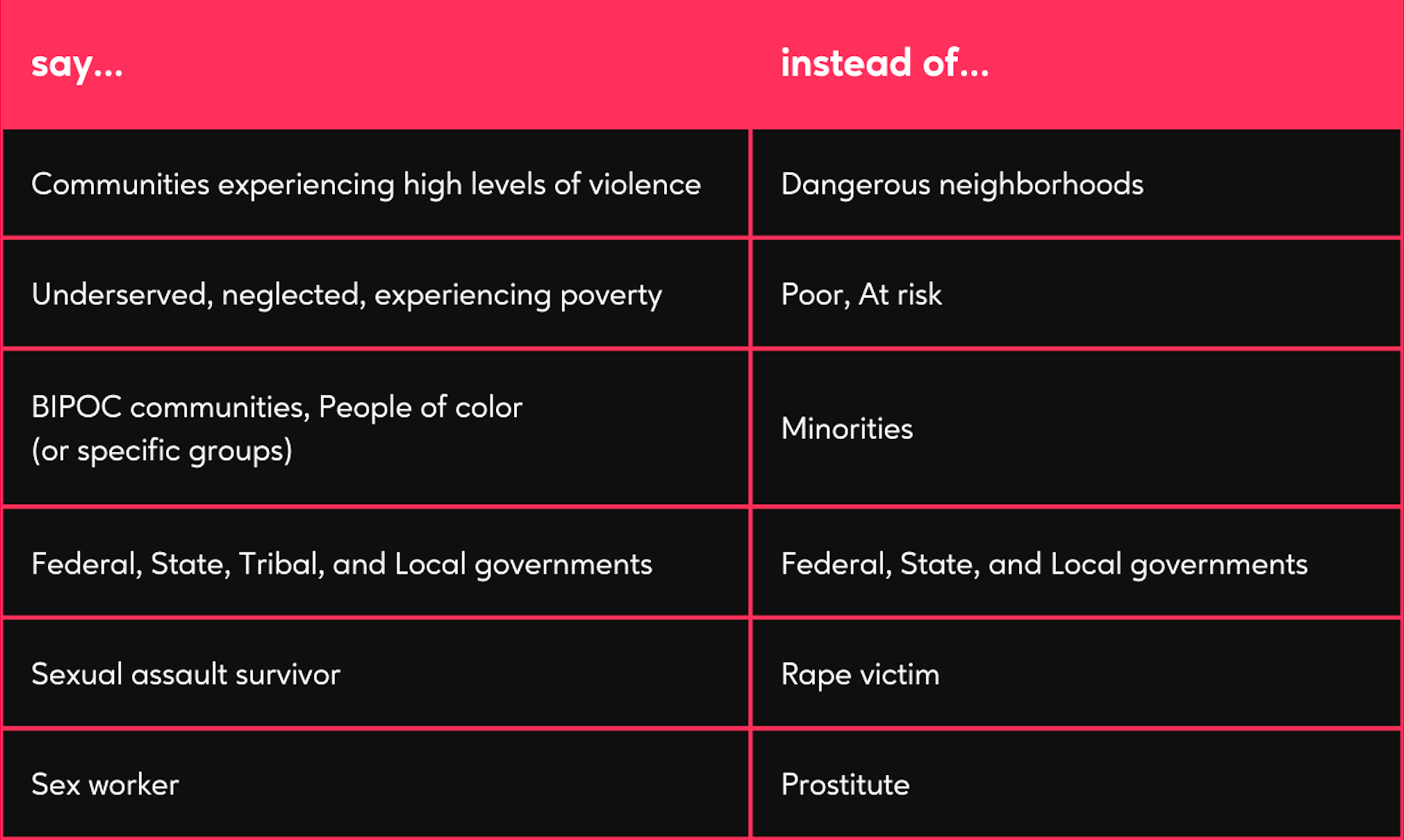
Antiquated language about communities and crime tends to perpetuate harmful stereotypes and drive flawed and misdirected policy. Use language that respects communities and acknowledges the disinvestment in neighborhoods and groups that contributes to higher levels of crime and violence.


5. Avoid Unnecessary and Harmful Distinctions

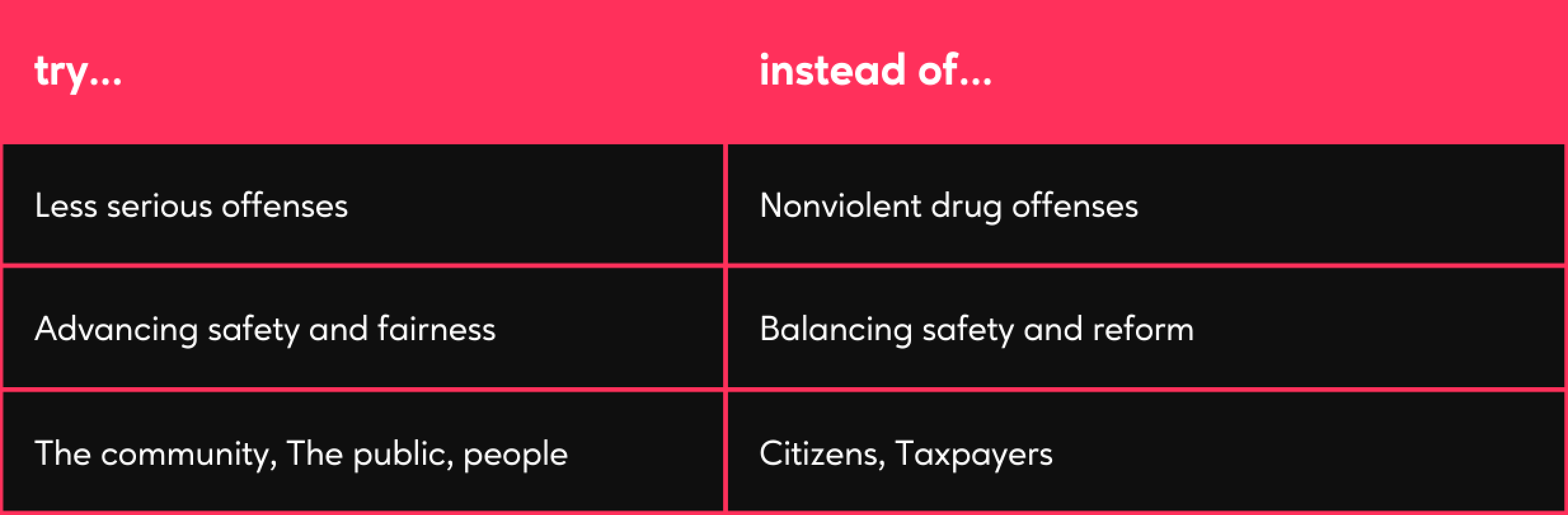
Public opinion research shows that most Americans support reforming the justice system and do not automatically distinguish between violent and nonviolent crimes or drug and other offenses. Avoid making those distinctions unnecessarily; these lines of demarcation can reduce support for broad-based reform of the system.


Respect People’s Voice and Choice

This phrase guide provides helpful tips for talking about issues relating to the criminal system. However, there may be instances when you are talking with communities and individuals whose preferences differ from the advice in this guide. That’s okay. Respect people’s choices and voices. Not everyone in a group is the same. Although the language from this guide builds upon organizing, advocacy, and research arguing that humanizing people most impacted by the criminal system is a step toward making the system fairer, some people might have different language preferences in certain instances. The most important thing to recognize is that people impacted by the criminal system are people, and how we talk about them affects the public discourse, narratives, and policies that impact their everyday life.

Values to uplift in your messaging:

  • Preventing Harm
  • Promoting Community Safety
  • Accountability
  • Rehabilitation
  • Dignity
  • Restoration
  • Equal Justice
  • Due Process
  • Doing what works

Additional criminal justice reform communication resources:

Supporting Judge Ketanji Brown Jackson’s Historic Nomination

President Biden made history by nominating Judge Ketanji Brown Jackson to serve as Associate Justice of the U.S. Supreme Court and people have shared their enthusiastic support across the nation. Nevertheless, Judge Jackson has been subjected to hostile and disrespectful questioning from senators, which reflects how the standards of civility shift when a Black woman is in question. Given these attacks, we must continue to do the hard work of contextualizing this moment concerning what it means for the future of our country. We must continue to highlight the significance of this nomination for the aspirations we have toward breaking down systemic barriers that stand in the way of progress.  We need Supreme Court Justices who reflect the integrity and honor that Judge Jackson has shown throughout her career.

The Opportunity Agenda (TOA) strongly encourages communicators, advocates, and anyone concerned with social justice to uplift the importance of this nomination. Below is communications advice for talking about Judge Jackson’s nomination informed by recent opinion research.

Public Opinion

Despite attempts to tarnish Judge Jackson’s reputation, a Gallup poll found that Judge Jackson enjoys the highest support of any Supreme Court nominee since Chief Justice John Roberts, with 58 percent of people in the United States in favor of her confirmation.[1] An NBC National Poll found she had “the highest net support rating of any Supreme Court nominee since 2005.”[2]

This polling is likely due to her extraordinary background and credentials, along with the advocacy of groups like #SheWillRise and others. Through consistent message engagement, advocates can help promote a media and cultural landscape that is favorable to Judge Jackson while also effectively pivoting toward calling out unwarranted attacks when they arise.

Values-Based Messages

Because our research consistently shows that leading with values is an effective approach to communication, we encourage people to adopt a “VPSA” format in drafting their messages about Judge Jackson. We have described VPSA below and provided sample messages that adopt this format.

VPSA

  • Leading with VALUES creates broad points of agreement and shared goals that will resonate with nearly any audience.
  • Being explicit about the PROBLEM, and how it threatens shared values, creates a sense of urgency and connects individual stories to broader systems and dynamics.
  • Offering a SOLUTION gives audiences a sense of hope and motivation. The best solutions are connected directly to the problem offered and make clear where the responsibility for change lies.
  • Assigning an ACTION gives the audience a concrete next step that they can picture themselves doing and creates a feeling of agency.

Sample Actions

TOA encourages people to continue their advocacy for Judge Ketanji Brown Jackson by:

  1. Writing newspaper editorials or blogs that connect Judge Jackson’s nomination to their own shared experience.
  2. Posting on social media to celebrate her background and highlight how she reflects our shared values.
  3. Talking with those close to you about the significance of her nomination and likely confirmation to the Supreme Court.

Sample VPSA Messages

Judge Jackson is Committed to Equal Justice Under Law

The words “Equal Justice Under Law” are engraved into the entrance of the U.S. Supreme Court, and Judge Jackson’s historic nomination illustrates that this country is slowly coming closer to this ideal. Judge Jackson is on track to be the first Black woman to serve on the Supreme Court and has led a life of public service through her work as a judge, public defender, and on the U.S. Sentencing Commission.

Yet, some have tried to question her background because of this public service. As a judge and lawyer, she worked to ensure that everyone she served was treated fairly and equally. She was fair, measured, and consistent in reflecting the value of “Equal Justice Under Law,” but opponents are trying to distort her record.

Consequently, it is important to push for Judge Jackson’s speedy confirmation to the Supreme Court given her commitment to equal justice. We must continue to talk about the importance of her nomination. It is historic not only because Judge Jackson is a Black woman, but because she would help to realize a foundational goal of our highest court—Equal Justice Under Law.

Reach out to your local newspaper to submit a Letter to the Editor about why this nomination is so critical for you and your community

Judge Jackson Reflects the Ambitions of Americans

The American identity is inseparable from the ideal of achieving full opportunity, where everyone has a fair chance to reach their full potential. Judge Brown’s story as a public-school graduate from Miami to a current nominee to the U.S. Supreme Court is an example of a classic American success story. James Truslow Adams described this dream as “that dream of a land…with opportunity for each according to ability or achievement…a dream of social order in which each man and each woman shall be able to attain to the fullest stature of which they are innately capable, and be recognized by others for what they are, regardless of the fortuitous circumstances of birth or position.” Judge Jackson worked hard in the face of extraordinary challenges and has achieved an exemplary stature as a jurist and lawyer committed to public service.

For far too long, access to education, advancement in the legal profession, and countless other hurdles have stood in the way of Black women aspiring to someday join the Supreme Court. Nevertheless, Judge Ketanji Brown Jackson has worked hard to obtain preeminent qualifications that exemplify what is possible when we expand access to opportunity.

By having Ketanji Brown Jackson as a Supreme Court Justice, the high court will be better positioned to more effectively confront those systemic hurdles that stand in the way of true opportunity and equal justice. The court will be hearing cases that might shift our access to opportunity in this country, and Judge Jackson’s background and experiences will only enrich the perspectives on the court.

In order to share your support for Judge Jackson’s speedy confirmation, tweet at your senator about why you support Judge Jackson’s confirmation to the Supreme Court, or post on social media about what this nomination means to you using #ConfirmJackson.

Talking About Justice and Equity Through Sports

Tips for Advocates Seeking Guidance on How to Add to the Conversation

From Colin Kaepernick taking a knee to Simone Biles speaking candidly on the importance of prioritizing mental health, athletes continue to use their power and platforms as cultural influencers to tip the scales towards justice and equity for all.

The power of political and narrative organizing by athletes and grassroots organizers has forced the hand of professional sports leagues and collegiate associations to, in the least, manage a public relations crisis, and at best, look internally to how their structures replicate social inequity. Furthermore, personal acts of resistance by athletes in the public view have forced the nation into conversations about injustice and liberation.

Here are five principles for advocates who don’t follow sports closely but want to engage in these conversations. Together, we can speak with sports fans who share our values but fail to recognize how systemic injustice plagues American institutions. Once we reach that shared understanding, we can move them to support justice reform in both their communities and favorite sports leagues.

1. Lead with shared values of fairness and community and widen the lens towards systemic equity. Sports fans hate cheaters, love underdogs, understand the value of teamwork, and crave stories about people who overcame long odds to find success — the rags to riches story. When viewed through a racial justice lens, however, sports narratives tend to be grounded in assumptions of meritocracy, relying on a familiar (and false) assumption that we social justice communicators regularly tackle about how everyone starts on an equal playing field. There are two important points to remember when you are facing this framing:

  • Be cautious of how the use of sports themes like “equal playing field” create a competitive framework that implies that one person’s win is another person’s loss. This framing can lead to a false sense of scarcity that expanding economic security or educational opportunity in one community threatens access for another. Abundance messaging counters scarcity mindsets. By starting with an abundance frame, it becomes easier for audiences to see how equitable and inclusive health care or investments in public education can contribute to the common good.
  • Shift the conversation from one of individual opportunity to institutional equity. This narrative shift creates space to tackle how accessibility gaps have grown as youth sports transition into costly, club-based programs or how sports scholarships serve to reinforce racial disparities in higher education.

Required listening: “Special: Sports, Racism and The Myth of Meritocracy,” WBUR (June 26, 2020)

2. Know your audience and avoid “inside baseball” talk. The bleachers are one of the rare places where people with a very broad spectrum of political beliefs come together with the shared identity of being loyal fans of their team. Your goal should never be to reach everyone; however, you need to make sure you use language that is approachable to athletes and fans. Once you see that an emerging issue is developing, it essential that you decide on the frame you want to present that would have the greatest impact with your audience.

If your goal is to reach a demographic subset of sports fans and move them into action:

  • What do you know about their current thinking? Look into public opinion research, social media scans, or their own words.
  • What do you want to change about their thinking in order to inspire action?
  • Who do they listen to?

If you’re trying to leverage a moment in sports to speak to wider audiences:

  • What context does the broader audience need in order to understand what is at stake?
  • What details are needed for audiences to understand how the issue connects back to systemic policy solutions?
  • Do your advocacy goals align with those of grassroots, community-based groups or the athletes themselves who are closest to the problem?

In both cases, especially when speaking to sports fans, avoid jargon, which can leave many people out, and instead craft accessible messages that emphasize human-centered language to invite more people into the conversation. We recommend tailoring messages to specific audiences using the Values, Problem, Solutions and Action framework (VPSA).

Extra credit: complete “Vision, Values and Voice: A Communications Toolkit.”

3. Lean into your advocacy expertise and lived experience to add value to the conversation. Similar to cable news, sports programming has shifted strongly towards point, counter-point programs that thrive on spectacle and personality. In this media environment, analysis often focuses on internal or interpersonal dynamics — players’ faults, divisions among athletes, or tension between players and team owners or league commissioners. What is lacking in this analysis is the acknowledgment of how systemic inequality may manifest in player’s lives and their communities.

In the coverage of Simone Biles’ decision to withdraw from the 2020 Tokyo Olympics, commentators connected her honesty about mental health to Naomi Osaka’s decision to withdraw from the French Open. Some on-screen personalities “didn’t know what to make” of how these athletes’ decisions conflicted with the longstanding culture of toughing it out. Others applauded the shift toward athletes feeling empowered to be honest about their mental health, a struggle many of us share. In both contexts, however, discourse largely focused on the athletes themselves — not on athletic institutions — and how they personally react to pressure and stress.

In contrast, fellow Olympic gymnast Dominique Dawes added deeper context to the history and culture of misogyny and sexual abuse that pervaded many gymnasts’ training long before the pressure of high-profile competitions. Obviously, Dawes is uniquely positioned to pen this perspective, but you don’t need to be an expert sports analyst to add value. By leveraging your expertise in racial equity, economic opportunity, or any related issues, you can connect media moments in sports to larger systemic issues that sports pundits may miss in their analysis.

4. Follow Black athletes and journalists on social media to monitor for biased reporting in the news. You should trust your instincts when what’s on the surface (i.e. in the news or on social media) doesn’t resonate with what you know to be true in your own lived experience. Like organizing, being a good ally requires some level of accountability to those closest to the problem. By following influential athletes and sports journalists you can more effectively engage with them when issues arise to help reframe conversations in the broader context, rather than allowing the dominant narrative to dictate the frame.

We don’t need to tell you that how news media functions often reinforces racism, and the same is true in sports media. More than a decade after it happened, NBA basketball point guard Allen Iverson’s viral “talking about practice” rant was revealed to be a sound bite from a larger statement where he also spoke honestly about his pain over the killing of his best friend, a case that went to trial days before this media moment. Rather than view Iverson with empathy and compassion for the deeply painful experience he was navigating, reporting in the moment focused on the drama between Iverson and his coach, reinforcing biased assumptions about his work ethic and commitment to the team.

Russell Westbrook’s NBA career has been marked by highly visible, heated exchanges with fans. Westbrook plays with a level of passion rarely seen, and his intensity on the court resonates with harmful stereotypes historically assigned to Black masculinity in media portrayals. The verbal assaults, sometimes referred to as “playful bantering” by fans, are rooted in racism that views Black athletes as less-than-human, and NBA franchises have acted decisively to issue lifetime bans against fans who verbally and physically assaulted Westbrook.

Looking at these specific incidents, how both athletes’ experiences were initially reported is emblematic of the racially biased ways Black men can be portrayed in the media. Following Black athletes and reporters on social media can help add context when learning more about unfamiliar narrative territory in sports.

5. Use the public commitments of sports leagues and teams as a jumping-off point for larger conversations about representation and justice. Much like our national and local politics, professional and amateur athletics are at a key inflection point in our work towards creating an equitable, inclusive society. While this is a key moment to leverage the power of professional athletes and leagues in our work for justice, it’s also vital that we validate players’ internal, anti-oppression organizing to reform policies and practices within their own leagues.

Scrutiny of professional league’s diversity, equity, and inclusion practices continues to reveal significant disconnects between demographics of athletes and their coaches, team owners and executive leadership. Most professional leagues have a labor union, often referred to as the players association. Tracking the efforts of both these bodies and their player representatives helps add context to disputes between athletes and owners during collective bargaining negotiations. In 2020, the Women’s National Basketball Association (WNBA) Players Association made gains to increase base salaries, bonuses and secure paid family leave. In the international arena, the United States Women’s Soccer Team (USWNT) legal battle for pay equity continues.

Acts of resistance by athletes are also challenging leagues and teams to make public statements and financial commitments to addressing systemic racism. Analysis of Federal Election Commission (FEC) records on political contributions, however, raise questions of whether publicly stated commitments to racial justice or admissions of wrongdoing serve as little more than public relations window dressing.

As advocates, our expertise in both policy reforms and anti-racism cultural change within institutions uniquely positions us to use the public statements of athletic associations as openings for larger conversations about social justice.

As one example, a recent Supreme Court decision regarding financial compensation for college athletes further complicated the National Collegiate Athletic Association (NCAA) reluctance to answer state legislative action that opens the door for amateur athletes to monetize use of their name, image and likeness (NIL). The NCAA has justified its position by arguing that athletes receive a free education. When reframed as yet another example where primarily white coaches and administrators are profiting off the free labor of predominantly Black athletes, the roughly $8 billion collegiate sports industry serves as yet another example of a “plantation economy.”

Required viewing: watch LFG on HBO Max (released June 24, 2021)

CONCLUSION

Since Colin Kaepernick first took a knee in August 2016, hundreds of athletes have joined his protest of police brutality. His actions sparked a significant increase in both social media discourse and news media articles over a 12-month span preceding and following his protest. As we saw again with Simone Biles, cultural influencers hold tremendous power to propel conversations into our national discourse and create space for other high-profile individuals and the public to speak out.

Working directly with cultural influencers, or engaging in the conversations they spark, creates an opportunity to center the voices of people with direct experience of the issues at hand and convert short-term media moments into long-term narrative shifts and lasting policy changes. Given the upside of jumping into the debate, we shouldn’t sit on the sidelines.

Talking About the Attacks on Critical Race Theory

Narrative Principles for Promoting Truth in Education & How to Tell the Story about our Country

Our nation has been forced to reckon with its history of racial oppression, particularly after the tragic and senseless circumstances surrounding the deaths of George Floyd, Breonna Taylor, Ahmed Arbery, and many others.  Millions have protested in the streets, on a global scale, to demand the elimination of racially biased policing and the respect for Black lives. Corporations, school districts, nonprofits, institutions of faith, and others have declared their commitment to recognizing that “Black Lives Matter.”

In the wake of what has been considered by many a national racial reckoning, there has been opposition against efforts to educate the public, including our children in schools, about this country’s legacy of racial inequality. The most prominent of this opposition includes efforts to ban and demonize “critical race theory,” a legal theory that emerged in the 1980s by scholars in legal academic literature. Simply put, critical race theory is a theory about the law that recognizes that racism has been a core feature of American history. As a theory, it is primarily discussed within legal scholarship. However, conservatives have labeled any approach to education that recognizes this nation’s history as “critical race theory,” distorting its definition and concurrently distracting the public from efforts to undermine inclusive participation in our democracy through limits on voting and other aspects of civic participation (e.g., undermining the U.S. Census and efforts to consider racial factors in redistricting), as well as the promotion of false narratives about the so-called, “fairness and accuracy of” the 2020 election.

This memorandum provides recommendations for addressing the attacks on critical race theory and the misinformation being promoted around it. As is the case in the majority of our recommendations, The Opportunity Agenda believes that social justice communicators must tell an affirmative and aspirational story about the importance of education that reflects our diverse racial and ethnic backgrounds, which includes aspects of our history that are tough or challenging to discuss, but nonetheless important to touch on with honesty about our country’s legacy of racial injustice. This advice is informed by our past experience and research on communicating effectively about racial and social justice.

General Advice

1. Acknowledge that most audience don’t know what critical race theory is. Critical race theory was developed by legal scholars in the late 1970s and 1980s, and it examines how the law reproduces racism. While critical race theory includes a diverse array of perspectives, some of its core tenets include (1) an acknowledgement that race is a socially-constructed phenomenon rather than a biological fact; and (2) racism is a core feature that permeates American legal and social structures rather than an aberration. As a legal theory, it is most commonly debated within legal and academic circles, and most audiences are not very familiar with its principles. Nevertheless, critical race theory has become a symbol for conservatives, and this body of legal theory is being redefined through divisive rhetoric. Those who decry critical race theory are particularly concerned about education on our nation’s factual history of colonialism, slavery, and racial segregation. The concern is less about “critical race theory” per se than a truthful retelling of history that acknowledges this country’s shortcomings, or, as some put it, greatest sins.

We advise that communicators briefly explain what critical race theory is (e.g., critical race theory is a legal theory that recognizes that racism has been a core feature of American history, which has shaped American laws and society) but spend most of your time emphasizing the need for a truthful recounting of our history in order for us to get to racial healing. The Opportunity Agenda agrees with the basic reminder that in order to heal, one must first diagnose and discuss the malady.

2. Focus on how the refusal to tell the full truth about our history undermines our shared values. It’s important to find ways to engage on a level that can connect with audiences who are unfamiliar with critical race theory, and a great way to do this is to focus on values. While most audiences are probably unfamiliar with the history and content of critical race theory, they are generally familiar with our country’s legacy of slavery and racial inequality. They know that slavery existed and that there was a reconstruction, and a continuing Civil Rights Movement that began by contesting Jim Crow laws. Most Americans know that these events occurred.

Remind audiences that banning education about our racial history, which these bans on “critical race theory” seek to do, undermine our efforts to promote shared values like equal justice, honesty, opportunity, and basic compassion. For example, remind people of the kind of country we want to be and draw on how our best ideals mean that we be truthful about our past. We have come a long way, and we can only continue to move forward by confronting our past shortcomings. Discuss how these attacks undermine these shared values and others including: Free Speech, Education, Fairness, and Opportunity.

3. Tell an affirmative story about the importance of inclusive education that allows us to confront our history as a nation. Explaining the details of how K-12 schools don’t teach “critical race theory” is not as powerful as affirmatively stating what type of education we should be striving for and what our opponents are really trying to do: eliminate a truthful recounting of history, which is necessary for us to finally overcome our country’s legacy of racial inequity. Remember that engaging the opposition arguments and myth busting on critical race theory also serves to feed into the conversation that opponents have started and are shaping. Talk about our goals instead: we should aim for an education system that is inclusive, reflects diverse perspectives, and facilitates an equitable future. Spending too much time “myth busting” or telling audiences that schools don’t teach critical race theory, only repeats the phrase and strengthens it in audiences’ minds.

4. Connect the attacks on critical race theory to the attacks on racial and social justice more broadly. Right now, there is a coordinated effort to undermine this country’s democracy as conservatives launch a cultural war on critical race theory, among other imagined “woke” threats. These provide a useful distraction from the current unprecedented threat to democracy. Racial and social justice advocates should connect the attacks on critical race theory to the attacks on participation in our democracy and on how they amount to attempts to concentrate power in voting blocks that are white while limiting the power of new citizens or people of color. They are attempts to undermine social justice and progress, and they share a collective goal to uproot democracy. The cultural attacks on “critical race theory” are a distraction from the social and political attacks on our democracy. Be explicit about this.

5. Discuss the importance of the values of Honesty, Truth, and Free Speech. As the population of children in this country becomes increasingly diverse, efforts to ban a full and truthful accounting of our country’s history ensures that children will not learn about their peoples’ own histories. Efforts to equip children to thrive in a diverse society will be undermined if these bans persist. Attempts to ban racially inclusive education also violate the free speech rights of educators who want to talk about the truth; they encourage a dishonest accounting of our nation’s history; and they promote disinformation and dishonesty. We can’t work together if we can’t even be honest about where we’ve been. We must ensure that the history that is taught celebrates ethnic diversity and acknowledges that slavery was a part of this country’s legacy so we can learn from the past rather than hide from it.

6. Pivot to solutions and action. The early reporting on this issue was lackluster to the extent that it reflects a lack of knowledge about critical race theory and general confusion about how to respond to the attacks. There has been little focus on the solutions for this issue or the path forward.  It is therefore important to discuss the constitutional values that are threatened by these attacks (Free Speech and First Amendment protections) and how they are inconsistent with our Constitution and the spirit and values of our democracy.  Advocates should provide ways for ensuring that education becomes inclusive and emphasize that despite the rhetoric about critical race theory, we still have a way to go to make education more inclusive. Promote your solutions for providing an education that promotes an equitable society.

Values to Lead With

1. Honesty and Truth: In order for this country to achieve racial healing, we must be honest about what has ailed our nation and how far we have come, and how far we still have to go.  Being truthful about where we have been as a country can be challenging, but it is also rewarding if we consider how far we have come. While we still have a long way to go, discussing this history provides guidance on how we can continue to make progress toward racial justice.

2. Inclusivity: Equal justice is a founding principle for this country, and it requires that we strive to create an inclusive environment where everyone can learn about their and other cultures and histories at school.

3. Education: Our schools should be places where young people learn the skills to thrive in our increasingly diverse society. They should learn about each other’s culture and should leave schools equipped to thrive with these teachings so that we can ensure that our modern society is forward-thinking and learns from the past.

Talking About the Supreme Court

Narrative Principles for Discussing Supreme Court Cases

As the Supreme Court prepares to issue its final decisions of the term, it is vital that we remember the values which underly the essential liberties we strive for. Although our hope is that the Court will ensure that everyone can fully enjoy the protections and rights provided by the Constitution, there are a number of cases pending that could set us back on this aspiration. This includes challenges regarding the extent to which local governments can take steps to prevent organizations from discriminating against LGBTQ couples who want to foster children; whether states can constitutionally restrict voting; and whether the healthcare protections in the Affordable Care Act remain constitutional, among other important cases.

The Opportunity Agenda strongly believes that it is important to uplift the need to protect the hard-fought gains our country has made in promoting and preserving opportunity, while also acknowledging that these hard-fought gains are, in many respects, still incomplete. It is on this premise that we prepare ourselves to critically analyze Supreme Court decisions that might undermine the very progress that has been achieved.

We encourage communicators, advocates, and anyone concerned with social justice to uplift the important point that Supreme Court justices must preserve prior decisions that protect and advance constitutional rights. Below are some suggestions for how to do this, informed by recent opinion research for talking about the Supreme Court as it gets ready to issue these end-of-term decisions.

General Advice

  1. Focus on what Supreme Court decisions mean to our shared values. Most audiences are not at all familiar with – or even focused on – the outcomes of Supreme Court cases and their impressions will be shaped by headlines and topline rhetoric. It’s important to find ways to engage at that level. A great way to do this is to focus on values, such as reminding people of the kind of country we want to be and drawing on our best ideals. Consider what the decision suggests for the celebration or undermining of those values. Values: Justice, Freedom, Dignity, Fairness, Opportunity, Democracy, Family.
  2. Don’t focus on what a decision is not. Discuss what it is. Explaining the legal details of what the case does not mean is less powerful than affirmatively stating what it does mean. Spending too much time “myth busting” or telling audiences that the ruling does not outlaw abortion, for instance, only repeats the phrase and strengthens it in audiences’ minds. Remember that “myth busting” doesn’t result in audiences remembering your point – it instead results in the further penetration of the points that opponents make.
  3. Pivot to solutions and action. While reporters covering the case may want “just the facts,” there are many opportunities to remind audiences of the solutions that the case highlights, and what they can do to make those solutions happen. Progressive and base audiences will be fired up to do something to celebrate or express anger or discontent, so make sure to provide a concrete action. Sympathetic audiences need to be primed to feel as though their efforts matter, and that they can be both despairing of this moment in history, while at the same time remembering that our country’s core principles and history are to slowly make progress even through challenging times. Undecided audiences need to hear the positive alternatives that are possible. Values: Pragmatism, Common Sense, Innovation, Determination to Do the Right Thing, Our Shared Responsibility to Fix Flawed Policies, Solidarity.

Specific Advice for the Pending Decisions

1. LGTBQ Justice and So-Called Religious Freedom

Fulton v. City of Philadelphia

The Supreme Court will be deciding whether the City of Philadelphia improperly terminated its relationship with a Catholic charity that refused to screen same-sex couples as foster parents. The City of Philadelphia refused to work with this charity because of its discriminatory screening practices. Now, the charity is arguing that this termination violated its right to freedom of religion. This case presents a conflict of rights in which the City of Philadelphia is concerned with same-sex couples’ right to be free from discrimination, and the charity is claiming that it has a right to religious freedom in its discriminatory decision not to work with same-sex couples.

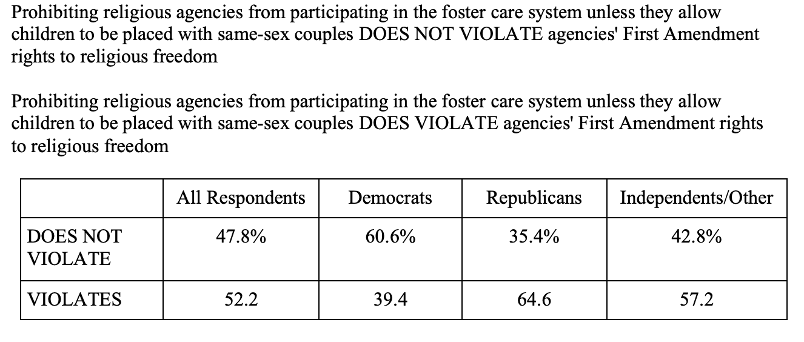
Recent public opinion research is helpful in assessing how to respond to this case and the others that are before the Court this term. A recent study polled a nationally representative sample of 2,158 American adults about their views on upcoming Supreme Court decisions[1] The SCOTUS Study asked respondents whether they believed that requiring foster agencies to place children with same-sex couples violated the foster agencies’ right to religious freedom, and 52.2% of the public stated that it does violate these agencies’ right to religious freedom.

Table 1[2]

This finding suggests communicators and advocates should emphasize the government’s role in preventing discrimination and in ensuring that everyone is able to build a family with dignity. Emphasizing the government’s role in preventing discrimination and the importance of protecting everyone’s right to family and equal justice – including the rights of potential LGBTQ foster couples and their prospective foster children – will be critical. Moreover, communicators and social justice leaders should connect the outcome in the case to our shared values by describing how the outcome in this case might undermine or bolster local governments’ abilities to prevent discrimination.

Values to Uplift When Discussing This Case: Family, Equal Justice, Human Rights, Community, Empathy.

2. Affordable Care Act

California v. Texas

Following its 2012 decision upholding the Affordable Care Act, the Supreme Court will again be deciding upon a challenge to its constitutionality. The Court will decide on two main issues: (1) whether the individual mandate is constitutional; and (2) if the individual mandate is unconstitutional, whether it is nevertheless severable from the Affordable Care Act, allowing this Act to remain in force even if the individual mandate provision is no longer part of it. While it is possible that the Court will not decide upon the substance of the case and will instead find the parties who brought the case to not have standing, it is important to plan for the decision, nonetheless.

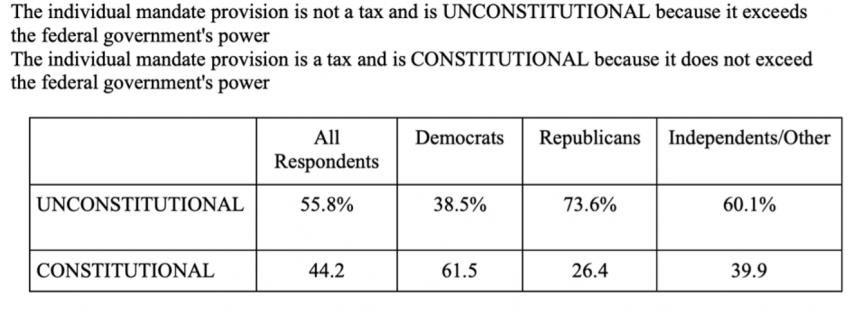
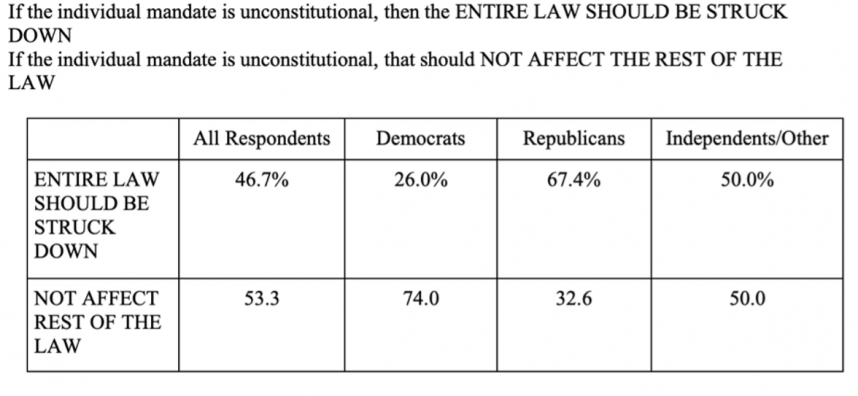
The SCOTUS Study found that 55.8% of respondents believed that the individual mandate is unconstitutional. This finding suggests that there is additional work needed to explain how the mandate broadens access to healthcare and is critical to a better-functioning healthcare system.

Table 2[3]

Nevertheless, most respondents (53.3%) stated that even if the individual mandate is unconstitutional, it should not affect the rest of the law.

Table 3[4]

If the Court strikes down the mandate and thereby strikes down Obamacare, it will be important to emphasize how the Supreme Court’s choice was excessive and that millions of Americans will be left uninsured by it.

Remind audiences of our responsibilities to our fellow human beings. Access to healthcare is incredibly important and should be uplifted as a value, and after enduring the COVID-19 pandemic, audiences may be more open to these messages than ever before. As we are starting to see glimmers of hope regarding the progression of the COVID-19 pandemic, it remains important to protect everyone’s access to healthcare.

Values to Uplift When Discussing This Case: Human Rights, Community, Health, Empathy, Compassion, Looking Out for One Another.

3. Voting Rights

Brnovich v. Democratic National Committee I

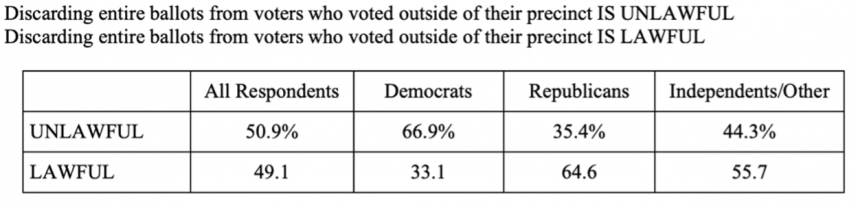
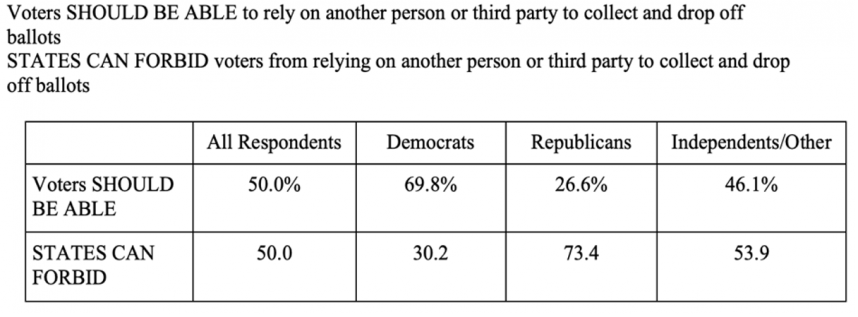
Following Donald Trump’s false claims about the 2020 election, his followers have initiated a massive effort to both continue the drumbeat promoting fraud and suppress voter turnout in many states. For example, Arizona passed a law that (1) prohibits people from getting assistance from others to drop off their ballots on their behalf, and (2) requires that provisional ballots be automatically discarded when a voter votes in the wrong precinct. According to the SCOTUS Study, voters are evenly split on how the Court should resolve these two issues.

Table 4[5]

Table 5[6]

The widespread, “big lies” about the 2020 election present unprecedented challenges to our democracy and warrant bold action. The response to the Supreme Court’s decision in this case should emphasize the Court’s role in ensuring that every citizen is able to exercise their right to vote. The Court’s decision may include a ruling about the appropriate standard for challenging voter suppression efforts, which may or may not make it more difficult to contest these threats to our democracy.

Values to Uplift When Discussing This Case: Democracy, Equal Justice, Human Rights, Community, Fairness.

4. Criminal Justice

Terry v. United States

Taharick Terry was convicted for possessing just 4 grams of crack cocaine, the equivalent weight of around four paper clips. He was sentenced to more than 15 years in prison because of a law that produced a 100:1 sentencing disparity for crack cocaine as compared to powder cocaine. This disparity contributed to gross racial inequities in sentencing by targeting the form of cocaine – crack cocaine – that is more prevalent in Black and brown, and lower-income, communities for grossly higher sentences than its powder form.

In 2010, President Obama and Congress reduced the disparity to 18:1 in the Fair Sentencing Act. In 2018, Congress passed the First Step Act, which allowed sentencing reforms to apply retroactively to people already sentenced in prison because of draconian sentencing laws. This case addresses whether offenses like Terry’s fit within the provisions that allow for less serious offenses to be re-sentenced. The decision in this case could have a broad impact on efforts to address some of the harms of excessive and racially biased sentencing laws.

Values to Uplift When Discussing This Case: Equal Justice, Fairness, Human Rights, Community, Family, Due Process.

Conclusion

As a general matter, it is important to communicate carefully, as the first read of any decision can sometimes mislead communicators into saying something they come to later regret, or to say something that isn’t quite the message that is important to uplift. It is therefore especially important to carefully review the Court’s holding(s) in each case and consult those who are working directly on interpreting and commenting about them. Sometimes it may be beneficial to narrowly construct any comments on a decision when formulating your response. Don’t comment until you’ve seen the facts and the lead party’s statement, as well as consulted with those most closely connected to the story that social justice leaders are recommending. Remember, the first statement you make will be the most powerful. Regardless of the outcome, it is beneficial to emphasize how values represent our vision for the aspirations we have for our country, and the importance of what the Supreme Court means to those values.


[1] Stephen Jessee, Neil Malhotra, & Maya Sen, “What Do The American People Think About the 2021 Supreme Court Cases? Results from SCOTUSPoll, a collaboration between researchers at the Harvard Kennedy School of Government, the Stanford Graduate School of Business, and the University of Texas” (April 22, 2021), https://projects.iq.harvard.edu/files/scotus-poll/files/scotuspoll-summary2021.pdf.

[2] Id. at 3.

[3] Id. at 4.

[4] Id. at 5.

[5] Id. at 6.

[6] Id. at 7.

Five Strategies for Talking About Anti-Asian Racism

The past year has seen a marked increase in anti-Asian attacks across the country. And while words alone cannot address, heal, or prevent the damage that these cause, shaping and promoting narratives about equity, justice, dignity and respect does shift attitudes and culture over time. In that spirit, we offer five strategies for talking about anti-Asian hate, knowing that these are not sufficient alone, but are a place to start when tackling the long-term narrative shift work that helps to create a more just and equitable world.

This memo was written with consultation and guidance from Gregory Cendana, president and co-founder of Can’t Stop! Won’t Stop! Consulting, and AJ Titong, partner and consultant at [re]imagine collective.

1. Paint a vision that your audience wants to support and engage with: where anti-Asian American and Pacific Islander (AAPI) racism has no place.

While audiences are accustomed to hearing about the harms of racism and, more recently, are becoming aware of the different and ongoing impacts of anti-Asian racism, they are less likely to be familiar with a positive anti-racism vision, rooted in shared values, that they can embrace. If we start our communications with a shared vision of what our country should be: a safe, inclusive place of participation and belonging where everyone’s rights are protected and respected, we can frame anything that gets in the way of that as a pressing issue.

We inherently understand that violence is the opposite of safety, bigotry violates our human rights, microaggressions make true feelings of belonging impossible, and political entities trying to divide us by race are an ongoing barrier to a national community where everyone can participate equally with justice, which should be a shared goal. Drawing those lines explicitly gives audiences some glimmer of hope and can help set them up for long-term participation in a range of solutions.

We need to frame barriers to this vision of becoming an anti-racist society as problems we must all solve. Doing this ties anti-Asian racism to the larger struggle, solidifying the lines of allyship and creating ways to link to Black, Latinx, Pacific Islander, and Native voices without directly comparing or ranking experiences or scapegoating.

Example:

A beautiful thing about this country is its multiracial character. But right now, we’ve got diversity with a lot of segregation and inequity. I want to see a truly inclusive society. I think we will always struggle as a country toward that—no postracial society is possible or desirable—but every generation can make progress toward that goal.[1]

– Rinku Sen, Race Forward, to NBC News

We have spoken out before, and we speak out now to express our solidarity and support, even as we seek to build and sustain a campus community where everyone feels welcome, respected and safe. We also must stand and work together with all who believe in and are committed to a peaceful, equitable world where justice is pursued.[2]

– Chancellor Carol Christ, University of California, Berkeley

2. Move to the Problem. Opening conversations with a shared vision gives audiences a destination. Walking them there is the next challenge. We must have the hard conversations about why and how anti-Asian racism exists, how it differs from other forms, and the particular harms it causes. This is where the advice becomes maybe the most complicated, and the need for balance is clear.

Acknowledge intersectionality—that people experience racism differently based on the multiple identities they hold. Experiencing poverty, misogyny and racism, for instance, poses its own set of challenges and it’s important that we’re clear about that with audiences. Any of these oppressions stand in the way of the country we want to build, but the solutions to them are different.

Be aware, and careful not to further, the “model minority” myth – the notion that many Asian Americans work harder or are somehow better than other racial groups. It’s more powerful and effective to focus on the values we all share – as we all want to be able to provide for our families, see our children get a good education, and to be treated with dignity and respect.

Acknowledge diversity within the larger Asian American community. While people of Asian descent account for a smaller percentage of the population than other racial groups, they are the fastest growing, are not a monolith, and are arguably among the most diverse communities in terms of countries of origin, religion, immigration or refugee status, and culture. They consist of approximately 50 ethnic groups speaking over 100 languages. What Asian Americans share is that the U.S. is home, and they deserve to be treated with dignity and respect and included in the larger fabric of this county. However, that means different things to different groups. For example, while some immigrated here, others are refugees who were fleeing violence in their home countries, which can be markedly different experiences. It’s important to acknowledge such distinctions in history and experience. Similarly, Asian Americans experience things differently based on where they live in the country. It’s crucial to pull this out in our messaging and highlight the diverse practices, philosophies, and experiences that comprise the Asian American identity, while always pointing back to the shared values and the shared desire and right to be treated with dignity and respect.

But be careful and strategic in how you draw distinctions. It is critical to avoid further othering of Asian and Asian American communities, and to instead bring all forms of racism and oppression into focus for what it is: anti-people.

  • One way to do this is to start communications with the bigger shared vision of a society where racism has no place, and to declare that this is something the vast majority of us want in this country. Then remind audiences that to achieve it, we have to eradicate all forms of racism, including the specific kinds Asian and Asian American communities face here, the different ways they experience it, and the different solutions required.
  • Another way is to include other identities in descriptions: mothers, workers, students, neighbors etc. to underscore the many facets of ourselves.

Strategically bring people to solutions and action. While many white people in the U.S. have signaled a newfound readiness to talk about racism and oppression, and BIPOC communities have been having those conversations for generations, it can still be a challenge for many audiences to understand how we can work to dismantle racist systems and prevent individual actions that perpetrate these systems. A starting point is to center on solutions that are specific to your audience and explain how and why they work. What does good allyship look like? How will this policy change people’s lives? How can people check their own behaviors? How are those directly impacted and most marginalized informing your actions and the organizations of causes you are supporting

Example:

Too often, racist policies at home and abroad pigeonhole Asian women, immigrant women, and poor women into unprotected, low-wage jobs — including as massage workers in spas even in the midst of a global pandemic — where they are subject to racist and sexist abuse on a daily basis, whether from their customers, employers or police. Violence against Asian American women— regardless of their country of origin or citizenship status — is not new. Racist narratives have exotified, fetishized and hypersexualized Asian women. As Georgia state Rep. Bee Nguyen said, Asian women constantly experience brutality at the “intersection of gender-based violence, misogyny and xenophobia.”

The core element of discrimination and bias, whether based on race, gender, nationality, or other characteristics, is the dehumanization and “othering” of people. This assumes all individuals within these categories are the same and are all of less value than those making these judgments. Many times, multiple forms of “othering” converge to target the most vulnerable intersections of these identities. The dehumanization of these women was personified when the killer justified the murders as the result him just having a bad day.[3]

– The Racial Equity Anchor Collaborative

As sociologists, we have studied racism and its consequences for over a century. Our studies have taught us to recognize myriad forms of racism and its intersection with other forms of oppression. It is clear that the historic and contemporary discrimination and violence against Asians in America are deeply rooted in anti-Asian racism. Yet, anti-Asian racism is too frequently rendered invisible. We have heard from our Asian and Asian American colleagues, students, and community members about the virulent racism they experience daily. We stand in solidarity with the Asian and Asian American community.[4]

– The American Sociological Association

3. Consider Audience and Goals. People in the U.S. are coming to conversations about anti-Asian racism from a range of viewpoints and experiences. Some may have only read about specific incidents and yet not understand the broader problem. Others may consider themselves allies in the fight to dismantle systemic racism, but don’t know what specifically to do about recent anti-Asian hate crimes. And some have first-person experiences, and may have trouble seeing what, if anything, could make things better. If the purpose of our messages is to move any of these groups to action, it’s important to choose the vocabulary, stories, metaphors and spokespeople that work for each specific audience. While we want to draw on the same vision and values in order to promote a common narrative of inclusiveness, belonging, safety, and community, we’ll likely promote it slightly differently. In other words, there is no such thing as general public when identifying our audience.

4. Know the counter narrative and do not reinforce it. Some anti-Asian themes consistently emerge in the media, pop culture, and other conversations. While we probably feel like these are quite familiar, they aren’t to all audiences. Though we need to understand where themes like “the model minority” or racist references to COVID-19 developed, we don’t need to spend too much time repeating these problematic phrases or mindsets, which just gives them more airtime. Instead, we should consider how to condemn the thinking behind false narratives, such as the need to divide communities of color against each other and disrupt allyship, the need for othering people, particularly based on heritage, the need to divide people into “deserving” and “undeserving.” By finding ways to consistently counter these harmful ideas, we can change the conversation.

5. Listen to and center the voices of Asian and Asian American communities. As social justice advocates, we should be accustomed to centering the voices of those who are most affected by any issue. It should go without saying that when talking about anti-Asian racism, Asian American community members should lead the strategies on how to counter it. We must also ensure we are engaging those across the diaspora including but not limited to Brown and Black Asians, South Asians and Southeast Asians.

This means taking cues from Asian and Asian American leaders on things like preferred language and strategy. For instance, a common strategy to elevate victims of racist violence is to “say their name,” but not only does this misalign with some Asian cultural practices and traditional grieving, this approach appropriates from a movement meant to honor Black women and Black trans women.

Centering the voices of Asian Americans does not mean that they are the only people responsible for talking about this. Nor does it mean that it’s the only thing they’re responsible for talking about. When it comes to racial justice, none of us will progress as far as we need to without solid allyship and deeper understandings of each other. In fact, we know that an approach that has worked for one movement may not work for another for many reasons including history, community cultures, and power dynamics. Deep listening and sincere allyship mean understanding how and when we can all play the most effective role in the larger struggle, whether it be leadership, support, marching together, or spotlighting each other’s efforts.

Moving Forward: Three Ideas for Talking About the Moment

As we process, discuss, and continue to respond to the January 6th attack on our democracy and what it means for the days leading up to the Inauguration and beyond, The Opportunity Agenda offers a few messaging ideas for the immediate moment that also advance a long-term vision for justice.

Together, we must put forth a strong and unified message that names the hypocrisy and violence that white supremacists perpetuated at our nation’s Capitol on Jan. 6. We must call for those who inspired and carried out this insurrection to be held to account, and we must uplift the aspirations and vision we are striving for our democracy to be. Our communities and our country’s ideals depend on it.

1. Lay out a long-term vision, framed with values. In crafting your message, uplift the values that serve us in the current moment while also strengthening our long-term narrative. For instance:

Voice: Our Democracy depends on ensuring that all our voices are heard, and votes counted. The history made in Georgia in the runoff election on Jan. 5, with BIPOC organizers and voters leading the way with their organizing prowess, voices, and votes, cannot be overstated, and we must continue to celebrate this #BlackJoy and #JoyToThePolls as progress for our democracy – it is a defining moment for what our country aspires to be. The values of Voice, Community, and Inclusion ruled the day in Georgia and in the nation with record voter turnout – particularly Black, Latinx and APIA voters — and with the historic election of Rev. Warnock to the U.S. Senate. It is progress that we should continue to celebrate and uplift loudly despite everything else we are witnessing and facing.

Safety: We must ensure the true safety of everyone, whether they are working a job during the pandemic, peacefully protesting, or experiencing an encounter with law enforcement. We can use the jarring memory of the January 6th actions at the U.S. Capitol as a stark reminder that we must commit to doing all that is in our power to promote true Safety for all. This means resoundingly rejecting white supremacy’s grasp on our society, our police departments, the White House, and all who enable it. We will not stand for a system that is complicit with the violence promulgated against Black protesters, while at the same time is easy going on white vigilantes who run roughshod on federal spaces.

Dignity: Because we are humans first, and all people deserve to live in peace and dignity. We must remind people that our new future is built upon everyone having a voice, all of us coming together as a community to solve shared problems, keeping each other safe, and helping each other live with Dignity. We cannot go back to business as usual because that is what led to this crisis. We must take bold action to make this country a true, inclusive democracy where we stand with and for each other and where our elected officials and public servants respect our rights, no matter who we are.

2. Emphasize moving forward. Many of the events of the past year have reminded us of some of the country’s worst instincts and darkest history. But we have a moment now to underscore with audiences the message that we can move toward a better version of this nation if we come together to address our shared challenges and go beyond. Emphasize your long-term vision and paint a vivid picture of that future as well as the clear actions we need to take to achieve it. Remind people that to move forward, we have to come together in our diverse experiences, ideas, and strengths to build an economy, society, and country that truly embraces and embodies justice and opportunity. This means fighting for transformational changes, not accepting incremental or piecemeal solutions that leave people out and put us on a sluggish path toward our vision. We have a moment, and we must seize it.

3. Build messages that move your long-term narrative. The events at the Capitol and the actions of this administration, both recent and over the past four years, represent much of what is wrong with our country. But remember to choose your examples carefully to build your story for moving forward. For instance, the hypocrisy of law enforcement’s response to the white nationalist attack on the Capitol compared to their stealthy and violent strong handling of Black Lives Matter protesters over the summer makes a powerful argument for those who are advocating to Defund the Police in favor of building community resources for achieving true safety. Also, those focusing on Democracy work may choose to highlight the president’s attacks on voice and vote that culminated in January 6th’s violence. Spending too much time describing or explaining all the many dimensions of a specific event will likely keep audiences in that experience rather than looking forward – so remember to keep a simple framework for talking about the Values, Problems, Solutions and Actions we are trying to share.

More resources:

Democracy Rising Social Media Toolkit

Speaking Out About January 6,” Frameworks Institute

“Our Democracy’s Ideals Depend on Our Actions Today,” The Opportunity Agenda

“Reflecting on 2020, Going Beyond in 2021,” The Opportunity Agenda

Telling a Story About Families and Opportunity

Increasing support for Paid Family and Medical Leave policies among key audiences

Updated September 2020

This memo lays out a foundation for communicating about the importance of paid family and medical leave policies for all types and shapes of families. It is based on both qualitative and quantitative research completed in 2019, with additional research from May 2020 during the COVID-19 pandemic, and builds on a range of additional communications best practices garnered from both research and the experience of communications experts and family support advocates from across the country.

The COVID-19 pandemic has added clarity and urgency to our nation’s critical need for comprehensive and equitable paid family and medical leave legislation. The Paid Leave for All movement has been galvanized, and we have before us a window to achieve effective, long-term change. We must use our messaging to seize this moment, to learn from the tragic experiences we have gone through as a nation, and to pass legislation that will ensure paid family and medical leave for all.

It is our hope that the guidance and research presented here help to bolster an already robust field of advocates and activists working on behalf of paid family and medical leave policies—from taking the time to care for a new baby, to looking after a loved one who is sick—so that they might tell a unified story about leave that conveys the urgency of passing long-term federal paid leave legislation that supports all families.

The Power of Narrative

A narrative is a Big Story, rooted in shared values and themes, that influences how people process information and make decisions. Overarching organizing stories help us make sense of the social and political world. Through narratives, seemingly unconnected events are organized into a whole and given meaning. Repetition and time are key to the narrative process.

Narratives play an important role in not only shaping our understanding of the world but also establishing and affirming our relationship to one another, institutions, and society. As such, narratives often reflect particular sets of cultural values that, in turn, establish social norms, systems, and structures. While many narratives can play an important social function, dominant narratives often reflect the interests and values of those in positions of power.

To shift, counter, and replace dominant narratives, it’s crucial that movement organizers work together to identify common messaging elements for amplifying. In this way, we can begin to undermine harmful narratives and replace them with stories that promote opportunity and equity, among other important values.

It’s also crucial that narratives and related messaging are rooted in research. In this case, we collaborated with Lake Research Partners, who conducted six focus groups in May 2019 and a national online survey in October 2019. Research methodology can be found at the end of this memo.

Building a Narrative

Experience and research suggest that successful narratives share a few common elements. They should:

  • Lead with shared values
  • Describe problems, but also point audiences toward clear solutions
  • Be informed by public opinion research, media analysis, communications practice, and collective experience
  • Adapt to key audiences, spokespeople, sub-issues, and circumstances
  • Support a coherent “drumbeat” of stories, messages, and events—both short and long term

Elements of a Paid Family and Medical Leave Narrative

Vision: A country that values families of all types and puts in place the support programs they need to survive and thrive. This means, for instance, making sure everyone can be with their loved ones in times of family need and still earn an income—no exceptions. A country where everyone, no matter what they look like or where they come from, can contribute to our economy and society and still be there for their families and attend to their own health and wellness.

Heroes: Families of all kinds who shouldn’t have to risk their financial stability to be there for each other. Innovative programs like paid family and medical leave policies that support this. It’s important to center families in this discussion, and individual stories can be a powerful way to put a human face on the issue. We should do this by always connecting individual stories to the broader systemic solution to paint a picture of exactly how paid family and medical leave would change that particular story and our shared story.

If we spend too much time focused on individuals, there is a danger that audiences either only relate to that individual problem or imagine the solutions to it (“Doesn’t she have a neighbor who can help?”) or judge the individual circumstance (“He should have a better job.”). By showing that this issue affects many people and by consistently drawing a line to the systemic solution, which is a central hero to the story, we can make sure that we keep audience’s focus on our shared responsibility to make this happen.

Villains: Certain lawmakers and corporate lobbyists who say they support paid leave but promote plans that exclude the vast majority of caregivers and often guarantee neither pay nor leave while weakening key safety net programs families need. Their proposals force those who would be eligible to choose between their present needs and the future economic stability of their families.

Note that for long-term narrative purposes, it is not necessarily helpful to indicate that people are immutable or naturally “bad.” It’s also true that, although drawing clear lines between what we are proposing vs. the opposition’s plans and motivations is crucial, many persuadable audiences see too much of this as partisan bickering. It’s a careful balance in ensuring that we have drawn distinctions while also giving persuadables a “side” that they’re interested in taking instead of dismissing all arguments as just politics.

Implication/Moral: When families of all kinds have the support they need through a range of programs like paid family and medical leave, they have the opportunity to thrive, which improves the overall health and sustainability of our economy and society. Denying people leave puts families at risk and forces people to choose between being there for their families and providing for their families.

Values: Family, opportunity, financial security, equity, fairness.

Familiar Themes/Metaphors: Health metaphors, linking physical health to economic health. Lack of paid family and medical leave is “breaking families’ backs and banks.”

Building a Message

To introduce people to a new way of thinking about an issue like paid family and medical leave, it’s important to carefully consider the structure of our messages—particularly how they begin. People think in shortcuts and once we’ve activated a familiar shortcut, they are likely to process all future information through the lens of that shortcut. If we start with vision and values and fit the importance of the programs we want into that framework, many audiences will find themselves more open to the rest of our points. To this end, we suggest you build messages using the following structure:

Values, Problem, Solution, Action

Values. Starting with shared values helps audiences to “hear” our messages more effectively than using dry facts or emotional rhetoric.

  • One of the values we hold dear is being there for our families. Family comes first.
  • In these trying times, we all want to protect the health and lives of our families, friends, and neighbors.[1]
  • Paid family and medical leave allows families to be there for the important first moments in the lives of their children and the last moments in the lives of their loved ones, or when a pandemic requires isolation and caution.[2]
  • When a family member is sick or a loved one needs help, we will do whatever is needed to ensure they get the care they need.
  • Everyone should enjoy full and equal opportunity.
  • The key to full and fair opportunity is the ability to work while maintaining a safe and healthy life for one’s children and family
  • No matter what we look like, where we come from, or what kind of families we live in, most of us agree that we are all trying to provide for our families. Time is a precious resource.[3]

Problem. Frame problems as a threat to our vision and values. Underscore our connections to one another and why this problem matters to everyone.

Why are paid sick days and paid leave so important during the COVID-19 crisis and beyond? Because families can’t afford to lose even a few days of pay, which means people go to work sick.[4]

Not only do people face barriers to accessing health care, but also many of those who have access can’t afford to take unpaid time from work to have the space to take care of themselves and their families.

Women, people of color, and people in hourly, lower-wage jobs are in a worse position because they are more likely to have care responsibilities but less likely to have paid leave.[5]

Right now, people are paying the cost through lost wages or even lost jobs because we don’t have a national paid family and medical leave program.

Working people and families in the United States lose nearly $22.5 billion annually in lost wages because they can’t access paid family and medical leave.

Lower-income people are less likely than higher-income people to have paid family and medical leave. Just 4% of lower-wage workers have access to paid family leave, compared to 31% of the highest wage workers. The majority of us don’t have even $1,000 to cover a medical emergency.

Employers are not required to provide even unpaid leave to care for an unmarried same-sex partner.

Problem Themes

  • No one should keep you from a spouse battling cancer, a parent nearing their final days, or a child who needs care during a pandemic.
  • No one should have to choose between a paycheck and being there for their family.[6]
  • No one should have to choose between their life and their livelihood.
  • The COVID-19 pandemic has shown us how vulnerable people are when everything depends on where you work.[7]
  • Right now, people are scared of losing their jobs or being forced to work sick in big box retail stores, grocery stores, and other essential businesses. That’s wrong.[8]
  • With childcare facilities and schools closed, parents and caregivers are doing their best to be good employees, good teachers, and good parents.[9]
  • Those with the fewest resources are the hardest hit and can’t get the benefits they need.
  • For most Americans, taking time from work is something they simply can’t afford.
  • People are forced to choose between caring for sick family members and earning the salary needed to support their families
  • You should not have to risk losing your job or paycheck because you are providing care.

Solution. In our efforts to point out problems, we often spend less time promoting solutions. This can result in crisis fatigue among key audiences. Positive solutions leave people with choices, ideas, and motivation.

What is the commonsense approach to the problem you have outlined? Find ways to frame the solution as both the most commonsensical and the most in line with our values.

Assign responsibility—who can enact this solution? It’s particularly important to outline government’s role in this solution: to administer and enforce the solution but not pay directly for it.

  • The coronavirus has shown us what people have long argued: Paid sick days and paid family and medical leave protections should have been in place nationally years ago.[10]
  • The sudden, swift, and severe nature of the COVID-19 crisis has shown how desperately we need to guarantee comprehensive paid sick days and paid family and medical leave to every working person in this country during this emergency and lay the groundwork for permanent protections.[11]
  • We need a law that guarantees all workers can be with their loved ones AND earn a living—no exceptions; no matter where we work; and regardless of whether we are white, Black, or brown.
  • We are strongest when we all have a fair chance to achieve our full potential, contributing fully to our economy and society.
  • Families need updated workplace standards to help meet their caregiving responsibilities.
  • We must join together with people from all walks of life to fight for our future, in the same way we won better wages.
  • We can create a program that works for all of us, no matter where we work, not just for the lucky few.
  • We need to share those costs, so we can all thrive.
  • We can promote health equity and reduce struggles for families by improving the health and well-being of all Americans.[12]

Descriptions of the Solution:

The federal policy we’re organizing for is an inclusive, effective program for family and medical leave that would pool small contributions from employers and employees to provide up to 12 weeks of paid leave to bond with a new child, deal with a serious personal or family illness, or handle needs that arise from a military deployment. The length of leave pales in comparison to what’s offered by many companies and virtually all industrialized countries. Although basic, it is also bold and transformative and would be the first new social insurance program in the United States since the New Deal.[13]

We are also organizing to expand emergency paid leave options for those dealing with COVID-19. Congress enacted 2 weeks paid sick leave for those needing to be tested, quarantine, or recover or care for someone with the virus and 12 weeks of emergency paid leave for those caring for a child whose school or childcare is closed due to the pandemic. We need the law to cover everyone—it excludes up to 106 million workers—and to extend use of emergency paid leave to the many people who need more than 2 weeks to recover from, or care for someone suffering from, the virus.[14]

Enacting paid family and medical leave in the United States will begin to value caregiving and reverse centuries of inequity based on forced and devalued care provided by women and people of color. Paid leave will make it possible for people—regardless of gender—to cherish the first months of a child’s life and enrich the last months of a beloved parent’s life; to heal and thrive from their own injury or illness; and to spur the recovery or ease the suffering of a loved one. No more having to abandon a preemie in the NICU; no more chemo on your lunch break; no more teenagers quitting school to take a job at McDonald’s because a parent got fired for having leukemia. Meaningful paid leave in the United States will be a vital part of eradicating poverty and boosting family stability. And it will make businesses more robust by reducing turnover and increasing consumer solvency.[15]

Paid leave plans have been in operation in four states and passed in five more. They guarantee workers paid time for the full range of care purposes. Each one builds on the ones before—mostly with bipartisan support—to create inclusive, effective programs. They have adequate and progressive wage replacement so that those who earn the least get most or all of their wages during leave. They ensure those workers are able to return to their same or a similar job after their leave. And they have an inclusive definition of family.[16]

Action. While the solution points out the overarching policy or program request, the action is an audience-specific way to spur action. In this case, point people toward the decisionmakers who need to act to pass the FAMILY Act, as well as those who influence them.

Highest Rated VPSA Messages from Online Survey:

No matter what we look like, where we come from, or what kind of families we live in, most of us believe that we are all trying to provide for our families. But today, certain politicians and their lobbyists hurt everyone by failing to pass a national paid family and medical leave program. We need to join together with people from all walks of life to fight for our future, just like we won better wages, safer workplaces, and civil rights in our past. By joining together, we can create a program that works for all of us, no matter where we work, not just the lucky few.

Time is a precious resource, and for most Americans taking time off is something they simply can’t afford. As of 2019, only 19% of people had access to paid leave through their employer. Often, those with the fewest resources are the hardest hit and can’t get the benefits associated with family leave, including the ability to nurture newborn or adopted children or to take care of their own serious illness or injury. This is particularly true for low-income families and people of color. Black and Latino people are twice as likely to report needing leave but not being able to take it. A universal paid family and medical leave program would promote health equity and reduce struggles for families by improving the health and well-being for all Americans, regardless of income and race.

One of the values we hold dear is being there for our family. No one should keep you from a spouse battling cancer, a parent nearing their final days, or a new baby needing attention. You should not have to risk losing your job or paycheck because you are providing care. Too many Americans can’t make ends meet and can’t afford to take time off to care for themselves or their family. That’s why we need a program that guarantees you can be with your loved ones and still earn a living while you do it.

When a family member is sick or a loved one needs help, we will do whatever is needed to ensure they get the care they need. However, too many people in this country can’t miss a paycheck in order to care for themselves or their families without the risk of economic hardship or even financial ruin. Taking care of the people you love shouldn’t force you to choose between working to support your family and losing pay and benefits when you take time to care for them. That’s why we need a law that guarantees all workers can be with their loved ones AND earn a living—no exceptions.

Family comes first, but today too many people are forced to part with their babies, parents, or spouses when they need care. Our nation should be a place where everyone enjoys full and equal opportunity, no matter where they work and whether they are white, Black, or brown. We are strongest when we all have a fair chance to achieve our full potential, contributing fully to our economy and society. When everyone has paid time to care for themselves or their families in times of need, the benefits flow to individuals, communities, and our nation as a whole.

Overview of Research

The following is a summary of the research conducted by Lake Research Partners, who conducted six focus groups in May 2019 and a national online survey in October 2019. This summary reports the research findings and describes audience reactions. Therefore, the messaging and points included below should be viewed as a report of the findings and not necessarily recommendations, which are covered above.

Audience Considerations

In any communications strategy, knowing the audience you are hoping to influence is crucial. Each message should be tailored to that specific audience’s needs. A narrative can span several audiences, with different language and points using the same general themes. A flexible narrative will be able to inspire messages to motivate our base, expand our constituency, bring along persuadables, and neutralize the opposition’s effect on all of these groups. We do not need to spend time and resources trying to change the mind of the opposition—or even fighting with them. Instead, we should focus on how to address any influence they have over the audiences of the middle and draw distinctions between our approach and motivations and theirs, giving persuadable audiences a side they want to join.

The research divided participants into three audience segmentations and defined them as follows:

Base

  • Strongly favor a nationwide program to guarantee access to up to 12 weeks per year of PAID family and medical leave to care for a new child joining their household through birth, adoption, or foster care; an aging or seriously ill family member; or their own serious health condition.
  • Believe it is very important for America to establish a nationwide program to guarantee access to up to 12 weeks per year of PAID family and medical leave.
  • Strongly favor a proposal that includes an option for all types of people to take paid leave—ranging from new mothers to someone supporting a family member who is deployed.

Characteristics of the Base

  • 22% of adults
  • Are likely to be very concerned that low-income, Black, and Hispanic people are less likely to have paid leave.
  • About three-quarters agree that people, including low-income people and people of color, face barriers to accessing health care and can’t afford to take time from work and that the burden is on people and families.
  • More likely to be women and Democrats.

Opposition

  • Oppose a nationwide program to guarantee access to up to 12 weeks per year of PAID family and medical leave to care for a new child joining their household through birth, adoption, or foster care; an aging or seriously ill family member; or their own serious health condition before messaging.
  • Oppose a nationwide paid family and medical leave program after messaging.

Characteristics of the Opposition

  • 10% of adults
  • Are most acutely concerned about abuse, trusting the government to run it, waste, and the impact on small business.
  • Believe we can’t afford a program, it is too hard on small business, and it is each person’s responsibility to take care of their own family—the government should stay out of it.
  • More likely to be men, older than age 65, white, and Republican.

Persuadables are defined as anyone who is not a part of the Base or the Opposition.

Characteristics of Persuadables

  • 67% of adults
  • Are generally favorable toward a paid family and medical leave program.
  • More closely reflect demographics of the general public.[17]
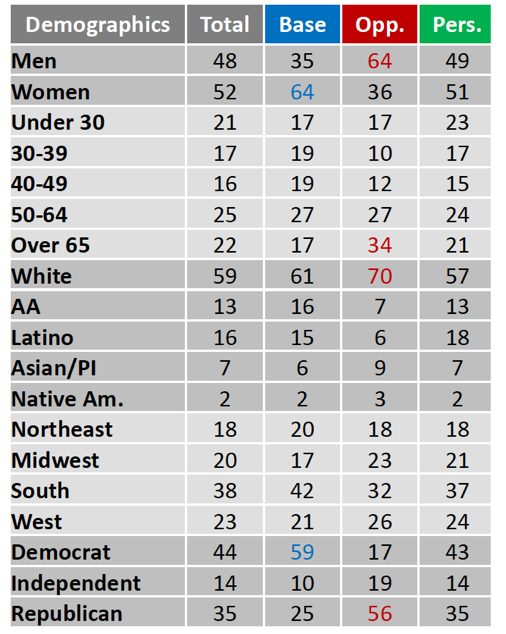
Key Findings: Support for Paid Family and Medical Leave Policies

  • By a three-to-one margin, people side with an argument that the United States should ensure all employers nationwide adopt a paid family and medical leave program that is available to everyone (65%) over an argument that would maintain the status quo by letting employers choose whether to provide their employees paid leave (22%).
  • Across every demographic and attitudinal subgroup, people side with the idea that the United States should ensure all employers adopt a universal paid family and medical leave program.
  • Only the Opposition sides with employers deciding.
  • Women, those under 30 and in their 40s, African Americans, those with a disability connection, Democrats, and the Base have the widest margins in favor of a national program.
  • Three-quarters favor and 6 in 10 strongly favor a nationwide program to guarantee access to up to 12 weeks per year of PAID family and medical leave to care for a new child joining their household through birth, adoption, or foster care; an aging or seriously ill family member; or their own serious health condition.

Audience Considerations

  • Across subgroups, two-thirds or more favor a national program.
  • The strongest favorability comes from women, those in their 30s, African Americans, Latinx people, parents, those living with an aging relative, those who have a disability or an immediate family member or close friend with a disability, and Democrats.
  • Three-quarters believe it is important for America to establish a nationwide program to guarantee access to up to 12 weeks of paid leave. Information about FMLA does not impact views.
  • By wide margins across every demographic and attitudinal subgroup, people think it is important to establish a nationwide program.
  • Those who are most likely to think it is important are people in their 30s, African Americans, Latinx people, parents, those who have a disability or an immediate family member or close friend with a disability, and Democrats.

Key Findings: Types of Leave and for Whom

  • At least half of people strongly favor eligibility for certain scenarios, including for a personal or family need due to a serious illness or injury, for new mothers, or to care for veterans. The best-testing are someone with a personal illness, condition, or injury; new mothers; and someone with an immediate family member with a serious illness, condition, or injury.
  • Although about two-thirds favor eligibility to care for service members, new fathers, or new foster parents or to support a family member who is deployed, fewer than half strongly favor these scenarios.
  • People are open to the idea that godparents, chosen family, friends who are like family, or other relatives should be included in the paid family leave program.
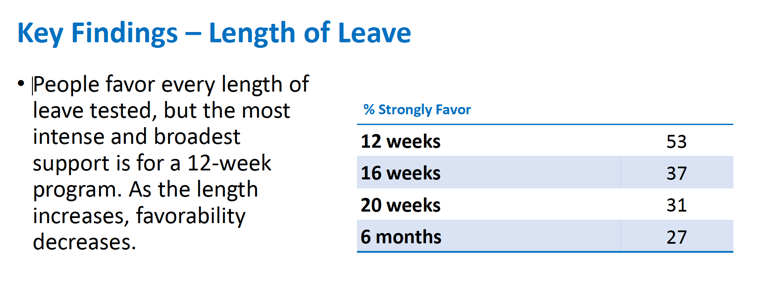
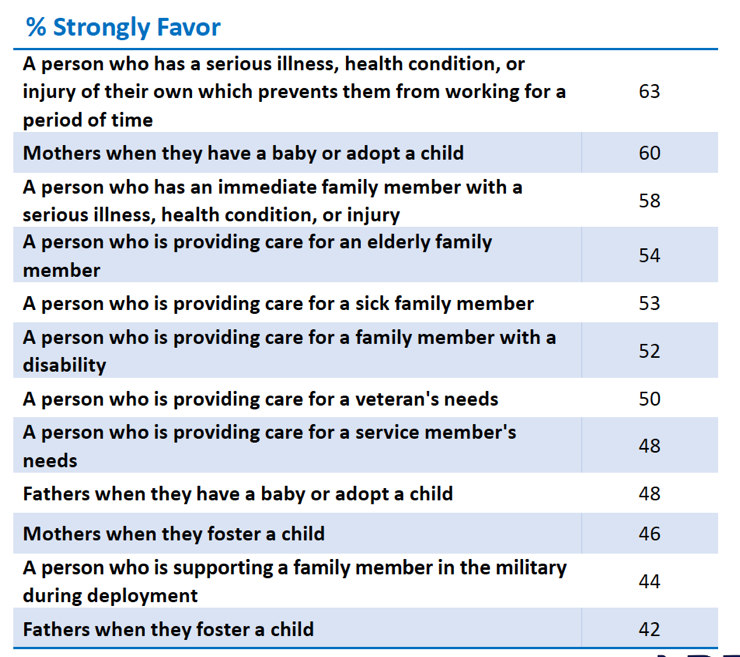
Audience Considerations

  • Younger people, parents, and those who are living with an aging family member are the most likely to agree.
  • Only people older than age 50 and the Opposition disagree.
  • Participants’ definition of “family” was broad and expansive, becoming situational in some minds by bringing in the “auntie” or other non-nuclear family under the umbrella of covered paid leave situations, but most believed at a minimum that the core family—parent, child, sibling, grandparent—would be covered.

Key Findings—Favorability of Aspects of a National Program

People favor all aspects of a national paid family and medical leave program, with few who oppose. The most favorable are as follows:

  • Eligibility for all, including low-income employees, hourly employees, and contractors
  • Covering all families, including LGBTQ families
  • Eligibility for people who work at businesses of all sizes

In a second tier are including part-time employees, a requirement that people earn income from employment during the year prior to needing leave, pro-rated rates for part-time employees, and funding the program through a small payroll tax.

Key Findings—Role of Government

  • By a 33-point margin, people side with an argument that government should have an active role to ensure people can care for themselves and their families without experiencing financial harm (59%) rather than each person is responsible for their own family and government should stay out (26%).
  • Only the Opposition thinks the government should stay out.
  • When framed as “to ensure people can care for themselves and their families without experiencing financial harm,” Republicans side with the active role argument (49%) over government staying out (35%) by 13 points.
  • Persuadables side with the active role argument (59%) over government staying out (23%) by a 36-point margin.
  • Similarly, by a 30-point margin, people side with an argument that government should have an active role to guarantee a basic standard of living for families (58%) rather than each person is responsible for their own family and government should stay out (28%).
  • Only Republicans and the Opposition think the government should stay out.
  • Republican women split between the two arguments, and younger Republicans side by wide margins with the government playing an active role. It is Republican men and older Republicans who are driving the sentiment that government should stay out.
  • Persuadables side with the active role argument (54%) over government staying out (27%) by a two-to-one margin.

Key Findings—Small Business

  • While small business is a vulnerability, we can contest this. By 20 points, people agree that a national program would take the burden off small business (53%) rather than an argument that says leave is too hard on small businesses (33%).
  • Republicans split and the Opposition sides with this being a burden on small business.
  • Persuadables side with the taking the burden off small business argument (49%) over government staying out (33%) by a 16-point margin.
  • Although participants across groups were supportive of 12 weeks paid leave, they also shared reservations around a small business’s ability to operate while offering such leave. Concerns about the employer’s ability to afford paying two workers at the same time also were echoed by the small business owners.

Key Findings—Doubts about a National Program

  • The idea that we cannot afford a national program is the strongest opposition frame (34%). People still side with the idea of pooling contributions to afford it (49%) but by just a 14-point margin.
  • Republicans and the Opposition side with not being able to afford it.
  • Persuadables side with the pooling contributions argument (46%) over the can’t afford it argument (34%) by a 12-point margin.
  • Participants were more likely to believe “a national program would ensure standards of living for people and greater economic security for us all” rather than “this sounds like a great idea, but we just can’t afford it.”
  • Doubts about a national program are low overall and driven by Republicans and the Opposition.
  • About a third are very concerned that people will abuse a national program and that small businesses can’t operate with their employees taking off for weeks or months.
  • In a second tier of concerns are this being a national big government tax and program, people paying in who won’t use it, it being too hard to fairly administer, and distrust in government.
  • The only concern that people push back on is that the program will be wasteful.
  • Persuadable voters resemble the Base more than the Opposition. The strongest doubts among Persuadables are that small businesses can’t operate if their employees can take time off for weeks or months (33% very concerned) and people will abuse the program (31% very concerned).

Methodology

Online Dial Survey

Lake Research Partners designed and administered this dial survey that was conducted online from October 17th–29th, 2019. The base and the oversamples were in the field those dates, and the advocates sample was in the field until November 14. The survey reached a total of 1,000 adults with oversamples of 100 African Americans, 150 Latinx, 150 Asian American/Pacific Islanders, 150 Native Americans, and 100 Advocates. The sample was drawn from an online panel of listed adults, and the advocate sample was drawn from a client list.

The base sample was weighted slightly by gender, region, age, race, race by gender, party identification, and educational attainment. The African American oversample was weighted by gender, region, age, and educational attainment. The Latinx oversample was weighted by gender, region, party identification, and educational attainment. The Asian American/Pacific Islander oversample and the Native American oversample were weighted by gender, region, age, party identification, and educational attainment. The oversamples were weighted down into the base to reflect their actual proportion of the population of adults nationwide.

The margin of error for the total sample is ±3.1%. The margin of error for the oversamples is ±9.8%.

Focus Groups

Lake Research Partners conducted six in-person focus groups in May 2019 broken down as follows:
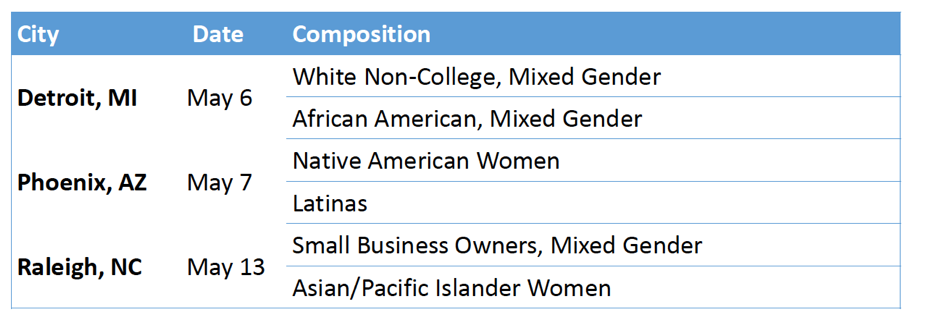
Participants were recruited to reflect a mix of age, marital status, educational attainment, employment status, party identification, parental status, and caregiver status. Those who were strongly opposed to a program that allows people 12 weeks per year of paid family and medical leave that working families can use when they need to care for a new baby or adopted child, when they need to care for a seriously ill family member, or when they have an illness were not invited to participate in the focus groups.


[1] Lake Research Partners and Chesapeake Beach Consulting: Findings from a National Survey on Paid Family and Medical Leave, June 2020.

[2] Ibid.

[3]Lake Research Partners Paid Family and Medical Leave: Findings based on Focus Groups and a National Survey. November 2019.

[4] Lake Research Partners and Chesapeake Beach Consulting: Findings from a National Survey on Paid Family and Medical Leave, June 2020.

[5] Ibid.

[6] Lake Research Partners Paid Family and Medical Leave: Findings based on Focus Groups and a National Survey. November 2019.
[7] Lake Research Partners and Chesapeake Beach Consulting: Findings from a National Survey on Paid Family and Medical Leave, June 2020.

[8] Ibid.

[9] Ibid.

[10] Lake Research Partners and Chesapeake Beach Consulting: Findings from a National Survey on Paid Family and Medical Leave, June 2020.

[11] Ibid.

[12] Lake Research Partners Paid Family and Medical Leave: Findings based on Focus Groups and a National Survey. November 2019.

[13] Ellen Bravo, Strategic Advisor, Family Values @ Work and the Paid Leave for All campaign.

[14] Ellen Bravo, Strategic Advisor, Family Values @ Work and the Paid Leave for All campaign.

[17] Lake Research Partners Paid Family and Medical Leave: Findings based on Focus Groups and a National Survey. November 2019.

The Opportunity Agenda
Privacy Overview

This website uses cookies so that we can provide you with the best user experience possible. Cookie information is stored in your browser and performs functions such as recognising you when you return to our website and helping our team to understand which sections of the website you find most interesting and useful.

close search